Kangbashi New District
⭐ 4.50
Kangbashi New District, Ordos City, Inner Mongolia Autonomous Region, China
 Kangbashi's narrative begins with the grasslands themselves—homeland of the Mongol peoples whose 13th-century empire, stretching from Korea to Hungary, ranks among history's largest land empires. Genghis Khan united these tribes near Ordos and launched conquests that reshaped Eurasia, forging the fabled Silk Road and linking East and West as never before. Today, Kangbashi honors that legacy while symbolizing modern China's westward urban renaissance. Covering 372 square kilometers yet home to only around 131,000 residents, the district is the antithesis of a dense Asian megacity—think of it less as a Chinese metropolis and more as a planned cultural park, comparable to Brasília's utopian ambitions or the open civic spaces of Canberra.
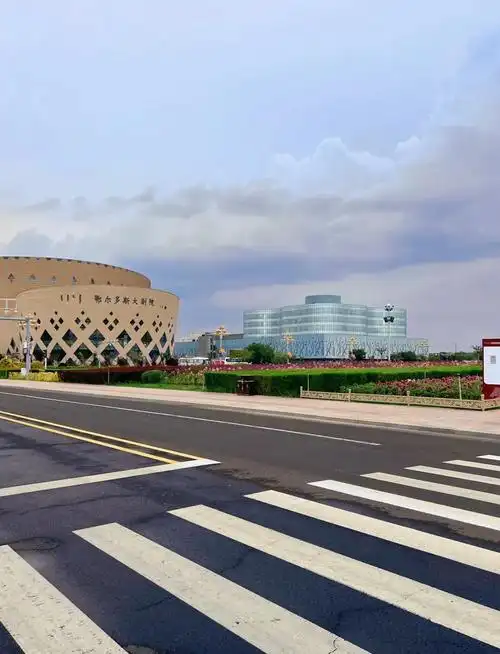
The architecture here is the headline act, and six signature buildings anchor the cultural axis like contemporary sculptures in a desert garden. The Ordos Museum, designed by Beijing-based starchitect Ma Yansong of MAD Architects, rises like a wind-eroded sandstone monolith straight out of a sci-fi film; its striking silhouette recalls Antoni Gaudí's organic forms more than any conventional museum. Nearby, the Grand Theatre mimics the curves of a Mongolian noblewoman's headdress, while the Library resembles a stack of leather-bound tomes clad in red sandstone etched with both ancient Mongol motifs and futuristic geometry. All are free to photograph and (in the museum's case) to enter—an unusual gift to visitors used to European admission fees.
At Genghis Khan Square, monumental bronze statues and a sweeping relief corridor illustrate scenes from the *Secret History of the Mongols*, the 13th-century chronicle that remains Central Asia's equivalent of Homer's epics. Towering cavalry figures and dramatic procession tableaux give the open plaza a stirring, almost Roman-monumental quality—imagine the Trevi Fountain square reimagined as a tribute to steppe warriors. A short climb leads to the sacred Ik Aobao, a cairn of piled stones perched on the district's highest point. Visitors may walk clockwise around the mound three times, just as pilgrims have done for centuries across the Eurasian steppe, while panoramic views reveal where city meets endless prairie—perhaps the most cinematic sunset perch in northern China.
As dusk falls, the focal point shifts to Wulanmulun Lake, where one of Asia's largest musical fountains sends its main jet soaring 209–230 meters skyward—roughly the height of two Eiffel Towers stacked. From late May through summer, nightly 8:30 pm performances combine water choreography, music, drones, and fireworks into a spectacle that rivals the Bellagio's famous shows. Thirsting for something with more horsepower? The Ordos International Racing Circuit hosts an FIA Grade 2 track used for the "Genghis Khan Grand Prix" and rounds of China's top touring-car championship, with public karting sessions available on select dates—China's answer to a mini-Monaco experience.
For a dose of nostalgic street life, Kang Town—a recreated Silk Road marketplace—clusters courtyard houses echoing the architectural flavors of Shaanxi, Shanxi, Inner Mongolia, and Beijing. Cobbled lanes host dumpling stalls, costumed performances, hanfu-rental photo spots, and lantern-lit evenings that feel like stepping into a folkloric theme park, comparable to a smaller Tivoli Gardens with a continental twist. Plan at least half a day (a full day is better), arriving in late afternoon to capture the futuristic buildings in golden light before the fountain show begins. Bring sunscreen and a windbreaker—grassland weather shifts quickly—and check the latest fountain schedule in advance, since performances pause during severe weather or winter maintenance.
Why make the detour? Because Kangbashi is one of the few places on Earth where you can spend a morning photographing avant-garde architecture, an afternoon contemplating Mongol imperial history, and an evening watching a 200-meter water symphony—all for free, and all within walking distance of each other, against a horizon still patrolled by the wide skies of the steppe.
Kangbashi's narrative begins with the grasslands themselves—homeland of the Mongol peoples whose 13th-century empire, stretching from Korea to Hungary, ranks among history's largest land empires. Genghis Khan united these tribes near Ordos and launched conquests that reshaped Eurasia, forging the fabled Silk Road and linking East and West as never before. Today, Kangbashi honors that legacy while symbolizing modern China's westward urban renaissance. Covering 372 square kilometers yet home to only around 131,000 residents, the district is the antithesis of a dense Asian megacity—think of it less as a Chinese metropolis and more as a planned cultural park, comparable to Brasília's utopian ambitions or the open civic spaces of Canberra.
The architecture here is the headline act, and six signature buildings anchor the cultural axis like contemporary sculptures in a desert garden. The Ordos Museum, designed by Beijing-based starchitect Ma Yansong of MAD Architects, rises like a wind-eroded sandstone monolith straight out of a sci-fi film; its striking silhouette recalls Antoni Gaudí's organic forms more than any conventional museum. Nearby, the Grand Theatre mimics the curves of a Mongolian noblewoman's headdress, while the Library resembles a stack of leather-bound tomes clad in red sandstone etched with both ancient Mongol motifs and futuristic geometry. All are free to photograph and (in the museum's case) to enter—an unusual gift to visitors used to European admission fees.
At Genghis Khan Square, monumental bronze statues and a sweeping relief corridor illustrate scenes from the *Secret History of the Mongols*, the 13th-century chronicle that remains Central Asia's equivalent of Homer's epics. Towering cavalry figures and dramatic procession tableaux give the open plaza a stirring, almost Roman-monumental quality—imagine the Trevi Fountain square reimagined as a tribute to steppe warriors. A short climb leads to the sacred Ik Aobao, a cairn of piled stones perched on the district's highest point. Visitors may walk clockwise around the mound three times, just as pilgrims have done for centuries across the Eurasian steppe, while panoramic views reveal where city meets endless prairie—perhaps the most cinematic sunset perch in northern China.
As dusk falls, the focal point shifts to Wulanmulun Lake, where one of Asia's largest musical fountains sends its main jet soaring 209–230 meters skyward—roughly the height of two Eiffel Towers stacked. From late May through summer, nightly 8:30 pm performances combine water choreography, music, drones, and fireworks into a spectacle that rivals the Bellagio's famous shows. Thirsting for something with more horsepower? The Ordos International Racing Circuit hosts an FIA Grade 2 track used for the "Genghis Khan Grand Prix" and rounds of China's top touring-car championship, with public karting sessions available on select dates—China's answer to a mini-Monaco experience.
For a dose of nostalgic street life, Kang Town—a recreated Silk Road marketplace—clusters courtyard houses echoing the architectural flavors of Shaanxi, Shanxi, Inner Mongolia, and Beijing. Cobbled lanes host dumpling stalls, costumed performances, hanfu-rental photo spots, and lantern-lit evenings that feel like stepping into a folkloric theme park, comparable to a smaller Tivoli Gardens with a continental twist. Plan at least half a day (a full day is better), arriving in late afternoon to capture the futuristic buildings in golden light before the fountain show begins. Bring sunscreen and a windbreaker—grassland weather shifts quickly—and check the latest fountain schedule in advance, since performances pause during severe weather or winter maintenance.
Why make the detour? Because Kangbashi is one of the few places on Earth where you can spend a morning photographing avant-garde architecture, an afternoon contemplating Mongol imperial history, and an evening watching a 200-meter water symphony—all for free, and all within walking distance of each other, against a horizon still patrolled by the wide skies of the steppe.