Mausoleum of Genghis Khan
⭐ 4.20
Dongsheng District, Ordos City, Inner Mongolia Autonomous Region, China
 Genghis Khan (c. 1162–1227) forged the largest contiguous land empire in history, an achievement rivaled only by Rome at its zenith. Yet unlike Augustus or Constantine, the conqueror was reportedly buried in an unmarked grave, and despite decades of research his resting place remains one of the great unsolved mysteries of the medieval world. The Ordos shrine is best understood as the Mongol equivalent of Westminster Abbey or Paris's Les Invalides: a memorial rather than a burial place, where relics, ceremonial regalia, and symbolic objects carry the legacy forward for the living rather than shelter the dead.
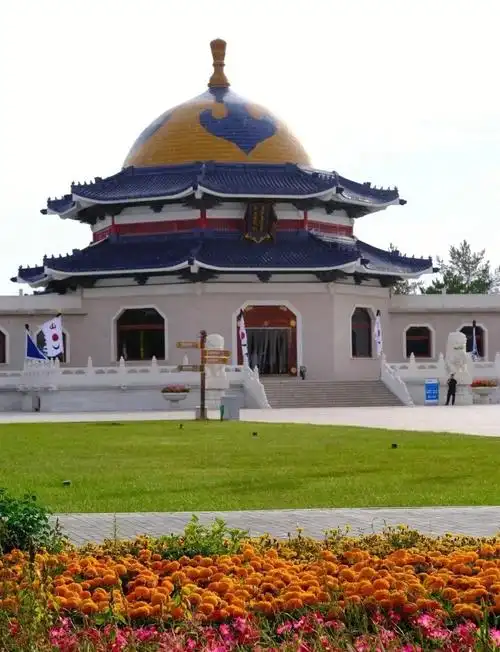
The site's lineage runs back to the Eight White Rooms (Naaman Tsagan Ger), mobile ger-shaped pavilions that carried sacred belongings across the steppe for centuries, guarded by the hereditary Darkhad clan. The present monumental complex was built between 1954 and 1956 on the Yijinholo grasslands. Three interconnected halls shaped like ceremonial Mongolian gers rise from the plain, crowned with sky-blue glazed tiles that echo the Mongols' worship of the eternal blue sky, or Tengri. Inside, frescoes and statuary chart the Khan's life and conquests, while an equestrian statue anchors the surrounding memorial grounds.
At the ritual core stands the Sülde Altar, a sacred shrine honoring the warrior-khan's spirit through a tall white banner—an emblem as central to Mongol identity as the Oriflamme was to medieval France. The Genghis Khan Sacrificial Ceremony, performed especially on the 21st day of the third lunar month, weaves chant, music, and oblation into a ritual older than any cathedral liturgy in Europe. The festival is listed as part of China's national intangible cultural heritage and remains a living practice rather than a museum piece.
The mausoleum lies roughly 40 km southeast of Ordos city, with limited public transport; taxis or organized tours from Ordos or the resort town of Kangbashi are the most reliable options. Hours shift with the season: roughly 7:30 a.m.–6:30 p.m. in summer (May–October) and 8:00 a.m.–5:30 p.m. in winter (November–April), so confirm before traveling. Expect separate fees for admission, audio guides, and performances such as the famed Erta Gala equestrian show; verify what your ticket covers before queuing, and book guides in advance during peak months.
Inside the halls, silence is mandatory, offerings must not be touched, and photography requires permission—observances similar to those at an Orthodox cathedral or a Shinto shrine. Allow three to four hours to take in the Qizhuang Shanhe Gate, the Iron Horse Golden Tent sculpture group, the main mausoleum halls, the Sülde Altar, and the symbolic 99-step staircase (nine being a sacred Mongolian number). Optional guided commentary and folkloric displays deepen the experience; pair the visit with the singing sand dunes of Xiangshawan and Kangbashi's striking modern skyline for a two- to three-day steppe itinerary. Steppe sun is fierce, so bring sunscreen, a hat, and water.
Genghis Khan (c. 1162–1227) forged the largest contiguous land empire in history, an achievement rivaled only by Rome at its zenith. Yet unlike Augustus or Constantine, the conqueror was reportedly buried in an unmarked grave, and despite decades of research his resting place remains one of the great unsolved mysteries of the medieval world. The Ordos shrine is best understood as the Mongol equivalent of Westminster Abbey or Paris's Les Invalides: a memorial rather than a burial place, where relics, ceremonial regalia, and symbolic objects carry the legacy forward for the living rather than shelter the dead.
The site's lineage runs back to the Eight White Rooms (Naaman Tsagan Ger), mobile ger-shaped pavilions that carried sacred belongings across the steppe for centuries, guarded by the hereditary Darkhad clan. The present monumental complex was built between 1954 and 1956 on the Yijinholo grasslands. Three interconnected halls shaped like ceremonial Mongolian gers rise from the plain, crowned with sky-blue glazed tiles that echo the Mongols' worship of the eternal blue sky, or Tengri. Inside, frescoes and statuary chart the Khan's life and conquests, while an equestrian statue anchors the surrounding memorial grounds.
At the ritual core stands the Sülde Altar, a sacred shrine honoring the warrior-khan's spirit through a tall white banner—an emblem as central to Mongol identity as the Oriflamme was to medieval France. The Genghis Khan Sacrificial Ceremony, performed especially on the 21st day of the third lunar month, weaves chant, music, and oblation into a ritual older than any cathedral liturgy in Europe. The festival is listed as part of China's national intangible cultural heritage and remains a living practice rather than a museum piece.
The mausoleum lies roughly 40 km southeast of Ordos city, with limited public transport; taxis or organized tours from Ordos or the resort town of Kangbashi are the most reliable options. Hours shift with the season: roughly 7:30 a.m.–6:30 p.m. in summer (May–October) and 8:00 a.m.–5:30 p.m. in winter (November–April), so confirm before traveling. Expect separate fees for admission, audio guides, and performances such as the famed Erta Gala equestrian show; verify what your ticket covers before queuing, and book guides in advance during peak months.
Inside the halls, silence is mandatory, offerings must not be touched, and photography requires permission—observances similar to those at an Orthodox cathedral or a Shinto shrine. Allow three to four hours to take in the Qizhuang Shanhe Gate, the Iron Horse Golden Tent sculpture group, the main mausoleum halls, the Sülde Altar, and the symbolic 99-step staircase (nine being a sacred Mongolian number). Optional guided commentary and folkloric displays deepen the experience; pair the visit with the singing sand dunes of Xiangshawan and Kangbashi's striking modern skyline for a two- to three-day steppe itinerary. Steppe sun is fierce, so bring sunscreen, a hat, and water.