Flying Sand Weir
⭐ 3.80
Feisha Weir Scenic Area, Dujiangyan City, Sichuan Province, China
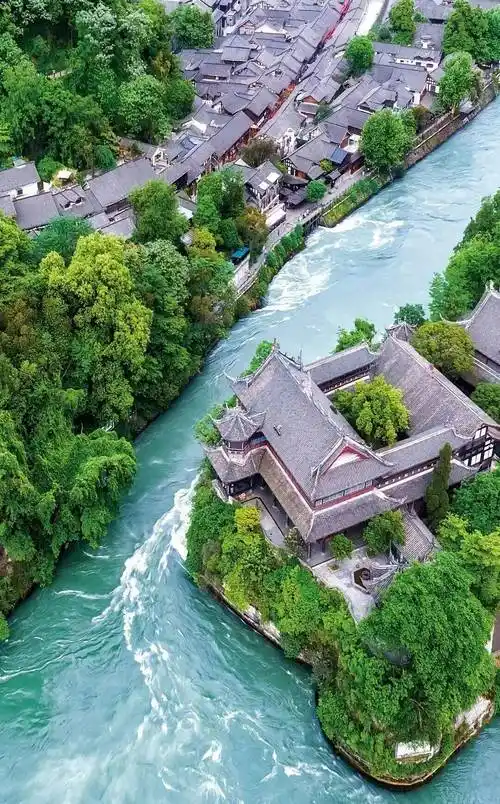 Dating to the late Warring States period around 256 BC, Feisha Weir predates nearly every major hydraulic engineering achievement of the ancient Mediterranean world. While Roman engineers were perfecting concrete arches in the 1st century AD, Li Bing's Qin-era workforce was already harnessing river dynamics to tame the flood-prone Min River. The weir works in concert with two sister structures—Yuzui (Fish Mouth Levee) which divides the river, and Baopingkou (Bottle-Neck Channel) which regulates intake—forming a three-part system that UNESCO inscribed as a World Heritage Site in 2000, alongside the Great Wall and the Forbidden City as one of China's great engineering treasures.
The brilliance of Feisha Weir lies in its passive engineering. Positioned along a natural bend in the Inner River, it exploits centrifugal force: as water rounds the curve, heavier silt and pebbles are flung outward and over the weir into the Outer River. When floodwaters rise, the low weir self-destructively overflows, sacrificing part of its structure to save the irrigation network downstream. Roughly 80 percent of sediment is expelled this way, keeping the irrigation channels clear without human intervention—a principle modern hydraulic engineers still cite as remarkably sophisticated.
This approach embodies the Daoist philosophy of "following nature's way" (道法自然), which Li Bing championed over the brute-force dam-building common in his era. The result is an ecologically harmonious system that has supported rice agriculture on the Chengdu Plain for over two millennia, sustaining a population density often called the "Land of Abundance." For Western visitors familiar with the Netherlands' wind-powered polder drainage, Feisha Weir offers a striking contrast: low-tech, gravity-driven, and operating continuously since before Julius Caesar crossed the Rubicon.
Practical access is straightforward. From Chengdu's Xipu Station, a high-speed train reaches Lidui Park Station in about 30 minutes; the entrance lies steps away. The scenic area costs roughly 80–90 RMB (about $12) and operates 8:00–18:00. June through September brings the rainy-season flood discharge, when visitors can witness the weir's full dramatic power—water thundering over the barrier and sediment-laden torrents roaring into the Outer River. Winter visits are quieter but less visually spectacular.
Guided interpretation is strongly recommended, as the engineering subtleties are invisible without explanation. Audio guides or licensed guides are available at the gate. The ideal route enters through Qin堰 Tower, then descends past Erwang Temple (dedicated to Li Bing and his son) and across the swaying Anlan Suspension Bridge to Yuzui, then loops back along Feisha Weir to Baopingkou and Fulong Temple. Allow three to four hours, and bring sturdy shoes—the stone pathways can be slippery when the weir is in full spate.
Dating to the late Warring States period around 256 BC, Feisha Weir predates nearly every major hydraulic engineering achievement of the ancient Mediterranean world. While Roman engineers were perfecting concrete arches in the 1st century AD, Li Bing's Qin-era workforce was already harnessing river dynamics to tame the flood-prone Min River. The weir works in concert with two sister structures—Yuzui (Fish Mouth Levee) which divides the river, and Baopingkou (Bottle-Neck Channel) which regulates intake—forming a three-part system that UNESCO inscribed as a World Heritage Site in 2000, alongside the Great Wall and the Forbidden City as one of China's great engineering treasures.
The brilliance of Feisha Weir lies in its passive engineering. Positioned along a natural bend in the Inner River, it exploits centrifugal force: as water rounds the curve, heavier silt and pebbles are flung outward and over the weir into the Outer River. When floodwaters rise, the low weir self-destructively overflows, sacrificing part of its structure to save the irrigation network downstream. Roughly 80 percent of sediment is expelled this way, keeping the irrigation channels clear without human intervention—a principle modern hydraulic engineers still cite as remarkably sophisticated.
This approach embodies the Daoist philosophy of "following nature's way" (道法自然), which Li Bing championed over the brute-force dam-building common in his era. The result is an ecologically harmonious system that has supported rice agriculture on the Chengdu Plain for over two millennia, sustaining a population density often called the "Land of Abundance." For Western visitors familiar with the Netherlands' wind-powered polder drainage, Feisha Weir offers a striking contrast: low-tech, gravity-driven, and operating continuously since before Julius Caesar crossed the Rubicon.
Practical access is straightforward. From Chengdu's Xipu Station, a high-speed train reaches Lidui Park Station in about 30 minutes; the entrance lies steps away. The scenic area costs roughly 80–90 RMB (about $12) and operates 8:00–18:00. June through September brings the rainy-season flood discharge, when visitors can witness the weir's full dramatic power—water thundering over the barrier and sediment-laden torrents roaring into the Outer River. Winter visits are quieter but less visually spectacular.
Guided interpretation is strongly recommended, as the engineering subtleties are invisible without explanation. Audio guides or licensed guides are available at the gate. The ideal route enters through Qin堰 Tower, then descends past Erwang Temple (dedicated to Li Bing and his son) and across the swaying Anlan Suspension Bridge to Yuzui, then loops back along Feisha Weir to Baopingkou and Fulong Temple. Allow three to four hours, and bring sturdy shoes—the stone pathways can be slippery when the weir is in full spate.