Nan Bridge
⭐ 4.60
Nan Bridge Scenic Area, Nanqiao Town, Dujiangyan City, Sichuan Province, China
 Nan Bridge traces its origins to 1878, raised during the late Qing dynasty under Emperor Guangxu and first called Puji Bridge—a wooden crossing for merchants shuttling goods across the Min. Yet its setting carries far older weight: just downstream stands Dujiangyan, the astonishing 256 BC irrigation network that still tames the river today, roughly contemporary with the early Roman Republic. Floods, warfare, and time repeatedly battered the original span; major rebuilds in 1958 and again in 2009 restored its Qing-era silhouette while reinforcing the foundations to withstand magnitude-eight earthquakes—a remarkable marriage of heritage and modern engineering.
Architecturally, the bridge is a five-arch stone-pier timber span crowned with a sweeping tiled roof whose upturned eaves recall a classical Chinese pleasure boat. Visitors walking the deck find themselves flanked by carved wooden panels, painted scenes, and brightly glazed folk-sculpture tableaux—episodes from Journey to the West, including Sun Wukong's three bouts with the White Bone Demon, sit alongside thirty-four landscape murals and calligraphic couplets by regional scholars. Craftsmen call the structure a "painted hall on water," and the comparison feels apt: imagine Florence's Ponte Vecchio or Lucerne's Kapellbrücke, here reimagined in Chinese timber and the colors of western Sichuan.
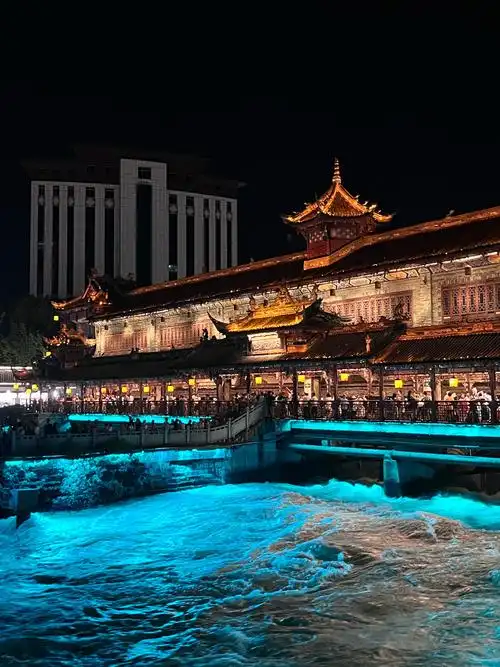
The bridge's greatest renown, however, arrives each evening at sunset. As daylight fades, an elaborate LED program gradually bathes the eaves, columns, and railings in cool blue tones, and the entire structure reflects upon the slow-moving river below in an unbroken sheet of luminous teal—the "blue tears" that have made the crossing an Instagram sensation across China. Locals describe the effect as "starfall cascading into the water," and there is no denying the romance of strolling the deck while a street musician plays erhu nearby, the summer breeze carrying the scent of Sichuan pepper from the old-town food stalls behind you.
Entry is free, and the bridge functions as a public pedestrian crossing open around the clock, though the lights perform their best work after roughly 5 pm, so plan to arrive at dusk. Before crossing, wander a few minutes into Guanxian Old Town for local specialties: chilled sweet-water noodles, fiery rabbit-head, and strong brick tea served by lantern-lit teahouses. Wear rubber-soled shoes; the flagstones grow slick after rain and after the nightly misting that intensifies the "blue tears." Summer weekends draw the biggest crowds—midweek or off-season visits offer a quieter experience and easier photography.
For travelers with a full day to spare, Nan Bridge anchors an ideal western-Sichuan circuit. Spend the morning exploring Dujiangyan itself—the Fish-Mouth Levee and Flying Sand Weir feel almost miraculous when you realize they still function after twenty-two centuries—then climb Qingcheng Mountain, the green Taoist peak that cradled the Quanzhen school, before descending to the old town for tea, opera, and a meal. Cap the day back at the bridge as the lamps ignite: the trilogy of ancient waterworks, sacred mountain, and luminous river-crossing captures the soul of Sichuan in a single, unforgettable arc.
Nan Bridge traces its origins to 1878, raised during the late Qing dynasty under Emperor Guangxu and first called Puji Bridge—a wooden crossing for merchants shuttling goods across the Min. Yet its setting carries far older weight: just downstream stands Dujiangyan, the astonishing 256 BC irrigation network that still tames the river today, roughly contemporary with the early Roman Republic. Floods, warfare, and time repeatedly battered the original span; major rebuilds in 1958 and again in 2009 restored its Qing-era silhouette while reinforcing the foundations to withstand magnitude-eight earthquakes—a remarkable marriage of heritage and modern engineering.
Architecturally, the bridge is a five-arch stone-pier timber span crowned with a sweeping tiled roof whose upturned eaves recall a classical Chinese pleasure boat. Visitors walking the deck find themselves flanked by carved wooden panels, painted scenes, and brightly glazed folk-sculpture tableaux—episodes from Journey to the West, including Sun Wukong's three bouts with the White Bone Demon, sit alongside thirty-four landscape murals and calligraphic couplets by regional scholars. Craftsmen call the structure a "painted hall on water," and the comparison feels apt: imagine Florence's Ponte Vecchio or Lucerne's Kapellbrücke, here reimagined in Chinese timber and the colors of western Sichuan.
The bridge's greatest renown, however, arrives each evening at sunset. As daylight fades, an elaborate LED program gradually bathes the eaves, columns, and railings in cool blue tones, and the entire structure reflects upon the slow-moving river below in an unbroken sheet of luminous teal—the "blue tears" that have made the crossing an Instagram sensation across China. Locals describe the effect as "starfall cascading into the water," and there is no denying the romance of strolling the deck while a street musician plays erhu nearby, the summer breeze carrying the scent of Sichuan pepper from the old-town food stalls behind you.
Entry is free, and the bridge functions as a public pedestrian crossing open around the clock, though the lights perform their best work after roughly 5 pm, so plan to arrive at dusk. Before crossing, wander a few minutes into Guanxian Old Town for local specialties: chilled sweet-water noodles, fiery rabbit-head, and strong brick tea served by lantern-lit teahouses. Wear rubber-soled shoes; the flagstones grow slick after rain and after the nightly misting that intensifies the "blue tears." Summer weekends draw the biggest crowds—midweek or off-season visits offer a quieter experience and easier photography.
For travelers with a full day to spare, Nan Bridge anchors an ideal western-Sichuan circuit. Spend the morning exploring Dujiangyan itself—the Fish-Mouth Levee and Flying Sand Weir feel almost miraculous when you realize they still function after twenty-two centuries—then climb Qingcheng Mountain, the green Taoist peak that cradled the Quanzhen school, before descending to the old town for tea, opera, and a meal. Cap the day back at the bridge as the lamps ignite: the trilogy of ancient waterworks, sacred mountain, and luminous river-crossing captures the soul of Sichuan in a single, unforgettable arc.