Erwang Temple
⭐ 4.20
Erwang Temple Scenic Area, Dujiangyan City, Sichuan Province, China
 **A Living Monument to Ancient Engineering**
Erwang Temple was originally built in 494 CE during the Southern Qi dynasty as the "Chongde Shrine" to honor Li Bing, the Qin governor of Shu who, alongside his son, designed the Dujiangyan irrigation system around 256 BCE. This feat—diverting the Min River without a single dam—has been irrigating the Chengdu Plain for over two millennia, earning comparison to Rome's aqueducts for its sheer longevity and ambition. Repeatedly damaged and rebuilt over the centuries, the temple suffered devastating blows in the 2008 Wenchuan earthquake but was meticulously restored, a recovery praised by UNESCO.
**Architecture Carved into the Mountain**
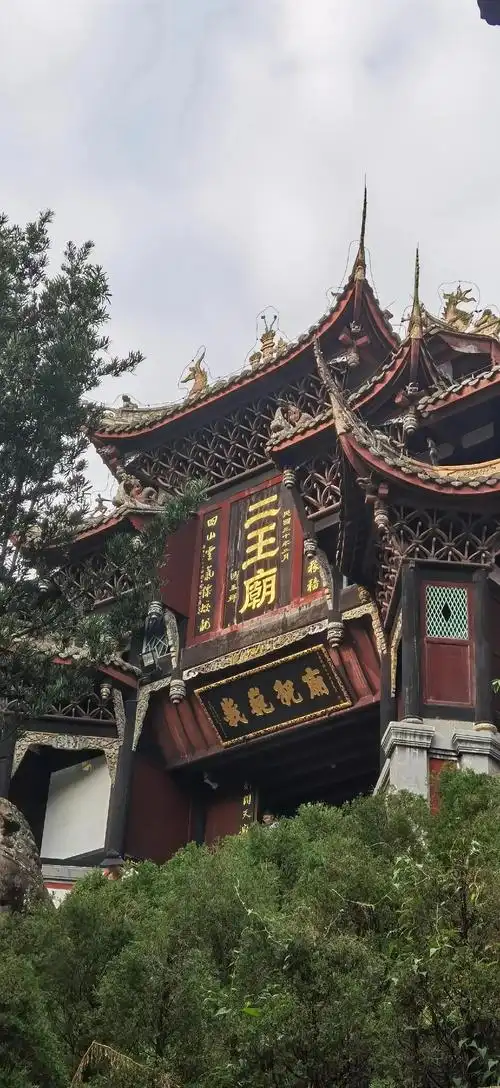
Following the contours of Yulei Mountain, the complex showcases classic Sichuan mountain architecture: crimson walls and dark tile roofs rise in tiered succession through ancient trees. The front gate bears calligraphy from warlord Feng Yixiang, while the main halls enshrine statues of Li Bing and his son. Most dramatic are the cantilevered stilt-house teahouses clinging to the cliff above the Min River, where visitors can sip tea while watching the same waters Li Bing tamed rush past below.
**Treasures of Stone and Calligraphy**
The temple is an open-air museum of inscriptions and couplets by masters including Zhang Daqian and Xu Beihong. Most prized are the "Six-Character Mantra" of water management—"Deep dredging, low weirs"—and the "Eight-Word Principle" of "cutting corners on bends, drawing hearts from straightaways." Together they articulate Dujiangyan's philosophy of working with nature's force rather than against it, offering insight into a sustainability mindset predating modern engineering by two thousand years.
**Practical Visitor Information**
Erwang Temple is included with the Dujiangyan Scenic Area ticket (80 RMB for adults; free for seniors 65+ and children under 1.3m); no separate entry fee is required. The site is reachable via buses 4 and 101 from central Dujiangyan, and parking is available for drivers. Note that the complex involves considerable stair climbing on steep, uneven stone steps—comfortable walking shoes are essential. Allow at least 45 minutes to explore thoroughly.
**Recommended Itinerary**
For the best experience, combine Erwang Temple with nearby highlights: begin at Qinyan Tower for panoramic views, descend to the temple, cross the historic Anlan Suspension Bridge, and end at the iconic Fish Mouth Levee. The full loop takes two to three hours and is far easier downhill. Early morning or late afternoon offers fewer crowds and softer light, ideal for capturing the temple's red walls against the Min River's morning mist. Pause at one of the cliffside teahouses to reflect on a civilization that turned a raging torrent into the lifeblood of a region.
**A Living Monument to Ancient Engineering**
Erwang Temple was originally built in 494 CE during the Southern Qi dynasty as the "Chongde Shrine" to honor Li Bing, the Qin governor of Shu who, alongside his son, designed the Dujiangyan irrigation system around 256 BCE. This feat—diverting the Min River without a single dam—has been irrigating the Chengdu Plain for over two millennia, earning comparison to Rome's aqueducts for its sheer longevity and ambition. Repeatedly damaged and rebuilt over the centuries, the temple suffered devastating blows in the 2008 Wenchuan earthquake but was meticulously restored, a recovery praised by UNESCO.
**Architecture Carved into the Mountain**
Following the contours of Yulei Mountain, the complex showcases classic Sichuan mountain architecture: crimson walls and dark tile roofs rise in tiered succession through ancient trees. The front gate bears calligraphy from warlord Feng Yixiang, while the main halls enshrine statues of Li Bing and his son. Most dramatic are the cantilevered stilt-house teahouses clinging to the cliff above the Min River, where visitors can sip tea while watching the same waters Li Bing tamed rush past below.
**Treasures of Stone and Calligraphy**
The temple is an open-air museum of inscriptions and couplets by masters including Zhang Daqian and Xu Beihong. Most prized are the "Six-Character Mantra" of water management—"Deep dredging, low weirs"—and the "Eight-Word Principle" of "cutting corners on bends, drawing hearts from straightaways." Together they articulate Dujiangyan's philosophy of working with nature's force rather than against it, offering insight into a sustainability mindset predating modern engineering by two thousand years.
**Practical Visitor Information**
Erwang Temple is included with the Dujiangyan Scenic Area ticket (80 RMB for adults; free for seniors 65+ and children under 1.3m); no separate entry fee is required. The site is reachable via buses 4 and 101 from central Dujiangyan, and parking is available for drivers. Note that the complex involves considerable stair climbing on steep, uneven stone steps—comfortable walking shoes are essential. Allow at least 45 minutes to explore thoroughly.
**Recommended Itinerary**
For the best experience, combine Erwang Temple with nearby highlights: begin at Qinyan Tower for panoramic views, descend to the temple, cross the historic Anlan Suspension Bridge, and end at the iconic Fish Mouth Levee. The full loop takes two to three hours and is far easier downhill. Early morning or late afternoon offers fewer crowds and softer light, ideal for capturing the temple's red walls against the Min River's morning mist. Pause at one of the cliffside teahouses to reflect on a civilization that turned a raging torrent into the lifeblood of a region.