Nagqu Horse Racing Festival
⭐ 4.80
Nagqu Horse Racing Festival, Nagqu City, Tibet Autonomous Region, China
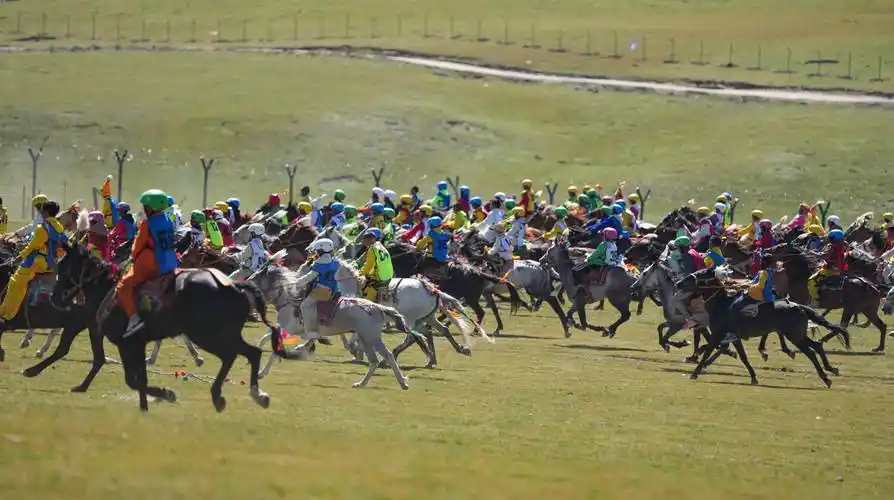 The Changthang horse has been prized for millennia. Tibetan steeds carried imperial messengers across the plateau as early as the 7th-century Tang dynasty and appear in Marco Polo's accounts of the Yuan era. The festival itself traces to inter-tribal horse selections and competitions among northern Tibetan nomads, gradually absorbing trade fairs and Buddhist ritual to become a comprehensive cultural gathering. Inscribed on China's National Intangible Cultural Heritage list in 2006, it stands alongside Mongolia's Naadam as one of Asia's great pastoral sporting festivals, but with a distinctly Tibetan character rooted in high-altitude horsemanship.
Nagchu sits at roughly 4,500 meters above sea level on the vast Changthang grasslands, often called the "Roof of the Roof of the World." There is no permanent stadium; the entire open steppe becomes the arena, with racing distances measured across the same endless horizons nomads have crossed for centuries. Compared to England's Ascot or Spain's Jerez, the festival's lack of grandstands is the point. Spectators gather spontaneously along the course, sharing the same altitude, dust, and sky as the riders, creating an intimacy no European venue can match.
The festival is fundamentally about the horse, the soul of Tibetan nomadic life. The 13 professional speed races include a punishing 10,000-meter invitational and a 12,000-meter walking-horse contest requiring extraordinary patience and training. Two traditional equestrian performances showcase young riders bending from their saddles to snatch ceremonial khata scarves from the ground at full gallop, a feat of courage as much as skill. Folk contests such as stone-carrying and yak tug-of-war echo daily pastoral labor, transforming routine herding tasks into spectacle.
Running parallel to the races, a heritage market brings together artisans from all 11 counties of Nagchu Prefecture, displaying thangka paintings, handwoven pulu fabrics, and silverwork. A cosmopolitan dimension comes from 33 foreign merchants representing Nepal, Bhutan, and Pakistan, recreating the cross-Himalayan trade routes that have linked the plateau to South Asia since antiquity. For Western travelers, this offers a rare chance to engage with Tibet's outward-facing cultural identity, a historical crossroads where Indian, Himalayan, and Central Asian influences have long converged.
The official performance days span three days in late summer, when grasslands are green and temperatures comparatively mild. Tickets must be purchased with a valid passport, limited to three per person per session, and online purchases require exchange for paper tickets at designated collection points. At over 4,500 meters, Nagchu poses serious altitude risks; travelers should acclimatize in Lhasa for several days beforehand, stay hydrated, and avoid strenuous activity on arrival. Trips into remote pastoral areas require registration with local public security authorities, and visitors should confirm current access requirements through official tourism channels before departure.
For Western travelers, the Nagchu Horse Racing Festival offers something no European tournament can replicate: an unbroken thread of pastoral tradition performed in the thin air of the world's highest plateau, by herders whose families have raced these same grasslands for a thousand years. It is at once a sporting event, a trade fair, a religious festival, and a cultural crossroads. Few experiences place the visitor so directly inside a living nomadic civilization, one that still pulses to the rhythm of hoofbeats on the Changthang steppe.
The Changthang horse has been prized for millennia. Tibetan steeds carried imperial messengers across the plateau as early as the 7th-century Tang dynasty and appear in Marco Polo's accounts of the Yuan era. The festival itself traces to inter-tribal horse selections and competitions among northern Tibetan nomads, gradually absorbing trade fairs and Buddhist ritual to become a comprehensive cultural gathering. Inscribed on China's National Intangible Cultural Heritage list in 2006, it stands alongside Mongolia's Naadam as one of Asia's great pastoral sporting festivals, but with a distinctly Tibetan character rooted in high-altitude horsemanship.
Nagchu sits at roughly 4,500 meters above sea level on the vast Changthang grasslands, often called the "Roof of the Roof of the World." There is no permanent stadium; the entire open steppe becomes the arena, with racing distances measured across the same endless horizons nomads have crossed for centuries. Compared to England's Ascot or Spain's Jerez, the festival's lack of grandstands is the point. Spectators gather spontaneously along the course, sharing the same altitude, dust, and sky as the riders, creating an intimacy no European venue can match.
The festival is fundamentally about the horse, the soul of Tibetan nomadic life. The 13 professional speed races include a punishing 10,000-meter invitational and a 12,000-meter walking-horse contest requiring extraordinary patience and training. Two traditional equestrian performances showcase young riders bending from their saddles to snatch ceremonial khata scarves from the ground at full gallop, a feat of courage as much as skill. Folk contests such as stone-carrying and yak tug-of-war echo daily pastoral labor, transforming routine herding tasks into spectacle.
Running parallel to the races, a heritage market brings together artisans from all 11 counties of Nagchu Prefecture, displaying thangka paintings, handwoven pulu fabrics, and silverwork. A cosmopolitan dimension comes from 33 foreign merchants representing Nepal, Bhutan, and Pakistan, recreating the cross-Himalayan trade routes that have linked the plateau to South Asia since antiquity. For Western travelers, this offers a rare chance to engage with Tibet's outward-facing cultural identity, a historical crossroads where Indian, Himalayan, and Central Asian influences have long converged.
The official performance days span three days in late summer, when grasslands are green and temperatures comparatively mild. Tickets must be purchased with a valid passport, limited to three per person per session, and online purchases require exchange for paper tickets at designated collection points. At over 4,500 meters, Nagchu poses serious altitude risks; travelers should acclimatize in Lhasa for several days beforehand, stay hydrated, and avoid strenuous activity on arrival. Trips into remote pastoral areas require registration with local public security authorities, and visitors should confirm current access requirements through official tourism channels before departure.
For Western travelers, the Nagchu Horse Racing Festival offers something no European tournament can replicate: an unbroken thread of pastoral tradition performed in the thin air of the world's highest plateau, by herders whose families have raced these same grasslands for a thousand years. It is at once a sporting event, a trade fair, a religious festival, and a cultural crossroads. Few experiences place the visitor so directly inside a living nomadic civilization, one that still pulses to the rhythm of hoofbeats on the Changthang steppe.