Manting Park
⭐ 4.50
Xishuangbanna Dai Autonomous Prefecture, Yunnan, China
 **A Living Relic of Dai Royalty**
Manting Park traces its origins to the 7th-century kingdom of the Dai people, whose civilization flourished along the Mekong long before the Tang Dynasty took shape in northern China. The garden was supposedly built by a king to win the affections of his beloved queen, earning it the romantic name "Chunhuan," the "Garden of the Soul." After 1950, it was opened to the public as a civic park, much like how Versailles transitioned from a royal residence into a shared cultural treasure. Today it stands as the best-preserved example of a Dai royal pleasure garden anywhere in the world.
**Architecture Amid the Rainforest**
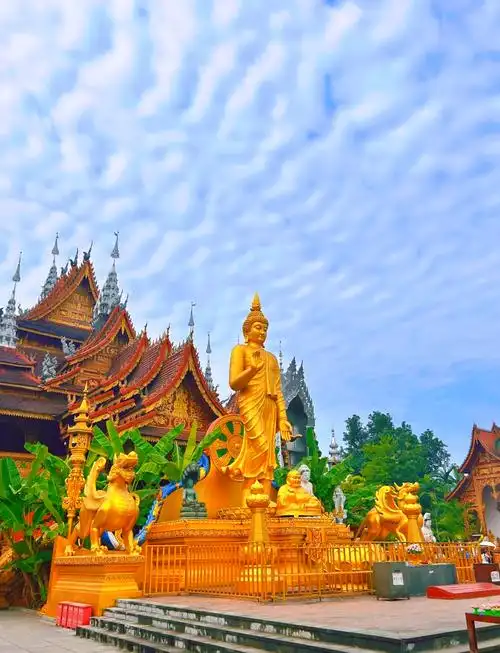
The park's layout weaves ornate religious architecture through dense tropical foliage in a style unlike anything in Europe. Crowning the grounds is a forest of gilded white stupas whose pointed spires echo the chedis of Thailand and Myanmar yet feel distinctly Chinese. An octagonal pavilion, the remnants of the king's audience hall, anchors the historic core, while statues commemorate the 1961 visit of Premier Zhou Enlai during the Water Splashing Festival, an event comparable in cultural weight to Songkran across the border. The image of the earth goddess Nang Thorani offers a graceful focal point for photographers.
**Buddhism and Sacred Neighborhood**
Manting Park connects directly to the nearby Zongfo Si, the highest-ranking Theravada Buddhist temple in Xishuangbanna, echoing the spiritual pairing of the Grand Palace and Wat Pho in Bangkok. Visitors are asked to dress modestly when walking between the two sites, covering shoulders and knees in keeping with monastic etiquette. The proximity allows travelers to absorb two sides of Dai civilization in a single morning, the royal and the sacred, in a way that feels surprisingly intimate compared with Europe's vast cathedral squares.
**Practicalities for Visitors**
The park welcomes guests daily from 8:00 a.m. to 6:00 p.m., with last entry at 5:00 p.m. Admission is just 40 yuan, an exceptional value for a site of this stature. Arrive after 3:00 p.m. to avoid the midday heat and enjoy softer photographic light. Inside, three daily performances at the parrot park and elephant cultural grounds delight families, while the fish-feeding pond at the Liberation Lake offers a calming pause. Wear breathable clothing plus a light jacket, as breezes off the lake can turn surprisingly cool at dusk.
**The Night Experience**
No visit is complete without staying for the evening "Lancang-Mekong Night" gala, where a candlelit buffet precedes a bonfire show featuring dancers from six nations, including performances that nod to Lao, Thai, Burmese, and Vietnamese traditions. The flame-lit courtyard, framed by the silhouettes of ancient stupas, creates a magical atmosphere no daytime tour can match. Combining the historical park with this evening spectacle turns a simple sightseeing stop into the most memorable cultural evening in southern China, a fitting finale to any Yunnan itinerary.
**A Living Relic of Dai Royalty**
Manting Park traces its origins to the 7th-century kingdom of the Dai people, whose civilization flourished along the Mekong long before the Tang Dynasty took shape in northern China. The garden was supposedly built by a king to win the affections of his beloved queen, earning it the romantic name "Chunhuan," the "Garden of the Soul." After 1950, it was opened to the public as a civic park, much like how Versailles transitioned from a royal residence into a shared cultural treasure. Today it stands as the best-preserved example of a Dai royal pleasure garden anywhere in the world.
**Architecture Amid the Rainforest**
The park's layout weaves ornate religious architecture through dense tropical foliage in a style unlike anything in Europe. Crowning the grounds is a forest of gilded white stupas whose pointed spires echo the chedis of Thailand and Myanmar yet feel distinctly Chinese. An octagonal pavilion, the remnants of the king's audience hall, anchors the historic core, while statues commemorate the 1961 visit of Premier Zhou Enlai during the Water Splashing Festival, an event comparable in cultural weight to Songkran across the border. The image of the earth goddess Nang Thorani offers a graceful focal point for photographers.
**Buddhism and Sacred Neighborhood**
Manting Park connects directly to the nearby Zongfo Si, the highest-ranking Theravada Buddhist temple in Xishuangbanna, echoing the spiritual pairing of the Grand Palace and Wat Pho in Bangkok. Visitors are asked to dress modestly when walking between the two sites, covering shoulders and knees in keeping with monastic etiquette. The proximity allows travelers to absorb two sides of Dai civilization in a single morning, the royal and the sacred, in a way that feels surprisingly intimate compared with Europe's vast cathedral squares.
**Practicalities for Visitors**
The park welcomes guests daily from 8:00 a.m. to 6:00 p.m., with last entry at 5:00 p.m. Admission is just 40 yuan, an exceptional value for a site of this stature. Arrive after 3:00 p.m. to avoid the midday heat and enjoy softer photographic light. Inside, three daily performances at the parrot park and elephant cultural grounds delight families, while the fish-feeding pond at the Liberation Lake offers a calming pause. Wear breathable clothing plus a light jacket, as breezes off the lake can turn surprisingly cool at dusk.
**The Night Experience**
No visit is complete without staying for the evening "Lancang-Mekong Night" gala, where a candlelit buffet precedes a bonfire show featuring dancers from six nations, including performances that nod to Lao, Thai, Burmese, and Vietnamese traditions. The flame-lit courtyard, framed by the silhouettes of ancient stupas, creates a magical atmosphere no daytime tour can match. Combining the historical park with this evening spectacle turns a simple sightseeing stop into the most memorable cultural evening in southern China, a fitting finale to any Yunnan itinerary.