Dai Ethnic Park
⭐ 4.20
Jinuoshan Township, Jinghong City, Xishuangbanna Dai Autonomous Prefecture, Yunnan Province, China
 [DETAILED para 1 - Historical context]
The Dai people are believed to have migrated southward from Yunnan over a thousand years ago, eventually establishing kingdoms across today's Thailand, Laos, and Myanmar. The five villages that compose Dai Ethnic Garden—particularly Manchunman and Manting, with documented histories stretching back more than a millennium—remain the cultural heartland of this once-vast Tai civilization. Think of it as a living counterpart to Thailand's ancient Chiang Mai settlements or the heritage villages of Luang Prabang. Designated a national AAAA-level scenic area and a provincial center for intangible cultural heritage, this compact stretch of the Mekong plain preserves a way of life that elsewhere has largely faded into the past.
[DETAILED para 2 - Architecture]
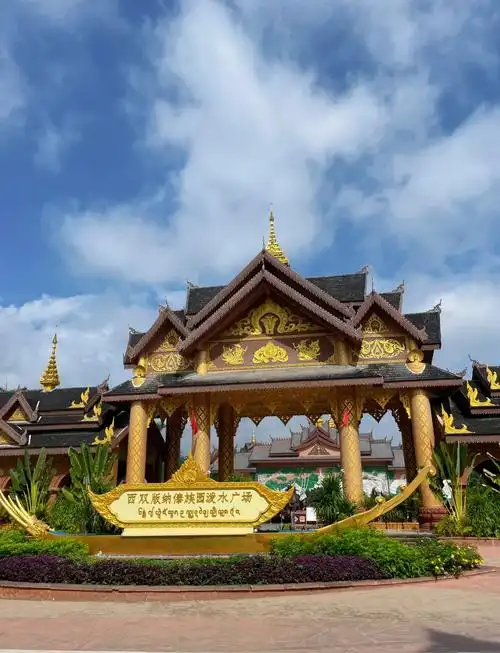
The villages' signature buildings are their stilted bamboo-and-timber houses, known as ganlan, raised high off the ground to escape the region's notorious humidity and insects. The steep, light roofs and open ground floors create an airy silhouette unique to Southeast Asia—visitors familiar with traditional villages in northern Thailand will find the architecture immediately recognizable. The spiritual heart of each settlement is its Theravada Buddhist temple: Manchunman Temple and Manting Temple, with their sweeping upturned eaves, golden finials, and gleaming white pagodas, recall the gilded wats of Bangkok or Mandalay. Sacred bodhi trees and flowering tropical plantings frame the courtyards, making the park a favorite haunt for photographers.
[DETAILED para 3 - Cultural significance]
Beyond its picturesque setting, the park is a working showcase of Dai intangible heritage, many items on China's national register. Visitors can watch artisans practice dai jin brocade weaving, slow-wheel pottery, the crafting of palm-leaf sutras (a Buddhist manuscript tradition dating back nearly two millennia), and listen to zhangha—a lyrical courtship singing style compared to a poetic cousin of Thai mor lam. Each craft reflects the Dai reverence for nature and their deep Buddhist faith. Watching a grandmother thread a backstrap loom or a monk inscribe sacred Pali verses offers travelers a tactile encounter with traditions that survive largely because this corner of Yunnan deliberately chose to keep them alive.
[DETAILED para 4 - Water festival]
The headline experience is the Daily Water-Splashing Festival, a ritual cousin of Thailand's famous Songkran, traditionally marking the lunar new year. Here it is staged twice daily—at 14:00 and 16:00—on a purpose-built plaza expanded in 2024 to accommodate roughly ten thousand revelers. Participants don borrowed Dai costumes and gleefully douse one another with buckets of blessed water, symbolically washing away misfortune and welcoming good fortune. Spectator zones ring the arena for those preferring to stay dry, though most visitors find the temptation irresistible. It is the rare cultural ritual designed to be touched, splashed, and laughed through rather than merely observed.
[DETAILED para 5 - Practical visit info]
The park sits in Menghan Town, about 27 kilometers south of Jinghong city. From the Jinghong bus station, dedicated shuttle buses run for roughly 15 yuan; taxis or ride-shares cost 80–100 yuan each way. Gates open from 08:00 to 17:00, with admission around 100 yuan; an add-on electric-cart ticket offers the best value. Half a day is sufficient to cover the temples, watch craft demonstrations, and join the afternoon water battle—arriving early lets you confirm the day's splash schedule. Pack quick-dry clothing, a waterproof phone pouch, sunscreen, and insect repellent; light long sleeves are ideal in both the heat and the temples.
[DETAILED para 6 - Etiquette and why visit]
A few courtesies matter: shoes come off at every temple threshold, shoulders and knees should remain covered, and menstruating women traditionally refrain from entering the main halls. On-site dining is limited and pricey, so eating back in Menghan's street-food stalls afterward is both tastier and friendlier to the wallet. For travelers with extra time, a Mekong speedboat ride offers a final dash of borderland adventure. Few places in China deliver so vivid a taste of mainland Southeast Asia in a single afternoon—Dai Ethnic Garden is the rare heritage site where you do not just see the culture, you get thoroughly, joyfully soaked in it.
[DETAILED para 1 - Historical context]
The Dai people are believed to have migrated southward from Yunnan over a thousand years ago, eventually establishing kingdoms across today's Thailand, Laos, and Myanmar. The five villages that compose Dai Ethnic Garden—particularly Manchunman and Manting, with documented histories stretching back more than a millennium—remain the cultural heartland of this once-vast Tai civilization. Think of it as a living counterpart to Thailand's ancient Chiang Mai settlements or the heritage villages of Luang Prabang. Designated a national AAAA-level scenic area and a provincial center for intangible cultural heritage, this compact stretch of the Mekong plain preserves a way of life that elsewhere has largely faded into the past.
[DETAILED para 2 - Architecture]
The villages' signature buildings are their stilted bamboo-and-timber houses, known as ganlan, raised high off the ground to escape the region's notorious humidity and insects. The steep, light roofs and open ground floors create an airy silhouette unique to Southeast Asia—visitors familiar with traditional villages in northern Thailand will find the architecture immediately recognizable. The spiritual heart of each settlement is its Theravada Buddhist temple: Manchunman Temple and Manting Temple, with their sweeping upturned eaves, golden finials, and gleaming white pagodas, recall the gilded wats of Bangkok or Mandalay. Sacred bodhi trees and flowering tropical plantings frame the courtyards, making the park a favorite haunt for photographers.
[DETAILED para 3 - Cultural significance]
Beyond its picturesque setting, the park is a working showcase of Dai intangible heritage, many items on China's national register. Visitors can watch artisans practice dai jin brocade weaving, slow-wheel pottery, the crafting of palm-leaf sutras (a Buddhist manuscript tradition dating back nearly two millennia), and listen to zhangha—a lyrical courtship singing style compared to a poetic cousin of Thai mor lam. Each craft reflects the Dai reverence for nature and their deep Buddhist faith. Watching a grandmother thread a backstrap loom or a monk inscribe sacred Pali verses offers travelers a tactile encounter with traditions that survive largely because this corner of Yunnan deliberately chose to keep them alive.
[DETAILED para 4 - Water festival]
The headline experience is the Daily Water-Splashing Festival, a ritual cousin of Thailand's famous Songkran, traditionally marking the lunar new year. Here it is staged twice daily—at 14:00 and 16:00—on a purpose-built plaza expanded in 2024 to accommodate roughly ten thousand revelers. Participants don borrowed Dai costumes and gleefully douse one another with buckets of blessed water, symbolically washing away misfortune and welcoming good fortune. Spectator zones ring the arena for those preferring to stay dry, though most visitors find the temptation irresistible. It is the rare cultural ritual designed to be touched, splashed, and laughed through rather than merely observed.
[DETAILED para 5 - Practical visit info]
The park sits in Menghan Town, about 27 kilometers south of Jinghong city. From the Jinghong bus station, dedicated shuttle buses run for roughly 15 yuan; taxis or ride-shares cost 80–100 yuan each way. Gates open from 08:00 to 17:00, with admission around 100 yuan; an add-on electric-cart ticket offers the best value. Half a day is sufficient to cover the temples, watch craft demonstrations, and join the afternoon water battle—arriving early lets you confirm the day's splash schedule. Pack quick-dry clothing, a waterproof phone pouch, sunscreen, and insect repellent; light long sleeves are ideal in both the heat and the temples.
[DETAILED para 6 - Etiquette and why visit]
A few courtesies matter: shoes come off at every temple threshold, shoulders and knees should remain covered, and menstruating women traditionally refrain from entering the main halls. On-site dining is limited and pricey, so eating back in Menghan's street-food stalls afterward is both tastier and friendlier to the wallet. For travelers with extra time, a Mekong speedboat ride offers a final dash of borderland adventure. Few places in China deliver so vivid a taste of mainland Southeast Asia in a single afternoon—Dai Ethnic Garden is the rare heritage site where you do not just see the culture, you get thoroughly, joyfully soaked in it.