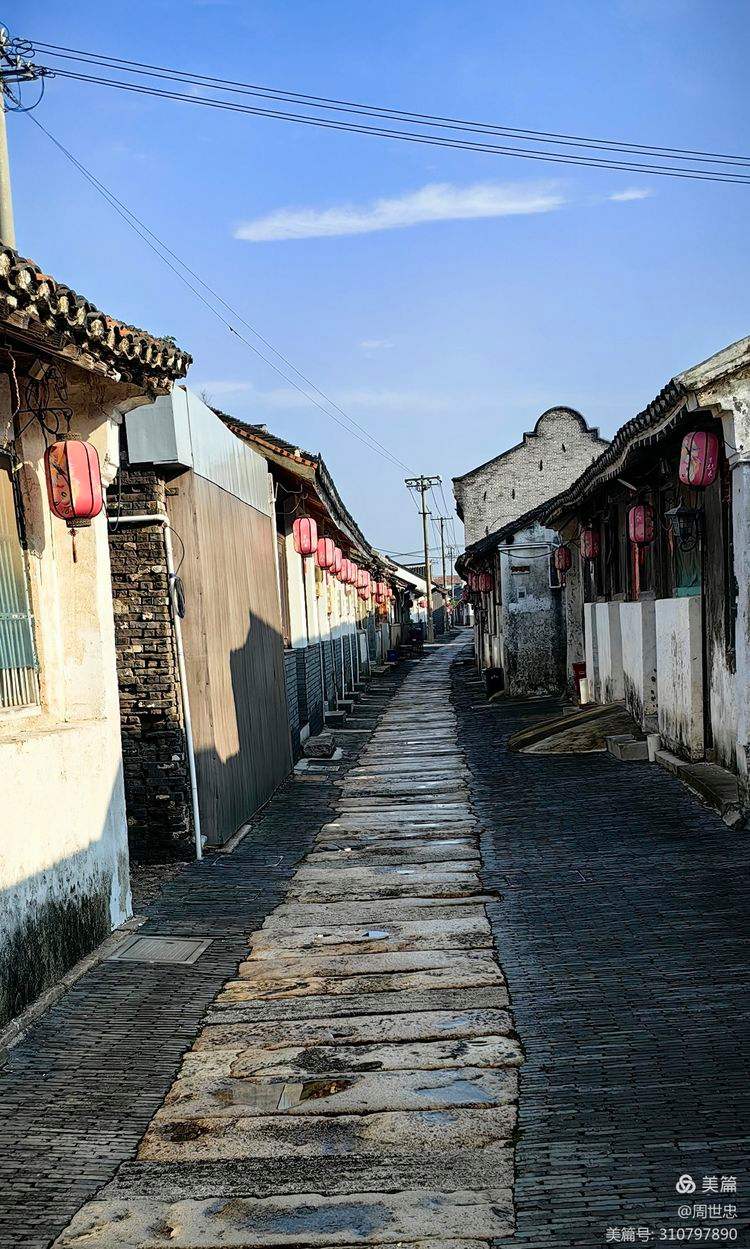
Yudong's history begins in 875 AD, when salt-makers established settlements along Jiangsu's coast. To place this in global context, the town emerged during the same era as the foundation of Viking settlements in Iceland and just before the Norman consolidation of Europe. By the Song dynasty, Yudong had become a state-run salt field, and the Ming rulers—contemporaries of the Tudors and Medici—fortified it into a walled garrison town. The "salt town" concept has parallels across the globe: think of Lüneburg in Germany, which funded entire cities through the white gold trade, or the salt routes that shaped medieval Europe. Yudong's prosperity peaked when salt revenues made it a vital commercial junction where the Yangtze met the sea.
The architectural heart of Yudong is its 876-meter flagstone street, paved with 2,146 hand-cut bluestone slabs—an extraordinary survival of Ming-era urban engineering. Beneath these stones lie original drainage channels and hidden military tunnels, a feature that may remind visitors of the underground passages beneath European medieval cities like Edinburgh or Carcassonne. Flanking the street, traditional Hui-style residences display their characteristic whitewashed walls, dark roof tiles, and carved wooden lintels. Notable structures include the Fan family mansion, the Guo Limao silver shop, and the partially preserved South Gate, all maintaining their authentic street pattern since the 16th century.
The town's cultural life continues to pulse through its historic setting. Faguang Temple, dating from the Wanli era of the Ming dynasty (1573–1620), uniquely blends Confucian, Buddhist, and Taoist teachings under one roof—a syncretic tradition that Western visitors might compare to the religious layering seen in sites like Jerusalem or Mount Athos. The temple's wooden beam carvings and ancient ginkgo trees create an atmosphere of contemplative stillness. The "Sisters' Well," twin Ming-era wells said to possess beautifying waters, adds folkloric charm. Above all, Yudong remains a living community: tofu makers still operate from centuries-old storefronts, and traditional crafts such as paper-cutting, blue-printed cloth, and Peking opera performances keep intangible heritage vividly alive.
Access is straightforward but favors those with their own transport. Driving from Nantong or central Haimen takes roughly 40 minutes; free parking is available at the town entrance. Public transport requires transferring to bus 203 or 210 in Haimen, with infrequent service, so a taxi or ride-hailing service is often more practical. The town itself is entirely free to enter, though some hands-on craft experiences cost between 30 and 50 yuan. Faguang Temple opens from 8:00 AM to 5:00 PM. Wear flat, non-slip shoes—the polished flagstones become treacherous when wet—and allow half a day to a full day for unhurried exploration.
For travelers weary of crowded tourist traps, Yudong offers something increasingly rare: authenticity. While the famous water towns of Zhouzhuang and Wuzhen have become open-air museums catering to bus tours, Yudong still breathes with the rhythms of daily Chinese life—grandmothers gossiping on doorsteps, children cycling past ancient wells, elders playing chess beneath willows. It pairs naturally with a visit to the nearby Zhang Jian Homeland, the birthplace of China's early 20th-century industrial pioneer and educational reformer. Spring and autumn provide the most comfortable weather for exploring. Come for the history, stay for the silence, and leave with the feeling of having discovered a place where centuries feel close enough to touch.