Xishuangbanna Tropical Botanical Garden
⭐ 4.70
Mengle Avenue, Jinghong City, Xishuangbanna Dai Autonomous Prefecture, Yunnan, China
 **A Botanical Outpost Born in the Mao Era**
Founded in 1959 by pioneering botanist Cai Xitao, the garden emerged during a period when China was racing to catalog and preserve its biodiversity. Cai, a visionary whose expeditions mapped countless species across Yunnan, chose a horseshoe-shaped island encircled by a tributary of the Mekong (Lancang) River as his living laboratory. Today, the institution stands as the country's premier tropical research center, comparable in scientific stature to the Royal Botanic Gardens at Kew, but operating at a scale and within a climatic zone that few temperate gardens can rival. Elevation shifts across the property create distinct microclimates, supporting extraordinary plant diversity.
**The Western Zone: A Symphony of Curated Beauty**
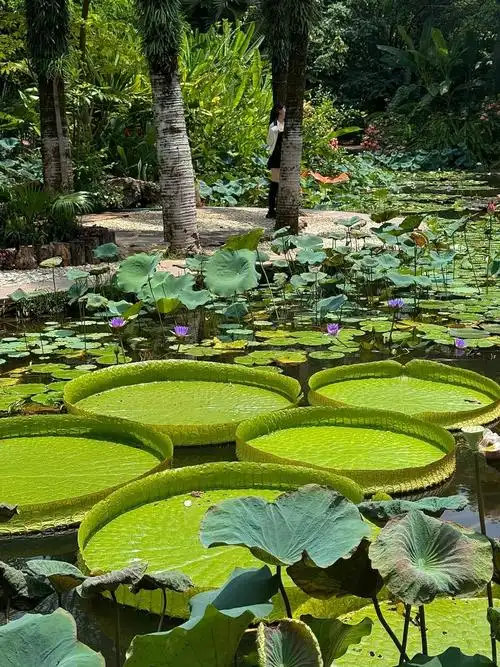
The flat, manicured western half unfolds across 38 specialty gardens, including the celebrated Hundred Flowers Garden, Palm Collection, and the Exotic Flowers Garden. The undisputed crowd-pleaser is the Giant Water Lily Pool, where Victoria amazonica pads regularly exceed two meters across, strong enough to briefly cradle a child. Dancing grass, the notoriously toxic "suicide tree," and hundreds of orchid varieties make this zone the photographic heart of the visit. Compared to the formal parterres of Versailles or Kew's Palm House, the styling here feels looser, more jungle-adjacent, with hedges giving way to towering palms.
**The Eastern Zone: Walking Inside "Earth's Lungs"**
Cross to the eastern half and the cultivated paths dissolve into primary tropical rainforest spanning roughly 900 hectares. This protected ecosystem showcases the rainforest's famous "five spectacles": strangler figs slowly throttling their host trees, enormous buttress roots flaring like Gothic flying buttresses, epiphytes forming aerial gardens, parasitic plants suspended in mid-air, and the surreal phenomenon of a single tree felling itself into multiple clones (the aptly named "one tree, one forest"). With oxygen-rich air and a dense canopy that filters the tropical sun, hiking here feels like walking through a living greenhouse. Western hikers accustomed to Appalachian or Alpine forests will find this ecosystem both alien and mesmerizing.
**After Dark: The Wulan Night Walk**
For a completely different experience, the garden's signature "Wulan Shadow Tour" sends visitors into the rainforest after sunset with flashlights and expert guides. Expect encounters with fireflies blinking in synchronous constellations, leaf-mimic katydids the size of your hand, bamboo stick insects, and luminous tree frogs clinging to trunks. Like a guided night walk in Costa Rica's Monteverde, this is ecotourism at its most rewarding. Advance booking through the official WeChat mini-program is mandatory, as is hiring a guide or renting the audio device without one, you'll walk past treasures whose stories remain untold.
**Practical Tips for the Visitor**
Budget an entire day; underestimating distances here is the most common mistake. The garden sits 60 kilometers from Jinghong city, roughly a one-hour drive, so arrange a private car, taxi, or the official shuttle bus rather than relying on public transport. Once inside, purchase the full-park sightseeing tram ticket (100 yuan combined, or 50 yuan for either zone separately); the eastern rainforest alone spans kilometers. Bring mosquito repellent, sunscreen, a rain jacket, and wear long sleeves and sturdy, grippy hiking shoes, the climate mirrors Singapore or northern Queensland, humid, buggy, and intensely sunny between showers.
**Why It Belongs on Your Itinerary**
Few places on earth allow a visitor to stroll from a manicured flower garden straight into one of Asia's most intact rainforests within a single afternoon. Add in the chance to stand on a water lily bigger than a dining table, photograph a strangler fig in the act of slow-motion murder, and watch fireflies blink above your head, and the garden becomes not just a sightseeing stop but a genuine eco-adventure. For travelers tracing the Mekong, exploring Yunnan's biodiversity hotspots, or simply seeking something more memorable than another temple visit, this tropical Eden delivers consistently.
**A Botanical Outpost Born in the Mao Era**
Founded in 1959 by pioneering botanist Cai Xitao, the garden emerged during a period when China was racing to catalog and preserve its biodiversity. Cai, a visionary whose expeditions mapped countless species across Yunnan, chose a horseshoe-shaped island encircled by a tributary of the Mekong (Lancang) River as his living laboratory. Today, the institution stands as the country's premier tropical research center, comparable in scientific stature to the Royal Botanic Gardens at Kew, but operating at a scale and within a climatic zone that few temperate gardens can rival. Elevation shifts across the property create distinct microclimates, supporting extraordinary plant diversity.
**The Western Zone: A Symphony of Curated Beauty**
The flat, manicured western half unfolds across 38 specialty gardens, including the celebrated Hundred Flowers Garden, Palm Collection, and the Exotic Flowers Garden. The undisputed crowd-pleaser is the Giant Water Lily Pool, where Victoria amazonica pads regularly exceed two meters across, strong enough to briefly cradle a child. Dancing grass, the notoriously toxic "suicide tree," and hundreds of orchid varieties make this zone the photographic heart of the visit. Compared to the formal parterres of Versailles or Kew's Palm House, the styling here feels looser, more jungle-adjacent, with hedges giving way to towering palms.
**The Eastern Zone: Walking Inside "Earth's Lungs"**
Cross to the eastern half and the cultivated paths dissolve into primary tropical rainforest spanning roughly 900 hectares. This protected ecosystem showcases the rainforest's famous "five spectacles": strangler figs slowly throttling their host trees, enormous buttress roots flaring like Gothic flying buttresses, epiphytes forming aerial gardens, parasitic plants suspended in mid-air, and the surreal phenomenon of a single tree felling itself into multiple clones (the aptly named "one tree, one forest"). With oxygen-rich air and a dense canopy that filters the tropical sun, hiking here feels like walking through a living greenhouse. Western hikers accustomed to Appalachian or Alpine forests will find this ecosystem both alien and mesmerizing.
**After Dark: The Wulan Night Walk**
For a completely different experience, the garden's signature "Wulan Shadow Tour" sends visitors into the rainforest after sunset with flashlights and expert guides. Expect encounters with fireflies blinking in synchronous constellations, leaf-mimic katydids the size of your hand, bamboo stick insects, and luminous tree frogs clinging to trunks. Like a guided night walk in Costa Rica's Monteverde, this is ecotourism at its most rewarding. Advance booking through the official WeChat mini-program is mandatory, as is hiring a guide or renting the audio device without one, you'll walk past treasures whose stories remain untold.
**Practical Tips for the Visitor**
Budget an entire day; underestimating distances here is the most common mistake. The garden sits 60 kilometers from Jinghong city, roughly a one-hour drive, so arrange a private car, taxi, or the official shuttle bus rather than relying on public transport. Once inside, purchase the full-park sightseeing tram ticket (100 yuan combined, or 50 yuan for either zone separately); the eastern rainforest alone spans kilometers. Bring mosquito repellent, sunscreen, a rain jacket, and wear long sleeves and sturdy, grippy hiking shoes, the climate mirrors Singapore or northern Queensland, humid, buggy, and intensely sunny between showers.
**Why It Belongs on Your Itinerary**
Few places on earth allow a visitor to stroll from a manicured flower garden straight into one of Asia's most intact rainforests within a single afternoon. Add in the chance to stand on a water lily bigger than a dining table, photograph a strangler fig in the act of slow-motion murder, and watch fireflies blink above your head, and the garden becomes not just a sightseeing stop but a genuine eco-adventure. For travelers tracing the Mekong, exploring Yunnan's biodiversity hotspots, or simply seeking something more memorable than another temple visit, this tropical Eden delivers consistently.