Wangtianshu Scenic Area
⭐ 4.60
Wangtianshu Scenic Area, Jinuoshan Township, Jinghong City, Xishuangbanna Dai Autonomous Prefecture, Yunnan Province, China
 The Wangtianshu Scenic Area, anchored by a national nature reserve at 21° north latitude, holds singular importance in global conservation: it is the only region in China where the international forestry community recognizes a true tropical rainforest. The towering Parashorea chinensis trees, soaring beyond 80 meters—roughly the height of a 25-story building or London's Big Ben laid on its side—earn their name as "rainforest giants." Their existence places China among the world's tropical rainforest nations, a status few associate with this largely temperate country. Like the emergent trees of Borneo's Danum Valley or Brazil's Amazon basin, these giants define an entire ecosystem.
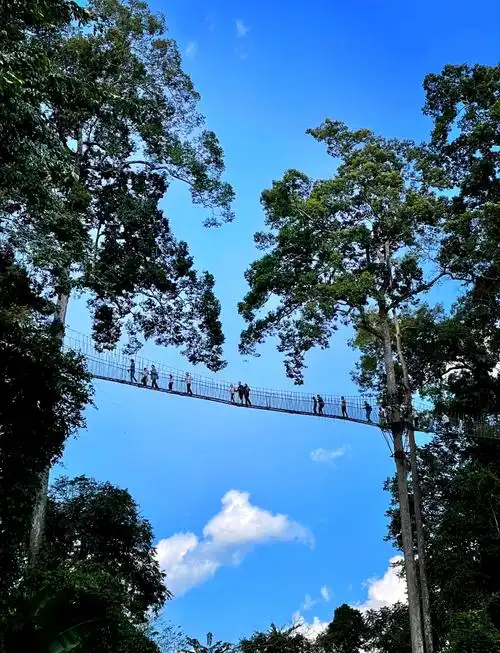
The signature attraction is the 500-meter Canopy Walkway, suspended 36 meters above the forest floor and strung between massive Wangtianshu trunks at heights ranging from 40 to 70 meters—comparable to walking at the level of a 12-story building. Engineered with flexible suspension cables, the swaying bridge delivers an adrenaline rush similar to canopy walks in Costa Rica's Monteverde or Australia's Otway Fly, while offering an unmatched vantage of the rainforest's upper layers. Visible from the walkway, the umbrella-shaped crowns merge into a living green cathedral, a perspective impossible to attain from the ground.
The park pioneered a water-land-air itinerary that immerses visitors fully in the rainforest's vertical world. The journey begins aboard a longtail-style boat gliding along the Nalan River, where overhanging vegetation evokes comparisons to a miniature Amazon. On land, the Philippe Trail—named for the Belgian botanist who surveyed the region—winds through primeval forest revealing dramatic buttress roots, strangler vines, and ancient lianas. The experience culminates in the aerial walkway, completing a sensory progression from riverbank to canopy crown.
The surrounding reserve harbors roughly one-quarter of China's wild animal species and one-fifth of its wild plants, ranking it as a biodiversity hotspot on par with Madagascar's protected reserves. Summer temperatures hover pleasantly between 24–26°C, while negative-ion concentrations rank among China's highest, earning it the nickname "Oxygen-Intoxicating Paradise." The Cai Xitao Trail, honoring the pioneering Chinese botanist who first documented these forests in the 1950s, links natural wonders with nearby Dai and Hani ethnic villages, where visitors encounter traditional stilted houses and Theravada Buddhist temples distinct from anything in Europe.
The park lies 2.5–3.5 hours by road from Jinghong, the prefectural capital; chartered vehicles or official shuttle buses are recommended. Tickets for entrance, river cruise, and canopy walkway are sold separately, with combined packages ranging from 198–215 yuan—best booked online in advance, especially during the dry season (November–April) when crowds peak. Plan visits between 9 AM and 4 PM, arriving early to avoid queues. Wear anti-slip hiking shoes and quick-dry clothing, and bring rain gear plus strong insect repellent during the May–October monsoon.
For travelers seeking an authentic tropical rainforest experience without crossing continents, Wangtianshu delivers a rare combination of scale, accessibility, and ecological significance. Few places on Earth allow visitors to boat through jungle waterways, hike among buttress-rooted giants, and walk at treetop level—all within a single day. The fusion of Southeast Asian geography, diverse ethnic heritage, and conservation science creates an experience wholly unlike any European landmark, making Xishuangbanna's rainforest canopy one of Asia's most rewarding adventure destinations for curious Western travelers.
The Wangtianshu Scenic Area, anchored by a national nature reserve at 21° north latitude, holds singular importance in global conservation: it is the only region in China where the international forestry community recognizes a true tropical rainforest. The towering Parashorea chinensis trees, soaring beyond 80 meters—roughly the height of a 25-story building or London's Big Ben laid on its side—earn their name as "rainforest giants." Their existence places China among the world's tropical rainforest nations, a status few associate with this largely temperate country. Like the emergent trees of Borneo's Danum Valley or Brazil's Amazon basin, these giants define an entire ecosystem.
The signature attraction is the 500-meter Canopy Walkway, suspended 36 meters above the forest floor and strung between massive Wangtianshu trunks at heights ranging from 40 to 70 meters—comparable to walking at the level of a 12-story building. Engineered with flexible suspension cables, the swaying bridge delivers an adrenaline rush similar to canopy walks in Costa Rica's Monteverde or Australia's Otway Fly, while offering an unmatched vantage of the rainforest's upper layers. Visible from the walkway, the umbrella-shaped crowns merge into a living green cathedral, a perspective impossible to attain from the ground.
The park pioneered a water-land-air itinerary that immerses visitors fully in the rainforest's vertical world. The journey begins aboard a longtail-style boat gliding along the Nalan River, where overhanging vegetation evokes comparisons to a miniature Amazon. On land, the Philippe Trail—named for the Belgian botanist who surveyed the region—winds through primeval forest revealing dramatic buttress roots, strangler vines, and ancient lianas. The experience culminates in the aerial walkway, completing a sensory progression from riverbank to canopy crown.
The surrounding reserve harbors roughly one-quarter of China's wild animal species and one-fifth of its wild plants, ranking it as a biodiversity hotspot on par with Madagascar's protected reserves. Summer temperatures hover pleasantly between 24–26°C, while negative-ion concentrations rank among China's highest, earning it the nickname "Oxygen-Intoxicating Paradise." The Cai Xitao Trail, honoring the pioneering Chinese botanist who first documented these forests in the 1950s, links natural wonders with nearby Dai and Hani ethnic villages, where visitors encounter traditional stilted houses and Theravada Buddhist temples distinct from anything in Europe.
The park lies 2.5–3.5 hours by road from Jinghong, the prefectural capital; chartered vehicles or official shuttle buses are recommended. Tickets for entrance, river cruise, and canopy walkway are sold separately, with combined packages ranging from 198–215 yuan—best booked online in advance, especially during the dry season (November–April) when crowds peak. Plan visits between 9 AM and 4 PM, arriving early to avoid queues. Wear anti-slip hiking shoes and quick-dry clothing, and bring rain gear plus strong insect repellent during the May–October monsoon.
For travelers seeking an authentic tropical rainforest experience without crossing continents, Wangtianshu delivers a rare combination of scale, accessibility, and ecological significance. Few places on Earth allow visitors to boat through jungle waterways, hike among buttress-rooted giants, and walk at treetop level—all within a single day. The fusion of Southeast Asian geography, diverse ethnic heritage, and conservation science creates an experience wholly unlike any European landmark, making Xishuangbanna's rainforest canopy one of Asia's most rewarding adventure destinations for curious Western travelers.