Zongfo Temple
⭐ 4.60
Manting Avenue, Jinghong City, Xishuangbanna Dai Autonomous Prefecture, Yunnan, China
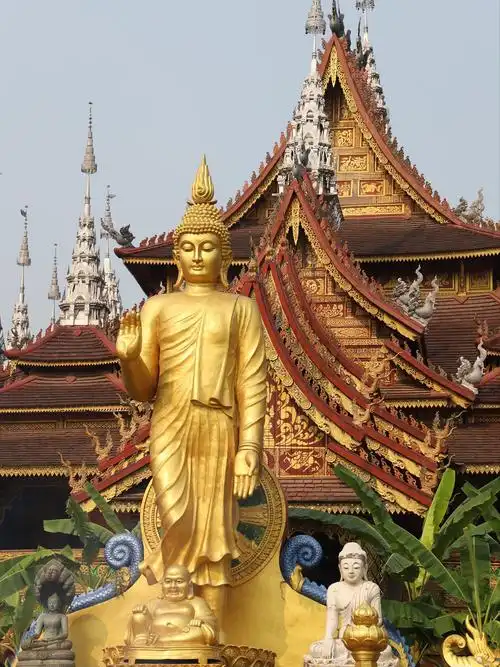 Founded in 615 CE—just as the Tang dynasty was taking shape in northern China—the General Buddhist Temple, or Wabaji, holds the distinction of being the first Theravada Buddhist monastery established in southern Yunnan after the religion spread southward from Southeast Asia. To put this in perspective, the temple was erected in the same era that saw the conversion of Rome's Pantheon into a Christian church and the early Christianization of Anglo-Saxon England. About seven centuries ago it was elevated to the highest-ranking Buddhist seat in the region, serving as the royal chapel of successive Dai kings—comparable in status, perhaps, to the Sainte-Chapelle in Paris or the great monastic cathedrals of medieval Europe.
The current complex, rebuilt between 1989 and 2012, draws on a fusion of Dai vernacular craftsmanship and the gilded aesthetics of mainland Southeast Asia. Brilliant gold facades, sweeping tiered roofs, and the dazzling white stupa at the courtyard's center echo the great wats of Thailand and the pagodas of Myanmar, yet the ornamental flourishes—particularly the twelve zodiac reliefs that ring the main hall—remain distinctly Chinese-Dai. The twin bell and drum towers recall the campanile tradition of Italian church squares, while the surrounding cloisters offer a serene counterpoint to the flamboyant central sanctuary.
Beyond its visual splendor, the temple functions as the living administrative heart of Buddhism in Xishuangbanna, supervising more than 590 branch monasteries. Inside the Vihan main hall, visitors encounter a rare bamboo-woven Buddha figure—an art form virtually unknown outside the region—and a bronze image consecrated by the Supreme Patriarch of Thailand, underscoring the enduring religious links between China's Dai Buddhists and their coreligionists across the Mekong. The temple's collection of palm-leaf sutras, inscribed in Pali script, places it within the same manuscript tradition that gave rise to Southeast Asia's great literary heritage.
The temple sits at 18 Baji Road in Jinghong city, the relaxed capital of Xishuangbanna. Admission is free, and visitors can enter directly through the main gate; those holding a Manting Park ticket may also walk through from inside the park. Opening hours typically run from 8:00 a.m. to 6:00 p.m. Dress is strictly enforced: shoulders and knees must be covered, and visitors in inappropriate attire may be turned away at the entrance. No flash photography is permitted inside the halls, and quiet behavior is expected throughout the grounds.
Allow 30 minutes to an hour for a visit, and aim for late afternoon, around 4 p.m., when the slanting tropical light gilds the rooftops and softens the white stupa into something almost luminous. Pairing the temple with the adjacent Manting Park—one of the former royal gardens—creates a deeply satisfying cultural loop, moving from secular leisure to sacred ritual in the space of a few steps. For travelers who know Angkor Wat or have explored the temples of Chiang Mai, this site offers the rare privilege of witnessing an authentic, working Theravada monastery at the geographic and spiritual crossroads of China and mainland Southeast Asia.
Founded in 615 CE—just as the Tang dynasty was taking shape in northern China—the General Buddhist Temple, or Wabaji, holds the distinction of being the first Theravada Buddhist monastery established in southern Yunnan after the religion spread southward from Southeast Asia. To put this in perspective, the temple was erected in the same era that saw the conversion of Rome's Pantheon into a Christian church and the early Christianization of Anglo-Saxon England. About seven centuries ago it was elevated to the highest-ranking Buddhist seat in the region, serving as the royal chapel of successive Dai kings—comparable in status, perhaps, to the Sainte-Chapelle in Paris or the great monastic cathedrals of medieval Europe.
The current complex, rebuilt between 1989 and 2012, draws on a fusion of Dai vernacular craftsmanship and the gilded aesthetics of mainland Southeast Asia. Brilliant gold facades, sweeping tiered roofs, and the dazzling white stupa at the courtyard's center echo the great wats of Thailand and the pagodas of Myanmar, yet the ornamental flourishes—particularly the twelve zodiac reliefs that ring the main hall—remain distinctly Chinese-Dai. The twin bell and drum towers recall the campanile tradition of Italian church squares, while the surrounding cloisters offer a serene counterpoint to the flamboyant central sanctuary.
Beyond its visual splendor, the temple functions as the living administrative heart of Buddhism in Xishuangbanna, supervising more than 590 branch monasteries. Inside the Vihan main hall, visitors encounter a rare bamboo-woven Buddha figure—an art form virtually unknown outside the region—and a bronze image consecrated by the Supreme Patriarch of Thailand, underscoring the enduring religious links between China's Dai Buddhists and their coreligionists across the Mekong. The temple's collection of palm-leaf sutras, inscribed in Pali script, places it within the same manuscript tradition that gave rise to Southeast Asia's great literary heritage.
The temple sits at 18 Baji Road in Jinghong city, the relaxed capital of Xishuangbanna. Admission is free, and visitors can enter directly through the main gate; those holding a Manting Park ticket may also walk through from inside the park. Opening hours typically run from 8:00 a.m. to 6:00 p.m. Dress is strictly enforced: shoulders and knees must be covered, and visitors in inappropriate attire may be turned away at the entrance. No flash photography is permitted inside the halls, and quiet behavior is expected throughout the grounds.
Allow 30 minutes to an hour for a visit, and aim for late afternoon, around 4 p.m., when the slanting tropical light gilds the rooftops and softens the white stupa into something almost luminous. Pairing the temple with the adjacent Manting Park—one of the former royal gardens—creates a deeply satisfying cultural loop, moving from secular leisure to sacred ritual in the space of a few steps. For travelers who know Angkor Wat or have explored the temples of Chiang Mai, this site offers the rare privilege of witnessing an authentic, working Theravada monastery at the geographic and spiritual crossroads of China and mainland Southeast Asia.