Gaozhuang Xishuangjing Scenic Area
⭐ 4.00
Gaozhuang Xishuangjing Scenic Area, Xishuangbanna, Yunnan Province, China
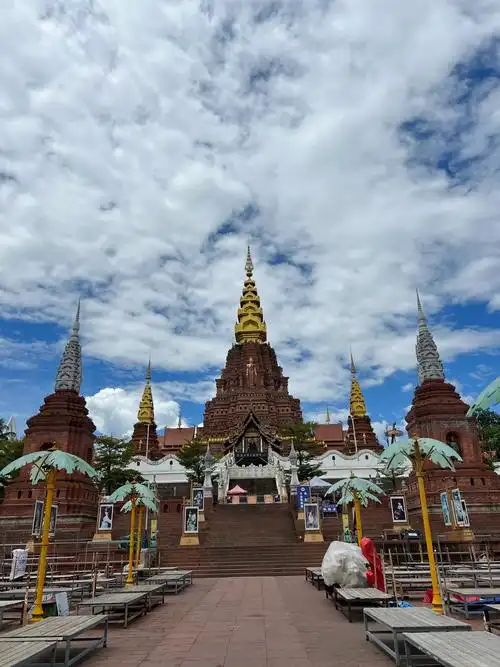 Standing where the ancient Silk Road's southern branch once ferried merchants between Yunnan and the Buddhist courts of Chiang Mai and Luang Prabang, Xishuangbanna remains one of China's most ethnically distinctive regions. The Dai people share linguistic and religious roots with the Thai, Lao, and Shan peoples, and Gaozhuang Xishuangjing deliberately echoes the gilded temple complexes of Luang Prabang, often called the "Pearl of Southeast Asia." The district's golden spires recall the great stupas of Bagan or the gilded chedis of Bangkok, though rendered in a distinctly local vernacular that draws on the warm earth tones of the tropical Mekong basin.
The architectural centerpiece is the 66.6-meter Great Golden Pagoda, a number considered auspicious in Chinese numerology for its repetition of the lucky digit six. Its tiered, tapering silhouette and intricate bas-reliefs mirror the Theravada Buddhist tradition common across mainland Southeast Asia. Throughout the district, buildings wear the characteristic gold-and-crimson palette of Dai temple architecture, with steeply pitched roofs and ornate finials. Come evening, thousands of handcrafted lanterns illuminate the narrow lanes, transforming the complex into something resembling a Mekong Valley version of a European Christmas market—but traded under tropical palms.
Beyond its photogenic appeal, Gaozhuang functions as a living showcase of contemporary Dai culture. Visitors can rent traditional Dai costumes for photography sessions, sample regional specialties like grilled tilapia, sticky rice in bamboo, and pineapple rice, and browse stalls selling handwoven Dai brocade, hill-tribe silver, and Pu'er tea. The night market is less an authentic local marketplace than a curated cultural performance, yet it remains one of the best introductions to southern Yunnan's ethnic diversity and culinary traditions.
Practically speaking, the complex sits just five kilometers from Xishuangbanna Gasa International Airport, with direct shuttle services available. Accommodation ranges from budget hostels to boutique guesthouses—book a room within a five-minute walk of the night market for maximum convenience. Plan to arrive around 5 p.m. to escape the equatorial heat and watch the lighting ceremony transform the district. Entrance to the pagoda interior costs roughly 40 yuan. Expect heavy crowds during summer holidays and Chinese New Year; the August rainy season brings mosquitoes, so pack repellent and a light rain jacket.
Most travelers need only one night here to experience the highlights—use daylight hours for excursions to the spectacular Xishuangbanna Tropical Botanical Garden or the Wild Elephant Valley, both within easy reach, then return for the dazzling evening spectacle. For authentic Pu'er tea and silver jewelry, skip the night market markups and visit reputable shops in Jinghong's old town. Gaozhuang Xishuangjing may be a modern creation, but it offers a uniquely accessible window into a cultural crossroads that has shaped Southeast Asia for over a millennium.
Standing where the ancient Silk Road's southern branch once ferried merchants between Yunnan and the Buddhist courts of Chiang Mai and Luang Prabang, Xishuangbanna remains one of China's most ethnically distinctive regions. The Dai people share linguistic and religious roots with the Thai, Lao, and Shan peoples, and Gaozhuang Xishuangjing deliberately echoes the gilded temple complexes of Luang Prabang, often called the "Pearl of Southeast Asia." The district's golden spires recall the great stupas of Bagan or the gilded chedis of Bangkok, though rendered in a distinctly local vernacular that draws on the warm earth tones of the tropical Mekong basin.
The architectural centerpiece is the 66.6-meter Great Golden Pagoda, a number considered auspicious in Chinese numerology for its repetition of the lucky digit six. Its tiered, tapering silhouette and intricate bas-reliefs mirror the Theravada Buddhist tradition common across mainland Southeast Asia. Throughout the district, buildings wear the characteristic gold-and-crimson palette of Dai temple architecture, with steeply pitched roofs and ornate finials. Come evening, thousands of handcrafted lanterns illuminate the narrow lanes, transforming the complex into something resembling a Mekong Valley version of a European Christmas market—but traded under tropical palms.
Beyond its photogenic appeal, Gaozhuang functions as a living showcase of contemporary Dai culture. Visitors can rent traditional Dai costumes for photography sessions, sample regional specialties like grilled tilapia, sticky rice in bamboo, and pineapple rice, and browse stalls selling handwoven Dai brocade, hill-tribe silver, and Pu'er tea. The night market is less an authentic local marketplace than a curated cultural performance, yet it remains one of the best introductions to southern Yunnan's ethnic diversity and culinary traditions.
Practically speaking, the complex sits just five kilometers from Xishuangbanna Gasa International Airport, with direct shuttle services available. Accommodation ranges from budget hostels to boutique guesthouses—book a room within a five-minute walk of the night market for maximum convenience. Plan to arrive around 5 p.m. to escape the equatorial heat and watch the lighting ceremony transform the district. Entrance to the pagoda interior costs roughly 40 yuan. Expect heavy crowds during summer holidays and Chinese New Year; the August rainy season brings mosquitoes, so pack repellent and a light rain jacket.
Most travelers need only one night here to experience the highlights—use daylight hours for excursions to the spectacular Xishuangbanna Tropical Botanical Garden or the Wild Elephant Valley, both within easy reach, then return for the dazzling evening spectacle. For authentic Pu'er tea and silver jewelry, skip the night market markups and visit reputable shops in Jinghong's old town. Gaozhuang Xishuangjing may be a modern creation, but it offers a uniquely accessible window into a cultural crossroads that has shaped Southeast Asia for over a millennium.