White Dragon Cave
⭐ 3.60
Bailong Cave Scenic Area, You County, Zhuzhou City, Hunan Province, China
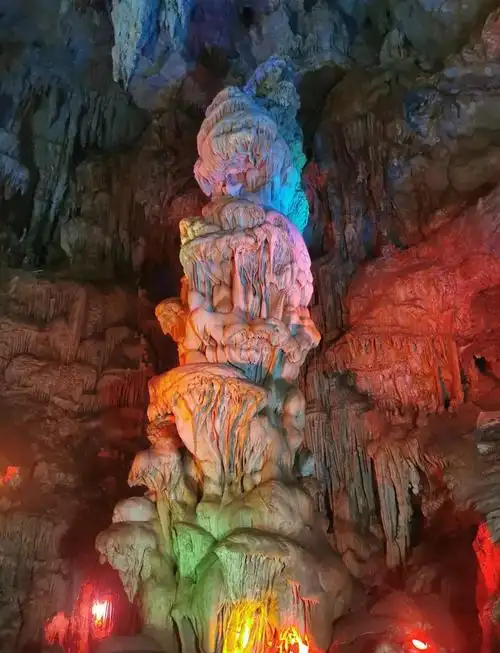 Carved into Carboniferous-era dolomitic limestone laid down roughly 300 million years ago—when the supercontinent Pangaea still existed and vast coal swamps dominated the global landscape—White Dragon Cave ranks among the older accessible cave systems in southern China. The limestone walls formed long before the dinosaurs, during an era when Europe and North America were joined as a single landmass. The cave sits in the northern foothills of the Luoxiao Mountains, a range that served as a remote base for Mao Zedong's revolutionary forces in the late 1920s and today forms the scenic boundary between Hunan and Jiangxi provinces.
At just over one kilometer in length, the cave is modest compared to Europe's sprawling systems such as Slovenia's 24-kilometer Postojna Cave, yet it delivers a remarkably varied experience by dividing its route into a water gallery and a dry chamber. Visitors begin aboard small wooden boats that drift beneath low ceilings where stalactites dangle into still pools, creating reflections that double the visual drama—reminiscent of France's Gouffre de Padirac or the illuminated water passages of Italy's Frasassi. Disembarking, the walking section reveals a dense forest of stalagmites and columns built drop by drop over millions of years.
The cave takes its name from one of its most photographed formations, a flowstone column said to resemble a white horse, evoking the legendary White Dragon Horse—Tang Sanzang's loyal steed in the 16th-century classic Journey to the West, a work that has reached Western audiences through Arthur Waley's translations and countless film and anime adaptations. Other whimsical formations have earned playful names such as "Tang Monk on His Pilgrimage," and local lore credits the cave with associations to benevolent water deities. Referred to locally as "Eastern Hunan's Number One Cave," it has long drawn pilgrims, scholars, and curious travelers seeking its cool, otherworldly atmosphere.
The cave opens daily from 8:00 a.m. to 5:00 p.m., with last admission at closing. Entry costs around 80 yuan for adults, which includes the boat ride and a mandatory guided tour; discounts apply for seniors, students, and children. From Pingxiang, travelers can take the Hukun Expressway south, exiting onto either the G319 or S315 provincial road—a journey of roughly 90 minutes by car. A shuttle bus returns visitors directly to Pingxiang in the late afternoon, and self-driving is straightforward. Tours last 40 to 60 minutes and run at regular intervals throughout the day.
With temperatures holding steady at 21°C (70°F) year-round, the cave offers a blissful respite from Jiangxi's humid summers, when surface temperatures routinely climb above 35°C. Visitors should wear sturdy non-slip footwear—limestone floors remain perpetually damp—and bring their own water, as there are no vending machines inside. The guided format makes this an easy outing for families and geology enthusiasts rather than serious spelunkers. For the best experience, arrive in the morning to avoid the midday tour groups and pair the visit with a stroll through the surrounding Jiubujiang Geopark landscapes.
Carved into Carboniferous-era dolomitic limestone laid down roughly 300 million years ago—when the supercontinent Pangaea still existed and vast coal swamps dominated the global landscape—White Dragon Cave ranks among the older accessible cave systems in southern China. The limestone walls formed long before the dinosaurs, during an era when Europe and North America were joined as a single landmass. The cave sits in the northern foothills of the Luoxiao Mountains, a range that served as a remote base for Mao Zedong's revolutionary forces in the late 1920s and today forms the scenic boundary between Hunan and Jiangxi provinces.
At just over one kilometer in length, the cave is modest compared to Europe's sprawling systems such as Slovenia's 24-kilometer Postojna Cave, yet it delivers a remarkably varied experience by dividing its route into a water gallery and a dry chamber. Visitors begin aboard small wooden boats that drift beneath low ceilings where stalactites dangle into still pools, creating reflections that double the visual drama—reminiscent of France's Gouffre de Padirac or the illuminated water passages of Italy's Frasassi. Disembarking, the walking section reveals a dense forest of stalagmites and columns built drop by drop over millions of years.
The cave takes its name from one of its most photographed formations, a flowstone column said to resemble a white horse, evoking the legendary White Dragon Horse—Tang Sanzang's loyal steed in the 16th-century classic Journey to the West, a work that has reached Western audiences through Arthur Waley's translations and countless film and anime adaptations. Other whimsical formations have earned playful names such as "Tang Monk on His Pilgrimage," and local lore credits the cave with associations to benevolent water deities. Referred to locally as "Eastern Hunan's Number One Cave," it has long drawn pilgrims, scholars, and curious travelers seeking its cool, otherworldly atmosphere.
The cave opens daily from 8:00 a.m. to 5:00 p.m., with last admission at closing. Entry costs around 80 yuan for adults, which includes the boat ride and a mandatory guided tour; discounts apply for seniors, students, and children. From Pingxiang, travelers can take the Hukun Expressway south, exiting onto either the G319 or S315 provincial road—a journey of roughly 90 minutes by car. A shuttle bus returns visitors directly to Pingxiang in the late afternoon, and self-driving is straightforward. Tours last 40 to 60 minutes and run at regular intervals throughout the day.
With temperatures holding steady at 21°C (70°F) year-round, the cave offers a blissful respite from Jiangxi's humid summers, when surface temperatures routinely climb above 35°C. Visitors should wear sturdy non-slip footwear—limestone floors remain perpetually damp—and bring their own water, as there are no vending machines inside. The guided format makes this an easy outing for families and geology enthusiasts rather than serious spelunkers. For the best experience, arrive in the morning to avoid the midday tour groups and pair the visit with a stroll through the surrounding Jiubujiang Geopark landscapes.