Nanyue Happy City
⭐ 4.20
Nanyue Happy City, Hengshan County, Hengyang City, Hunan Province, China
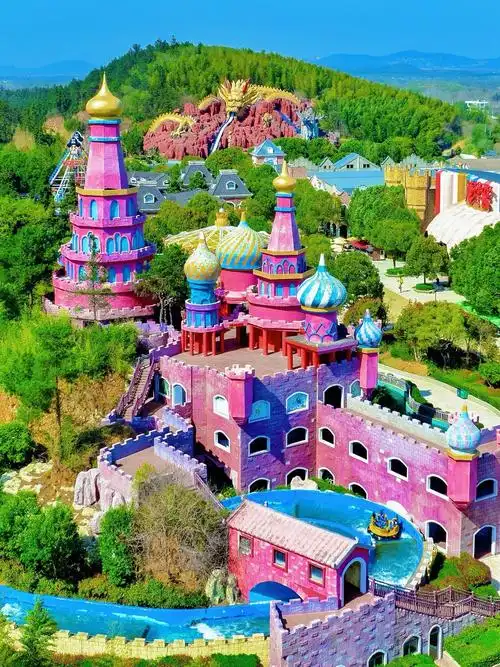 China has celebrated temple fairs—known as miao hui—for over a millennium. Traditionally held at Buddhist and Taoist temples where pilgrims gathered for worship, trade, and revelry, these gatherings date back to the Tang dynasty (618–907 CE). Nanyue, home to Mount Heng and one of China's Five Sacred Mountains, has long hosted such events. The new district echoes Europe's medieval pilgrimage routes like the Camino de Santiago or Bruges' seasonal market squares, but channels that communal spirit into a single nocturnal spectacle blending devotion, commerce, and entertainment.
The district follows a "one lake, one street, one island" configuration centered on Jinyue Lake's southern shore, with the historic Nanyue Old Town as its backdrop. Designers used replica grey-tiled rooftops, sloping eaves, lantern-strung passageways, and timber-framed shopfronts to evoke the guild halls of imperial China. Wandering the cobbled lanes feels like stepping into a Ming-dynasty streetscape—comparable to drifting through Venice's quieter calli or Seville's atmospheric Triana quarter, where every turn reveals another artisan's stall.
Nightly free performances form the district's beating heart, drawing comparisons to Edinburgh's Royal Mile buskers or Seville's flamenco courtyards, only amplified. Highlights include the spectacular "iron flower" show, where smiths beat molten iron into the air, sending showers of golden sparks over the crowd—a folk craft rooted in the Northern Song dynasty. Other acts feature fire-tossing, shadow puppetry, and choreographed water dances on the lake. Photographers and social-media-savvy travelers gravitate here for dramatic light-and-fire compositions.
Over 50 food stalls serve roughly a hundred local specialties, anchoring the temple-fair revival. Expect Hengyang homestyle dishes—smoky stir-fries, fish-ball soup, and lip-tingling Hunan chili preparations—alongside regional fusion snacks. Prices run slightly higher than downtown Hengyang, but variety is unmatched. Think of it as Hengyang's answer to Madrid's Mercado de San Miguel or London's Borough Market: a covered culinary crawl where every dozen steps introduces a new regional flavor paired with steaming woks and shouting vendors.
Entry is completely free and no advance booking is required. The district lies about 20 minutes by car from Hengshan West high-speed rail station or the Nanyue Grand Temple. Arrive after 5:30 PM—the daytime atmosphere is sleepy and shows don't begin until dark. Plan three to four hours: wander the lanes for photos (hanfu costume rental is widely available), sample stall dinners, then settle in for the evening's headline performances along the lakeside boardwalk.
What makes Nanyue Li genuinely distinctive is its fusion of intangible heritage, street-food culture, and modern night tourism into a single accessible package—a model increasingly common across Chinese cities but rarely executed with this theatrical polish. Pair it with a daytime pilgrimage up Mount Heng for blessings, then descend to the fair by evening: a full sensory arc from sacred silence to sizzling spectacle that few destinations can deliver in a single day.
China has celebrated temple fairs—known as miao hui—for over a millennium. Traditionally held at Buddhist and Taoist temples where pilgrims gathered for worship, trade, and revelry, these gatherings date back to the Tang dynasty (618–907 CE). Nanyue, home to Mount Heng and one of China's Five Sacred Mountains, has long hosted such events. The new district echoes Europe's medieval pilgrimage routes like the Camino de Santiago or Bruges' seasonal market squares, but channels that communal spirit into a single nocturnal spectacle blending devotion, commerce, and entertainment.
The district follows a "one lake, one street, one island" configuration centered on Jinyue Lake's southern shore, with the historic Nanyue Old Town as its backdrop. Designers used replica grey-tiled rooftops, sloping eaves, lantern-strung passageways, and timber-framed shopfronts to evoke the guild halls of imperial China. Wandering the cobbled lanes feels like stepping into a Ming-dynasty streetscape—comparable to drifting through Venice's quieter calli or Seville's atmospheric Triana quarter, where every turn reveals another artisan's stall.
Nightly free performances form the district's beating heart, drawing comparisons to Edinburgh's Royal Mile buskers or Seville's flamenco courtyards, only amplified. Highlights include the spectacular "iron flower" show, where smiths beat molten iron into the air, sending showers of golden sparks over the crowd—a folk craft rooted in the Northern Song dynasty. Other acts feature fire-tossing, shadow puppetry, and choreographed water dances on the lake. Photographers and social-media-savvy travelers gravitate here for dramatic light-and-fire compositions.
Over 50 food stalls serve roughly a hundred local specialties, anchoring the temple-fair revival. Expect Hengyang homestyle dishes—smoky stir-fries, fish-ball soup, and lip-tingling Hunan chili preparations—alongside regional fusion snacks. Prices run slightly higher than downtown Hengyang, but variety is unmatched. Think of it as Hengyang's answer to Madrid's Mercado de San Miguel or London's Borough Market: a covered culinary crawl where every dozen steps introduces a new regional flavor paired with steaming woks and shouting vendors.
Entry is completely free and no advance booking is required. The district lies about 20 minutes by car from Hengshan West high-speed rail station or the Nanyue Grand Temple. Arrive after 5:30 PM—the daytime atmosphere is sleepy and shows don't begin until dark. Plan three to four hours: wander the lanes for photos (hanfu costume rental is widely available), sample stall dinners, then settle in for the evening's headline performances along the lakeside boardwalk.
What makes Nanyue Li genuinely distinctive is its fusion of intangible heritage, street-food culture, and modern night tourism into a single accessible package—a model increasingly common across Chinese cities but rarely executed with this theatrical polish. Pair it with a daytime pilgrimage up Mount Heng for blessings, then descend to the fair by evening: a full sensory arc from sacred silence to sizzling spectacle that few destinations can deliver in a single day.