Nantong Grand Theatre
⭐ 4.20
No. 118, Renmin Road, Chongchuan District, Nantong, Jiangsu Province, China
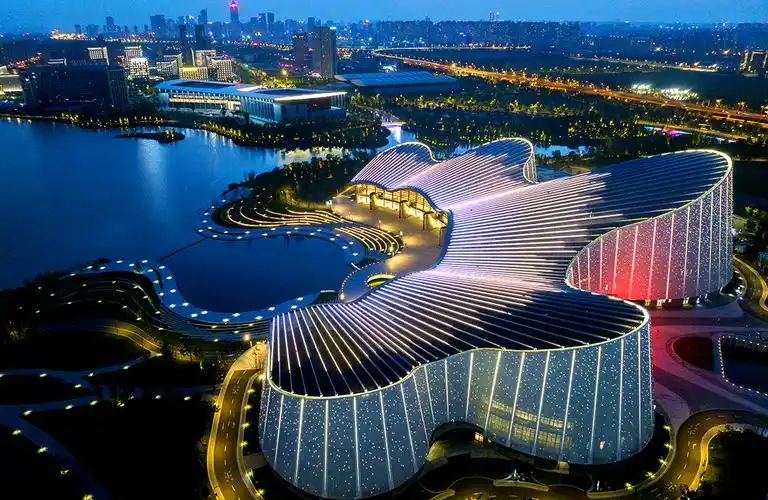 Nantong Grand Theatre opened in 2019 as the cultural heart of the city's Central Innovation District. Its designer, Paul Andreu (1938–2018), was one of France's most celebrated architects, best known for Terminal 1 at Paris's Charles de Gaulle Airport. Andreu's signature approach—blending monumental geometry with luminous forms—finds poetic expression here along the Jiangsu coast. While older Chinese cities preserve imperial legacies, Nantong's ambitious lakeside project echoes the cultural rebirths seen in Bilbao and Barcelona, where a flagship venue transformed a city's global profile. The theatre embodies Nantong's emergence as a creative hub, drawing international talent to a region shaped by textile trade and modern-education pioneer Zhang Jian.
Inspired by the Chinese concept of "Qinshan Zhushui"—"Piano Mountain and Pearl Water"—the building's rippling roof recalls a grand piano's curves and the swirling patterns of auspicious clouds. Facing Zilang Lake, a fully glazed curtain wall dissolves the boundary between interior and waterfront; on the city side, perforated aluminium panels transition from opaque to transparent in a subtle gradient. Inside, the atrium features rippled acoustic ceilings and sections of glass flooring, while the curving roof seems to float above the lake's reflections. At 57 metres tall across seven above-ground floors, the theatre reads as both sculpture and stage—comparable in ambition to Oslo's Opera House or Valencia's Palau de les Arts.
The five interconnected halls make the theatre a versatile cultural venue. The 1,523-seat Opera House and 1,184-seat Concert Hall host symphony orchestras, ballet companies, and touring productions from Europe and Asia. Smaller venues accommodate drama, experimental performances, and a dedicated 300-seat children's theatre—an unusual commitment to young audiences. Acoustics are calibrated with custom GRG wall panels and adjustable reflectors to suit chamber recitals and full-scale opera alike. International companies rotate year-round, placing Nantong alongside Beijing's National Centre for the Performing Arts and Shanghai's Oriental Art Center on China's premier performing-arts circuit.
The theatre sits at 68 Hudong Road, Chongchuan District. Travellers reach it via Metro Line 1 to "Grand Theatre Station," Exit 4, followed by a 600-metre walk. The free public areas—main lobby, café, and outdoor viewing terrace—are typically open 09:00 to 18:00, with no ticket required. To attend a performance, book through the official "Nantong Grand Theatre" WeChat account or website; advance booking is recommended as popular shows sell out quickly. Allow at least an hour for the architecture alone. Halls open 30 minutes before curtain; photography and video are prohibited during performances. Air conditioning is robust in summer, so bring a light layer.
Beyond the spectacle of a single show, the theatre rewards visitors seeking design inspiration, photography opportunities, or a leisurely cultural afternoon. Arrive at dusk to catch the building glowing against the lake—one of the most photogenic vantage points in Jiangsu. Afterwards, stroll along the Zilang Park lakeside promenade, or wander next door to the Nantong Art Museum for contemporary exhibits. Families appreciate dedicated children's programming, while architecture enthusiasts will recognise echoes of Andreu's Parisian legacy translated into a wholly Chinese lakeside setting. In a country of ancient wonders, this serene modern landmark offers a refreshing alternative—where music, water, and light converge into a single unforgettable frame.
Nantong Grand Theatre opened in 2019 as the cultural heart of the city's Central Innovation District. Its designer, Paul Andreu (1938–2018), was one of France's most celebrated architects, best known for Terminal 1 at Paris's Charles de Gaulle Airport. Andreu's signature approach—blending monumental geometry with luminous forms—finds poetic expression here along the Jiangsu coast. While older Chinese cities preserve imperial legacies, Nantong's ambitious lakeside project echoes the cultural rebirths seen in Bilbao and Barcelona, where a flagship venue transformed a city's global profile. The theatre embodies Nantong's emergence as a creative hub, drawing international talent to a region shaped by textile trade and modern-education pioneer Zhang Jian.
Inspired by the Chinese concept of "Qinshan Zhushui"—"Piano Mountain and Pearl Water"—the building's rippling roof recalls a grand piano's curves and the swirling patterns of auspicious clouds. Facing Zilang Lake, a fully glazed curtain wall dissolves the boundary between interior and waterfront; on the city side, perforated aluminium panels transition from opaque to transparent in a subtle gradient. Inside, the atrium features rippled acoustic ceilings and sections of glass flooring, while the curving roof seems to float above the lake's reflections. At 57 metres tall across seven above-ground floors, the theatre reads as both sculpture and stage—comparable in ambition to Oslo's Opera House or Valencia's Palau de les Arts.
The five interconnected halls make the theatre a versatile cultural venue. The 1,523-seat Opera House and 1,184-seat Concert Hall host symphony orchestras, ballet companies, and touring productions from Europe and Asia. Smaller venues accommodate drama, experimental performances, and a dedicated 300-seat children's theatre—an unusual commitment to young audiences. Acoustics are calibrated with custom GRG wall panels and adjustable reflectors to suit chamber recitals and full-scale opera alike. International companies rotate year-round, placing Nantong alongside Beijing's National Centre for the Performing Arts and Shanghai's Oriental Art Center on China's premier performing-arts circuit.
The theatre sits at 68 Hudong Road, Chongchuan District. Travellers reach it via Metro Line 1 to "Grand Theatre Station," Exit 4, followed by a 600-metre walk. The free public areas—main lobby, café, and outdoor viewing terrace—are typically open 09:00 to 18:00, with no ticket required. To attend a performance, book through the official "Nantong Grand Theatre" WeChat account or website; advance booking is recommended as popular shows sell out quickly. Allow at least an hour for the architecture alone. Halls open 30 minutes before curtain; photography and video are prohibited during performances. Air conditioning is robust in summer, so bring a light layer.
Beyond the spectacle of a single show, the theatre rewards visitors seeking design inspiration, photography opportunities, or a leisurely cultural afternoon. Arrive at dusk to catch the building glowing against the lake—one of the most photogenic vantage points in Jiangsu. Afterwards, stroll along the Zilang Park lakeside promenade, or wander next door to the Nantong Art Museum for contemporary exhibits. Families appreciate dedicated children's programming, while architecture enthusiasts will recognise echoes of Andreu's Parisian legacy translated into a wholly Chinese lakeside setting. In a country of ancient wonders, this serene modern landmark offers a refreshing alternative—where music, water, and light converge into a single unforgettable frame.