Fangguang Temple
⭐ 4.50
Fangguang Temple, Hengshan County, Hengyang City, Hunan Province, China
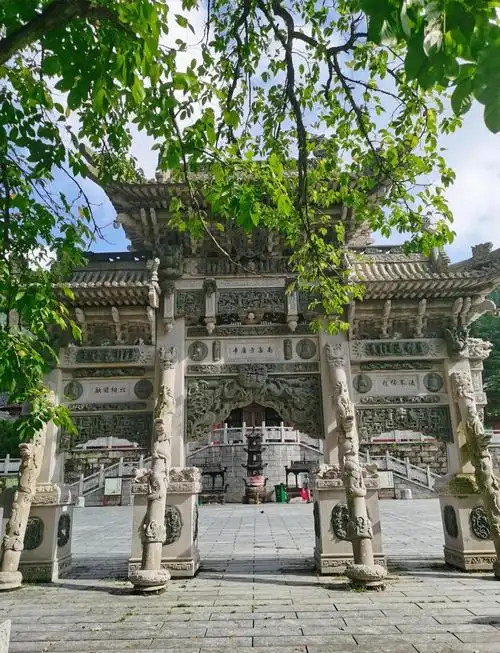 Fangguang Temple traces its origins to 503 AD during the Southern Liang Dynasty, contemporary with the establishment of Benedict's Monte Cassino in Italy. Originally a hermitage beneath Lotus Peak, it grew into one of the most spiritually significant sites on Mount Heng, one of China's five sacred Buddhist mountains. While many European monasteries were sacked during the Viking Age, Fangguang endured through every Chinese dynasty since, weathering wars, persecutions, and revolutions to remain an active sanctuary. Its unbroken continuity makes it a rare survivor among the world's ancient religious sites.
The temple complex rises in tiers that follow the mountain's natural contours rather than imposing rigid geometry. The wooden Buddha triads in the main hall were carved at the temple's founding—roughly contemporary with Japan's great Nara-era sculptures, though executed in a more restrained Chinese style. Their weathered timber forms retain remarkable serenity. Nearby stands the Erxian Shrine honoring the two Confucian scholars, alongside a replica of Emperor Huizong's Song-dynasty plaque reading "Famous Mountain Under Heaven."
What distinguishes Fangguang from most Chinese Buddhist temples is its fusion of Confucian and Buddhist traditions. The 1175 poetry exchange between Zhu Xi, the era's leading Neo-Confucian philosopher, and Zhang Shi echoes the intellectual ferment of 12th-century European scholasticism. Their verses, collected as the Nanyue Changhe Ji, are inscribed on steles scattered through the grounds and along the path to Heisha Pool, creating an open-air museum of Chinese literary culture.
The temple lies deep within the Mount Heng scenic area. From Nanyue Grand Temple or Banshan Pavilion, visitors can hike roughly 45 to 90 minutes along marked forest trails, or take the scenic shuttle bus and walk the final stretch. Sturdy footwear is essential—stone steps grow slippery after rain. The site is free to enter and welcomes both worshippers and travelers. Bring water and snacks; no shops or ATMs are available on site.
For travelers seeking a counterpart to Europe's great mountain monasteries—Montserrat in Spain or the Grande Chartreuse in the French Alps—Fangguang offers similar contemplative remoteness with a distinctly Chinese character. Mornings reward early visitors with mist drifting through ancient cedar groves around the rooftops, a scene unchanged for centuries. An afternoon walk along the creek trail leads to Heisha Pool, where ancient inscriptions blend with cascading water, capped by tea at a simple teahouse—an experience of mindful, meditative wandering Europeans would have recognized instantly.
Fangguang Temple traces its origins to 503 AD during the Southern Liang Dynasty, contemporary with the establishment of Benedict's Monte Cassino in Italy. Originally a hermitage beneath Lotus Peak, it grew into one of the most spiritually significant sites on Mount Heng, one of China's five sacred Buddhist mountains. While many European monasteries were sacked during the Viking Age, Fangguang endured through every Chinese dynasty since, weathering wars, persecutions, and revolutions to remain an active sanctuary. Its unbroken continuity makes it a rare survivor among the world's ancient religious sites.
The temple complex rises in tiers that follow the mountain's natural contours rather than imposing rigid geometry. The wooden Buddha triads in the main hall were carved at the temple's founding—roughly contemporary with Japan's great Nara-era sculptures, though executed in a more restrained Chinese style. Their weathered timber forms retain remarkable serenity. Nearby stands the Erxian Shrine honoring the two Confucian scholars, alongside a replica of Emperor Huizong's Song-dynasty plaque reading "Famous Mountain Under Heaven."
What distinguishes Fangguang from most Chinese Buddhist temples is its fusion of Confucian and Buddhist traditions. The 1175 poetry exchange between Zhu Xi, the era's leading Neo-Confucian philosopher, and Zhang Shi echoes the intellectual ferment of 12th-century European scholasticism. Their verses, collected as the Nanyue Changhe Ji, are inscribed on steles scattered through the grounds and along the path to Heisha Pool, creating an open-air museum of Chinese literary culture.
The temple lies deep within the Mount Heng scenic area. From Nanyue Grand Temple or Banshan Pavilion, visitors can hike roughly 45 to 90 minutes along marked forest trails, or take the scenic shuttle bus and walk the final stretch. Sturdy footwear is essential—stone steps grow slippery after rain. The site is free to enter and welcomes both worshippers and travelers. Bring water and snacks; no shops or ATMs are available on site.
For travelers seeking a counterpart to Europe's great mountain monasteries—Montserrat in Spain or the Grande Chartreuse in the French Alps—Fangguang offers similar contemplative remoteness with a distinctly Chinese character. Mornings reward early visitors with mist drifting through ancient cedar groves around the rooftops, a scene unchanged for centuries. An afternoon walk along the creek trail leads to Heisha Pool, where ancient inscriptions blend with cascading water, capped by tea at a simple teahouse—an experience of mindful, meditative wandering Europeans would have recognized instantly.