Memorial Temple of Su Dongpo
⭐ 2.50
Dengzhou Street, Penglai City, Shandong Province, China
 **A Shrine Born from Five Remarkable Days**
The year 1085 placed Su Shi—a polymath whose talents rival those of Leonardo da Vinci in their variety—at Dengzhou (modern Penglai) as newly appointed magistrate. In barely five days before being recalled to the capital, he drafted memorials urging the Song court to abolish the oppressive salt monopoly and strengthen coastal defenses. This astonishing burst of civic action, commemorated in the Chinese saying "five days at Dengzhou, a thousand years at Su Shrine," transformed the town into a touchstone of Confucian integrity. The shrine itself was erected more than five centuries later, during the twilight years of the Ming Dynasty around 1630, and has weathered 380 winters on this blustery stretch of the Yellow Sea coast.
**Architecture in Miniature**
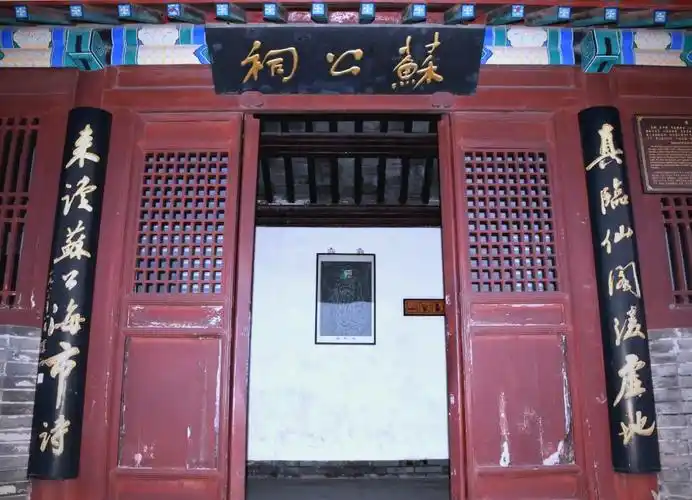
The hall follows a traditional xuan-ting (pavilion-porch) layout—China's equivalent of a small Greek oratory in scale and intimacy. Its understated elegance belies its cultural weight: the entrance plaque bears brushwork by Shu Tong, one of modern China's revered calligraphers, while carved couplets on the gate pillars announce its purpose to arriving pilgrims. Imagine a tiny Wren-era chapel in London transplanted to a cliff edge, and you have the spirit of the place—compact, scholarly, and steeped in atmosphere.
**Treasures Within: Portrait and Poetry in Stone**
The shrine's centerpiece is a stone-rubbing portrait of Su Shi sourced from the original at Guangzhou's Liu Rong Temple, his serene expression gazing across the centuries. Flanking it are more than twenty stelae, but the undisputed stars are the carved versions of Su's own poems "The Sea Market" and "Gazing at the Sea"—works written when he contemplated the same waves visible from the nearby cliffs. A Qing-dynasty copy by the scholar-calligrapher Weng Fanggang adds another layer, much as Renaissance engravers reproduced classical texts for new audiences.
**Practical Information for Visitors**
Su Shrine sits just east of the Wobei Pavilion within the Penglai Pavilion scenic area and requires no separate ticket—your main Penglai admission covers entry. Allow only fifteen to twenty minutes inside, as the space is genuinely compact. Most travelers combine it with the larger Penglai Pavilion complex, the ancient military piers, and the Eight Immortals Crossing the Sea temple; doing so transforms what could be a fleeting stop into a satisfying half-day circuit. A basic familiarity with Su Shi's life story beforehand will deepen your appreciation enormously, though even casual visitors will find the calligraphy visually arresting.
**Who Will Love This Stop**
This is not a monument designed for mass tourism, and casual beachgoers may find it underwhelming. But for travelers interested in Song-dynasty literature, Chinese calligraphy, or the moral traditions of imperial governance, the shrine offers an unusually direct encounter. Think of it as the Chinese cousin of visiting Petrarch's house in Arquà or a bardic memorial in Stratford-upon-Avon—small in footprint, enormous in cultural resonance. Read a few lines of Su's poetry before you go, and the stone carvings will reward you with centuries of human voice.
**A Shrine Born from Five Remarkable Days**
The year 1085 placed Su Shi—a polymath whose talents rival those of Leonardo da Vinci in their variety—at Dengzhou (modern Penglai) as newly appointed magistrate. In barely five days before being recalled to the capital, he drafted memorials urging the Song court to abolish the oppressive salt monopoly and strengthen coastal defenses. This astonishing burst of civic action, commemorated in the Chinese saying "five days at Dengzhou, a thousand years at Su Shrine," transformed the town into a touchstone of Confucian integrity. The shrine itself was erected more than five centuries later, during the twilight years of the Ming Dynasty around 1630, and has weathered 380 winters on this blustery stretch of the Yellow Sea coast.
**Architecture in Miniature**
The hall follows a traditional xuan-ting (pavilion-porch) layout—China's equivalent of a small Greek oratory in scale and intimacy. Its understated elegance belies its cultural weight: the entrance plaque bears brushwork by Shu Tong, one of modern China's revered calligraphers, while carved couplets on the gate pillars announce its purpose to arriving pilgrims. Imagine a tiny Wren-era chapel in London transplanted to a cliff edge, and you have the spirit of the place—compact, scholarly, and steeped in atmosphere.
**Treasures Within: Portrait and Poetry in Stone**
The shrine's centerpiece is a stone-rubbing portrait of Su Shi sourced from the original at Guangzhou's Liu Rong Temple, his serene expression gazing across the centuries. Flanking it are more than twenty stelae, but the undisputed stars are the carved versions of Su's own poems "The Sea Market" and "Gazing at the Sea"—works written when he contemplated the same waves visible from the nearby cliffs. A Qing-dynasty copy by the scholar-calligrapher Weng Fanggang adds another layer, much as Renaissance engravers reproduced classical texts for new audiences.
**Practical Information for Visitors**
Su Shrine sits just east of the Wobei Pavilion within the Penglai Pavilion scenic area and requires no separate ticket—your main Penglai admission covers entry. Allow only fifteen to twenty minutes inside, as the space is genuinely compact. Most travelers combine it with the larger Penglai Pavilion complex, the ancient military piers, and the Eight Immortals Crossing the Sea temple; doing so transforms what could be a fleeting stop into a satisfying half-day circuit. A basic familiarity with Su Shi's life story beforehand will deepen your appreciation enormously, though even casual visitors will find the calligraphy visually arresting.
**Who Will Love This Stop**
This is not a monument designed for mass tourism, and casual beachgoers may find it underwhelming. But for travelers interested in Song-dynasty literature, Chinese calligraphy, or the moral traditions of imperial governance, the shrine offers an unusually direct encounter. Think of it as the Chinese cousin of visiting Petrarch's house in Arquà or a bardic memorial in Stratford-upon-Avon—small in footprint, enormous in cultural resonance. Read a few lines of Su's poetry before you go, and the stone carvings will reward you with centuries of human voice.