Langshan
⭐ 4.60
Langshan Scenic Area, Langshan Town, Tongzhou District, Nantong City, Jiangsu Province, China
 Though modest in stature, Langshan has loomed large in Chinese spiritual life for over thirteen centuries. As the principal of China's Eight Small Buddhist Mountains—comparable in significance to smaller pilgrimage sites like Montserrat in Spain—it is the only sanctuary worldwide honoring Mahasthamaprapta, the Bodhisattva of Spiritual Power. The Tang dynasty (618–907 CE) poet Luo Binwang, one of early China's literary giants whose verses later influenced Western Sinologists and modernists alike, found his final resting place here. Walking these slopes, visitors trace the same paths as Tang pilgrims and Song scholars, with cliff-carved inscriptions still legible after a millennium.
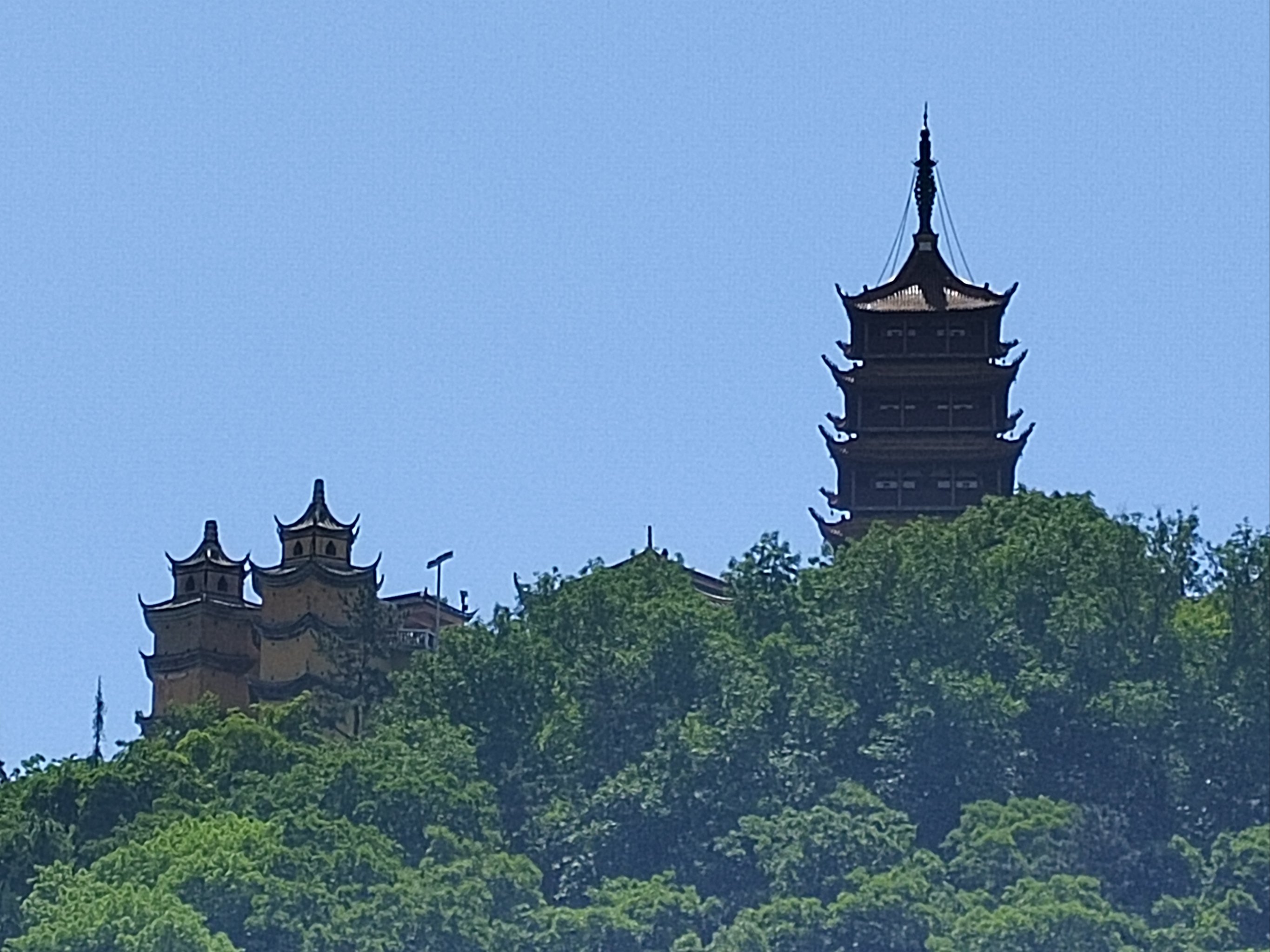
The mountain's architectural heart is Guangjiao Temple, founded in 669 CE during the early Tang—making it a contemporary of Europe's earliest monasteries yet radiating a wholly Eastern aesthetic. Its halls tier up the hillside in classic Song–Ming style, framing the ascent like stations on a sacred journey. Crowning the summit stands the five-story Zhiyun Pagoda, a Northern Song masterpiece whose square silhouette recalls European Romanesque campaniles but serves a distinctly Buddhist purpose—housing sacred relics and offerings. The pagoda has become Langshan's defining emblem, immortalized in paintings for centuries.
Langshan functions as an open-air museum where Buddhist devotion, Tang literary heritage, and modern patriotic memory converge. Beyond the temple complex, Song through Qing dynasty cliff inscriptions transform natural boulders into calligraphy scrolls, each weathered by centuries of monsoons. The mountain also commemorates Bai Yayu, a revolutionary martyr, demonstrating how this sacred site continues absorbing new chapters of national memory. As the symbol of Jianghai (River-Sea) culture, Langshan embodies where China's Buddhist heartland meets its maritime frontier.
Reachable from central Nantong via Bus 45 to the Langshan Visitor Center, the mountain is well-equipped for international tourists. Entry costs approximately 45–50 yuan (around $6–7 USD), with free admission for seniors over 65 and children; an extra small fee applies to climb Zhiyun Pagoda. Opening hours run 7:00 AM to 5:30 PM, with last entry at closing. The surrounding district offers abundant dining and accommodation, and adventurous travelers can combine Langshan with neighboring Junshan and Jianshan. Comfortable walking shoes are essential—though gentle, the 30–45 minute ascent includes many stone steps.
What makes Langshan essential is its improbable density: in a single morning, visitors can worship in a 1,300-year-old temple, climb a Song dynasty pagoda, stand on a Tang poet's grave, and gaze over the world's third-longest river as it births toward the Pacific. The Shanghai-Suzhou-Nantong Bridge—one of the planet's longest cable-stayed crossings—spans the waters below, a contemporary counterpoint to ancient stones. Few sites condense so much Chinese civilization into such a compact climb, making Langshan a perfect day trip for travelers exploring the Yangtze Delta region.
Though modest in stature, Langshan has loomed large in Chinese spiritual life for over thirteen centuries. As the principal of China's Eight Small Buddhist Mountains—comparable in significance to smaller pilgrimage sites like Montserrat in Spain—it is the only sanctuary worldwide honoring Mahasthamaprapta, the Bodhisattva of Spiritual Power. The Tang dynasty (618–907 CE) poet Luo Binwang, one of early China's literary giants whose verses later influenced Western Sinologists and modernists alike, found his final resting place here. Walking these slopes, visitors trace the same paths as Tang pilgrims and Song scholars, with cliff-carved inscriptions still legible after a millennium.
The mountain's architectural heart is Guangjiao Temple, founded in 669 CE during the early Tang—making it a contemporary of Europe's earliest monasteries yet radiating a wholly Eastern aesthetic. Its halls tier up the hillside in classic Song–Ming style, framing the ascent like stations on a sacred journey. Crowning the summit stands the five-story Zhiyun Pagoda, a Northern Song masterpiece whose square silhouette recalls European Romanesque campaniles but serves a distinctly Buddhist purpose—housing sacred relics and offerings. The pagoda has become Langshan's defining emblem, immortalized in paintings for centuries.
Langshan functions as an open-air museum where Buddhist devotion, Tang literary heritage, and modern patriotic memory converge. Beyond the temple complex, Song through Qing dynasty cliff inscriptions transform natural boulders into calligraphy scrolls, each weathered by centuries of monsoons. The mountain also commemorates Bai Yayu, a revolutionary martyr, demonstrating how this sacred site continues absorbing new chapters of national memory. As the symbol of Jianghai (River-Sea) culture, Langshan embodies where China's Buddhist heartland meets its maritime frontier.
Reachable from central Nantong via Bus 45 to the Langshan Visitor Center, the mountain is well-equipped for international tourists. Entry costs approximately 45–50 yuan (around $6–7 USD), with free admission for seniors over 65 and children; an extra small fee applies to climb Zhiyun Pagoda. Opening hours run 7:00 AM to 5:30 PM, with last entry at closing. The surrounding district offers abundant dining and accommodation, and adventurous travelers can combine Langshan with neighboring Junshan and Jianshan. Comfortable walking shoes are essential—though gentle, the 30–45 minute ascent includes many stone steps.
What makes Langshan essential is its improbable density: in a single morning, visitors can worship in a 1,300-year-old temple, climb a Song dynasty pagoda, stand on a Tang poet's grave, and gaze over the world's third-longest river as it births toward the Pacific. The Shanghai-Suzhou-Nantong Bridge—one of the planet's longest cable-stayed crossings—spans the waters below, a contemporary counterpoint to ancient stones. Few sites condense so much Chinese civilization into such a compact climb, making Langshan a perfect day trip for travelers exploring the Yangtze Delta region.