Fisherman's Wharf
⭐ 4.50
Xiangjiang New Area, Hunan, China
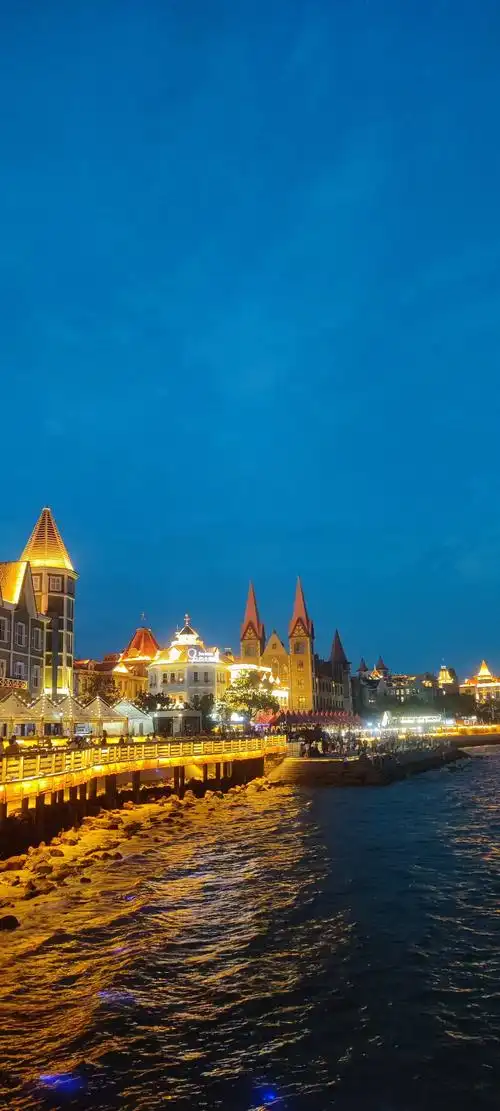 Think of Fisherman's Wharf as Changsha's answer to a Riviera quayside—or, as locals proudly bill it, the city's own stretch of the Seine. Built in the 2010s during Hunan's urban-renewal boom, the complex deliberately revives the European port-town aesthetic that 19th-century treaty ports once introduced to the Yangtze. The result feels familiar to anyone who has strolled Marseille's Vieux-Port or Hamburg's HafenCity, yet it is unmistakably anchored in the Hunan landscape, with Orange Isle and Yuelu Mountain forming a dramatic backdrop across the Xiang.
The architecture is a curated sampler of Western styles—English Tudor half-timbering, French Haussmannian cornices, Italianate arcades, and Spanish-Mediterranean tilework—spread across 23 detached villas. Wrought-iron balconies, a white lighthouse, and arcaded walkways (reminiscent of Havana's Malecón or Lisbon's riverside lanes) create an almost theatrical "old-world" stage set. After dark, the entire façade glows with golden uplighting that shimmers on the water, producing one of central China's most photographed skylines.
Culturally, the wharf is the epicenter of Changsha's celebrated night economy, an unmissable slice of contemporary Hunanese life. The 500-meter food street is dominated by legendary crayfish houses such as Juwei Quji and Tu Xiaoer, where diners crack shells while watching riverboats drift past. Beyond the signature spicy crawfish, you'll find charcoal-grilled meats, Hunan small plates, and craft-beer bars—a sensory immersion into Changsha's famously convivial, no-nonsense dining ethos, where meals average 60–100 RMB per person.
Plan to arrive around 18:30 to catch the sunset, when the Xiang turns copper and Yuelu Mountain's silhouette emerges. The complex is free and open 24 hours, but the magic happens after dark. Take Metro Line 4 to Guanshaling Station, then a 5-minute taxi or bike ride; parking is plentiful if you drive. Note that some waterfront edges lack railings—supervise children, pack mosquito repellent, and bring a light jacket from autumn through spring. Friday and Saturday evenings are busiest; the metro is the easiest way home.
Beyond the wharf itself, the location is a hub for broader exploration. The adjacent "Three Halls and One Museum" cruise pier runs evening boat trips linking Orange Isle (Mao Zedong's youthful haunt) and the Du Fu Riverside Pavilion, a memorial to the Tang-dynasty poet. Pairing Fisherman's Wharf with a daytime climb up Yuelu Mountain—home to the 1,700-year-old Yuelu Academy, a cradle of Chinese intellectual history—makes for a perfectly balanced day, bridging Hunan's ancient heritage with its vibrant, photogenic present.
Think of Fisherman's Wharf as Changsha's answer to a Riviera quayside—or, as locals proudly bill it, the city's own stretch of the Seine. Built in the 2010s during Hunan's urban-renewal boom, the complex deliberately revives the European port-town aesthetic that 19th-century treaty ports once introduced to the Yangtze. The result feels familiar to anyone who has strolled Marseille's Vieux-Port or Hamburg's HafenCity, yet it is unmistakably anchored in the Hunan landscape, with Orange Isle and Yuelu Mountain forming a dramatic backdrop across the Xiang.
The architecture is a curated sampler of Western styles—English Tudor half-timbering, French Haussmannian cornices, Italianate arcades, and Spanish-Mediterranean tilework—spread across 23 detached villas. Wrought-iron balconies, a white lighthouse, and arcaded walkways (reminiscent of Havana's Malecón or Lisbon's riverside lanes) create an almost theatrical "old-world" stage set. After dark, the entire façade glows with golden uplighting that shimmers on the water, producing one of central China's most photographed skylines.
Culturally, the wharf is the epicenter of Changsha's celebrated night economy, an unmissable slice of contemporary Hunanese life. The 500-meter food street is dominated by legendary crayfish houses such as Juwei Quji and Tu Xiaoer, where diners crack shells while watching riverboats drift past. Beyond the signature spicy crawfish, you'll find charcoal-grilled meats, Hunan small plates, and craft-beer bars—a sensory immersion into Changsha's famously convivial, no-nonsense dining ethos, where meals average 60–100 RMB per person.
Plan to arrive around 18:30 to catch the sunset, when the Xiang turns copper and Yuelu Mountain's silhouette emerges. The complex is free and open 24 hours, but the magic happens after dark. Take Metro Line 4 to Guanshaling Station, then a 5-minute taxi or bike ride; parking is plentiful if you drive. Note that some waterfront edges lack railings—supervise children, pack mosquito repellent, and bring a light jacket from autumn through spring. Friday and Saturday evenings are busiest; the metro is the easiest way home.
Beyond the wharf itself, the location is a hub for broader exploration. The adjacent "Three Halls and One Museum" cruise pier runs evening boat trips linking Orange Isle (Mao Zedong's youthful haunt) and the Du Fu Riverside Pavilion, a memorial to the Tang-dynasty poet. Pairing Fisherman's Wharf with a daytime climb up Yuelu Mountain—home to the 1,700-year-old Yuelu Academy, a cradle of Chinese intellectual history—makes for a perfectly balanced day, bridging Hunan's ancient heritage with its vibrant, photogenic present.