Tongtian Cave
⭐ 3.60
Tongtian Cave Scenic Area, Yuping Town, Libo County, Qiannan Prefecture, Guizhou Province, China
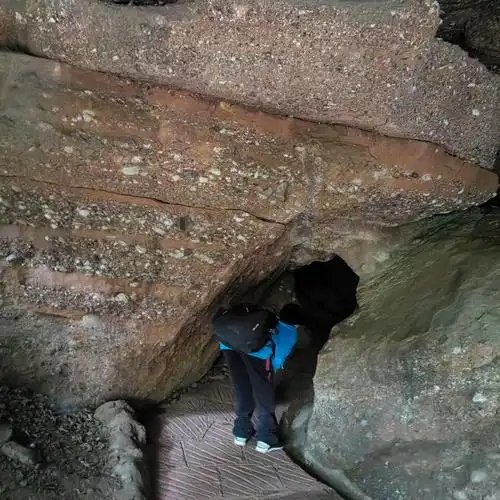 The cave system originated roughly 370 million years ago during the Devonian period—an era when Earth's first forests were spreading across continents and long before dinosaurs roamed the planet. Geologists classify it as a textbook example of subtropical karst topography, formed through the same slow dissolution processes that created Europe's celebrated Postojna Cave in Slovenia and the limestone labyrinths of England's Mendip Hills. The 10-kilometer network comprises two main passages, eight branches, and five themed chambers grandly named after celestial concepts: Heaven's Way, Heaven's Palace, Heaven's Street, Heaven's Grace, and Heaven's Buddha.
For nearly four hundred million years, mineral-rich waters have sculpted dense clusters of stalactites, stalagmites, columns, and stone curtains within Tian Cave. Visitors walk along relatively flat concrete pathways—a welcome contrast to the more strenuous climbs required at caves like Kentucky's Mammoth Cave—making the site unusually accessible for families and older travelers. Modern LED lighting paints the caverns in vivid hues, though purists may find the effects somewhat theatrical compared to the untouched natural darkness preserved in Slovenia's Skocjan or France's Gouffre de Padirac. The chambers' sheer scale rivals many European show caves.
Outside the cave entrance, a reconstructed Buyi ethnic village invites visitors into the living culture of southern Guizhou. The Buyi people, one of China's larger ethnic minorities, welcome guests with traditional "blocking-door wine" ceremonies, mountain singing duets, and demonstrations of handloom weaving—customs that echo folk traditions found across rural Southeast Asia and parts of pre-industrial Europe. Adjacent attractions include a medicinal dendrobium orchid garden and an imperial-style flower park, reflecting a contemporary Chinese tourism trend of blending geological wonders with agricultural heritage and ethnic experiences.
Entry costs roughly 80–120 RMB, though travelers should call ahead (0854-8888868) to confirm whether shuttle services are included. The cave opens daily from 8:30 a.m. to 5:00 p.m. and lies about 13 kilometers from Dushan County town, a 30-minute drive from the new Dushan East high-speed rail station on the Guiyang-Nanning line. Drivers can exit the Lan-Hai Expressway at Dushan, where parking is available on-site. Allow 2–3 hours for the cave itself and 3–4 hours for the entire complex including the ethnic village and gardens.
Inside, temperatures remain a steady 15–18°C year-round, so a light jacket is advisable even in summer. Wear sturdy, non-slip footwear, as limestone surfaces can be slick with condensation. A new "magic carpet" slide adds lighthearted fun for children. Tian Cave will not match the UNESCO-protected drama of Vietnam's Phong Nha or France's Dordogne caves, but its combination of gentle walking paths, spacious chambers, and cultural encounters makes it an ideal introduction to China's karst country for first-time visitors and a comfortable waypoint on any southern Guizhou itinerary.
The cave system originated roughly 370 million years ago during the Devonian period—an era when Earth's first forests were spreading across continents and long before dinosaurs roamed the planet. Geologists classify it as a textbook example of subtropical karst topography, formed through the same slow dissolution processes that created Europe's celebrated Postojna Cave in Slovenia and the limestone labyrinths of England's Mendip Hills. The 10-kilometer network comprises two main passages, eight branches, and five themed chambers grandly named after celestial concepts: Heaven's Way, Heaven's Palace, Heaven's Street, Heaven's Grace, and Heaven's Buddha.
For nearly four hundred million years, mineral-rich waters have sculpted dense clusters of stalactites, stalagmites, columns, and stone curtains within Tian Cave. Visitors walk along relatively flat concrete pathways—a welcome contrast to the more strenuous climbs required at caves like Kentucky's Mammoth Cave—making the site unusually accessible for families and older travelers. Modern LED lighting paints the caverns in vivid hues, though purists may find the effects somewhat theatrical compared to the untouched natural darkness preserved in Slovenia's Skocjan or France's Gouffre de Padirac. The chambers' sheer scale rivals many European show caves.
Outside the cave entrance, a reconstructed Buyi ethnic village invites visitors into the living culture of southern Guizhou. The Buyi people, one of China's larger ethnic minorities, welcome guests with traditional "blocking-door wine" ceremonies, mountain singing duets, and demonstrations of handloom weaving—customs that echo folk traditions found across rural Southeast Asia and parts of pre-industrial Europe. Adjacent attractions include a medicinal dendrobium orchid garden and an imperial-style flower park, reflecting a contemporary Chinese tourism trend of blending geological wonders with agricultural heritage and ethnic experiences.
Entry costs roughly 80–120 RMB, though travelers should call ahead (0854-8888868) to confirm whether shuttle services are included. The cave opens daily from 8:30 a.m. to 5:00 p.m. and lies about 13 kilometers from Dushan County town, a 30-minute drive from the new Dushan East high-speed rail station on the Guiyang-Nanning line. Drivers can exit the Lan-Hai Expressway at Dushan, where parking is available on-site. Allow 2–3 hours for the cave itself and 3–4 hours for the entire complex including the ethnic village and gardens.
Inside, temperatures remain a steady 15–18°C year-round, so a light jacket is advisable even in summer. Wear sturdy, non-slip footwear, as limestone surfaces can be slick with condensation. A new "magic carpet" slide adds lighthearted fun for children. Tian Cave will not match the UNESCO-protected drama of Vietnam's Phong Nha or France's Dordogne caves, but its combination of gentle walking paths, spacious chambers, and cultural encounters makes it an ideal introduction to China's karst country for first-time visitors and a comfortable waypoint on any southern Guizhou itinerary.