Maolan National Nature Reserve
⭐ 4.20
Maolan Town, Libo County, Qiannan Autonomous Prefecture, Guizhou Province, China
 Maolan was established in 1988 and joined UNESCO's Man and the Biosphere Programme in 1996, before being inscribed in 2007 as a cornerstone of the South China Karst World Heritage Site. Its remote setting and enclosed topography have shielded a pristine karst ecosystem that scientists consider almost miraculous at this latitude, where comparable forests in Europe, Africa, and the Americas have long since vanished. Like the Cévennes in France or parts of the Apennines, it represents a vanishing Mediterranean-climate biome, yet it is far older, wilder, and more biodiverse. Its international standing in ecological research is genuinely formidable.
The landscape is a textbook lesson in karst geology, where limestone dissolved over hundreds of millions of years has sculpted a dreamscape of conical peaks, sinkholes, dolines, underground rivers, and cathedral-like caves. Botanists have catalogued more than 3,384 higher plant species and 588 vertebrate species, while the forest canopy exceeds 87 percent coverage, generating extraordinarily high concentrations of negative oxygen ions that visitors feel almost immediately. The celebrated "stone-top forests" and funnel-shaped doline forests are visually arresting phenomena found virtually nowhere else on Earth in such concentration.
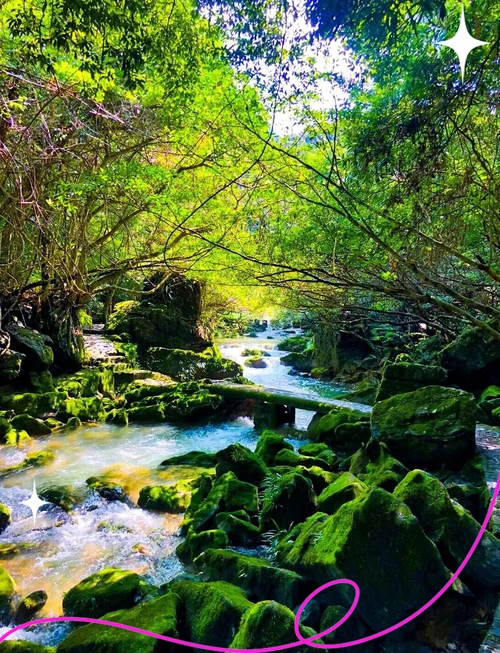
Water defines the park's soul. The Azure Dragon Pool glows an almost surreal jade-blue, while Azure Dragon Stream cascades in delicate bridal-veil waterfalls and Crab Stream offers gentle wading pools perfect for families. Easy interpretive trails link these features in two to three hours, suitable for children and casual walkers. More ambitious hikers can tackle the 12 to 15-kilometer intermediate route from the doline forest through to Golden Lion Cave, descending into four undeveloped caverns and gazing down into spectacular "green whirlpool" sinkholes, an unforgettable adventure for those with reasonable fitness.
Beyond its geology, Maolan shelters vibrant cultural heritage. Yao and Buyi villages such as Yaogu preserve complete stilted timber house clusters where elders still practise ancient papermaking and rice-wine fermentation using techniques passed down for centuries. These living communities offer an authentic cultural counterpoint to the natural wonders, much like a remote Alpine hamlet beside a glacier, though the traditions here are distinctly southwestern Chinese. Local Buyi guides can arrange village homestays that directly support conservation efforts.
Practicalities are refreshingly straightforward. Entry to the eco-tourism zone costs around 50 yuan per person, valid for multiple entries during its validity period, with optional sightseeing buses at roughly 50 yuan. The best seasons are April to May and September to November, when temperatures are mild and mosquitoes minimal; summer brings dramatic waterfalls but also humidity and biting insects. Sturdy water shoes, quick-dry long sleeves and trousers, headlamps, rain gear, and repellent are essential, as is hiring a licensed local guide for any cave exploration or unmarked terrain. Mobile signal is patchy, the caves have no installed lighting, and unauthorized wandering is strongly discouraged to protect this irreplaceable wilderness for future generations.
Maolan was established in 1988 and joined UNESCO's Man and the Biosphere Programme in 1996, before being inscribed in 2007 as a cornerstone of the South China Karst World Heritage Site. Its remote setting and enclosed topography have shielded a pristine karst ecosystem that scientists consider almost miraculous at this latitude, where comparable forests in Europe, Africa, and the Americas have long since vanished. Like the Cévennes in France or parts of the Apennines, it represents a vanishing Mediterranean-climate biome, yet it is far older, wilder, and more biodiverse. Its international standing in ecological research is genuinely formidable.
The landscape is a textbook lesson in karst geology, where limestone dissolved over hundreds of millions of years has sculpted a dreamscape of conical peaks, sinkholes, dolines, underground rivers, and cathedral-like caves. Botanists have catalogued more than 3,384 higher plant species and 588 vertebrate species, while the forest canopy exceeds 87 percent coverage, generating extraordinarily high concentrations of negative oxygen ions that visitors feel almost immediately. The celebrated "stone-top forests" and funnel-shaped doline forests are visually arresting phenomena found virtually nowhere else on Earth in such concentration.
Water defines the park's soul. The Azure Dragon Pool glows an almost surreal jade-blue, while Azure Dragon Stream cascades in delicate bridal-veil waterfalls and Crab Stream offers gentle wading pools perfect for families. Easy interpretive trails link these features in two to three hours, suitable for children and casual walkers. More ambitious hikers can tackle the 12 to 15-kilometer intermediate route from the doline forest through to Golden Lion Cave, descending into four undeveloped caverns and gazing down into spectacular "green whirlpool" sinkholes, an unforgettable adventure for those with reasonable fitness.
Beyond its geology, Maolan shelters vibrant cultural heritage. Yao and Buyi villages such as Yaogu preserve complete stilted timber house clusters where elders still practise ancient papermaking and rice-wine fermentation using techniques passed down for centuries. These living communities offer an authentic cultural counterpoint to the natural wonders, much like a remote Alpine hamlet beside a glacier, though the traditions here are distinctly southwestern Chinese. Local Buyi guides can arrange village homestays that directly support conservation efforts.
Practicalities are refreshingly straightforward. Entry to the eco-tourism zone costs around 50 yuan per person, valid for multiple entries during its validity period, with optional sightseeing buses at roughly 50 yuan. The best seasons are April to May and September to November, when temperatures are mild and mosquitoes minimal; summer brings dramatic waterfalls but also humidity and biting insects. Sturdy water shoes, quick-dry long sleeves and trousers, headlamps, rain gear, and repellent are essential, as is hiring a licensed local guide for any cave exploration or unmarked terrain. Mobile signal is patchy, the caves have no installed lighting, and unauthorized wandering is strongly discouraged to protect this irreplaceable wilderness for future generations.