Songluo Trail
⭐ 4.20
Songluo Trail, Xiulin Township, Hualien County, Taiwan Province, China
 The Songluo Trail follows in the footsteps of Taiwan's indigenous Atayal people, whose ancestors once used this ridgeline to track deer, wild boar, and mountain goats through the central mountain ranges. Modern Taiwan has designated it the country's sixth official national forest trail, placing it in the same protected category as America's Appalachian paths or Scotland's historic drovers' roads—a corridor where travellers literally retrace centuries-old footsteps. The route stands as a living bridge between Aboriginal land stewardship traditions and contemporary conservation practice, offering a quiet window into a heritage most Western visitors would otherwise never encounter.
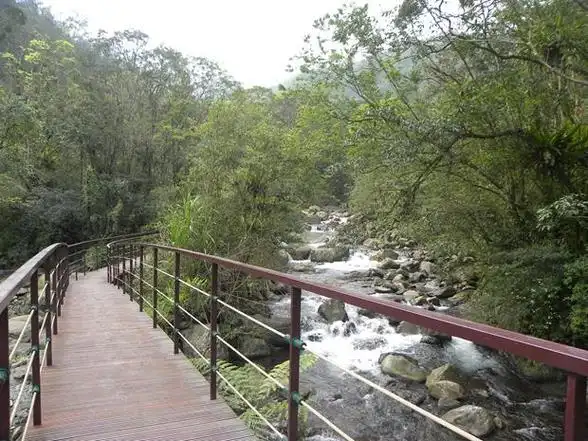
A 2.4-kilometre ribbon of packed earth and stone, the path rises and falls almost imperceptibly—nothing like the thigh-busting climbs of Peru's Inca Trail or Europe's Tour du Mont Blanc. Several charming wooden suspension bridges and bamboo footbridges hopscotch across the Songluo Stream, while the celebrated Bird's Nest Fern Tunnel arches overhead in a cool canopy of emerald fronds. The simplicity of its construction—respectful timber and stone, with nary a slab of concrete—echoes the design ethos of Japan's Kumano Kodo pilgrimage ways rather than over-engineered European park paths.
The Atayal, one of Taiwan's officially recognized indigenous groups, share deep cultural ties with highland peoples across Southeast Asia and the Pacific, and this trail preserves a tangible record of their traditional relationship with mountain streams. The standout ecological achievement is Taiwan's "stream-closure fish protection" policy, which has transformed the creek into one of the island's showcase conservation success stories—shovel-jaw fish, locally called "bitter-flower fish," dart in silvery schools plainly visible from the bank. In warmer months, fireflies flicker above the water after dusk, and moisture-loving ferns, figs, and wild gingers cling to nearly every available branch.
Reach the trailhead via a roughly one-hour bus ride from the laid-back township of Luodong, catching a coach bound for Lishan and alighting at the Songluo stop. Self-drivers must park before the entrance checkpoint, since private vehicles are barred from the protected core. Crucially, the path opens only on Sundays—weekday closures shield recovering wildlife—admission is free, and guards at the gate will screen visitors. There are no restrooms, no food vendors, and no lighting once darkness falls, so bring water, snacks, a headlamp, insect repellent, and a light jacket.
Strict rules prohibit wading, fishing, feeding the fish, picking plants, or leaving any trace—violations can carry fines under Taiwanese environmental law. The bamboo bridges grow treacherous when wet, so sturdy non-slip footwear is essential; think of the difficulty as roughly equivalent to a gentle English countryside footpath rather than a mountain scramble. English is limited among local volunteers, so downloading an offline map before departure is strongly advised.
For travellers seeking an antidote to the commercial bustle of Sun Moon Lake or the heavier traffic of Taroko Gorge, Songluo offers an unhurried encounter with a living mountain river, intact Atayal heritage, and a working model of grassroots stream conservation. Few places in East Asia let casual visitors watch protected native fish darting through crystalline pools, cross hand-built suspension bridges, and breathe in centuries-old primary forest—all within a single morning's outing. It captures the gentler, more contemplative side of Taiwan that mass tourism rarely touches, making it a quietly unforgettable stop for curious explorers drawn to nature, culture, and the older rhythms of indigenous land stewardship.
The Songluo Trail follows in the footsteps of Taiwan's indigenous Atayal people, whose ancestors once used this ridgeline to track deer, wild boar, and mountain goats through the central mountain ranges. Modern Taiwan has designated it the country's sixth official national forest trail, placing it in the same protected category as America's Appalachian paths or Scotland's historic drovers' roads—a corridor where travellers literally retrace centuries-old footsteps. The route stands as a living bridge between Aboriginal land stewardship traditions and contemporary conservation practice, offering a quiet window into a heritage most Western visitors would otherwise never encounter.
A 2.4-kilometre ribbon of packed earth and stone, the path rises and falls almost imperceptibly—nothing like the thigh-busting climbs of Peru's Inca Trail or Europe's Tour du Mont Blanc. Several charming wooden suspension bridges and bamboo footbridges hopscotch across the Songluo Stream, while the celebrated Bird's Nest Fern Tunnel arches overhead in a cool canopy of emerald fronds. The simplicity of its construction—respectful timber and stone, with nary a slab of concrete—echoes the design ethos of Japan's Kumano Kodo pilgrimage ways rather than over-engineered European park paths.
The Atayal, one of Taiwan's officially recognized indigenous groups, share deep cultural ties with highland peoples across Southeast Asia and the Pacific, and this trail preserves a tangible record of their traditional relationship with mountain streams. The standout ecological achievement is Taiwan's "stream-closure fish protection" policy, which has transformed the creek into one of the island's showcase conservation success stories—shovel-jaw fish, locally called "bitter-flower fish," dart in silvery schools plainly visible from the bank. In warmer months, fireflies flicker above the water after dusk, and moisture-loving ferns, figs, and wild gingers cling to nearly every available branch.
Reach the trailhead via a roughly one-hour bus ride from the laid-back township of Luodong, catching a coach bound for Lishan and alighting at the Songluo stop. Self-drivers must park before the entrance checkpoint, since private vehicles are barred from the protected core. Crucially, the path opens only on Sundays—weekday closures shield recovering wildlife—admission is free, and guards at the gate will screen visitors. There are no restrooms, no food vendors, and no lighting once darkness falls, so bring water, snacks, a headlamp, insect repellent, and a light jacket.
Strict rules prohibit wading, fishing, feeding the fish, picking plants, or leaving any trace—violations can carry fines under Taiwanese environmental law. The bamboo bridges grow treacherous when wet, so sturdy non-slip footwear is essential; think of the difficulty as roughly equivalent to a gentle English countryside footpath rather than a mountain scramble. English is limited among local volunteers, so downloading an offline map before departure is strongly advised.
For travellers seeking an antidote to the commercial bustle of Sun Moon Lake or the heavier traffic of Taroko Gorge, Songluo offers an unhurried encounter with a living mountain river, intact Atayal heritage, and a working model of grassroots stream conservation. Few places in East Asia let casual visitors watch protected native fish darting through crystalline pools, cross hand-built suspension bridges, and breathe in centuries-old primary forest—all within a single morning's outing. It captures the gentler, more contemplative side of Taiwan that mass tourism rarely touches, making it a quietly unforgettable stop for curious explorers drawn to nature, culture, and the older rhythms of indigenous land stewardship.