Guoshang Cemetery
⭐ 4.80
Guoshang Cemetery, Tengchong City, Baoshan City, Yunnan Province, China
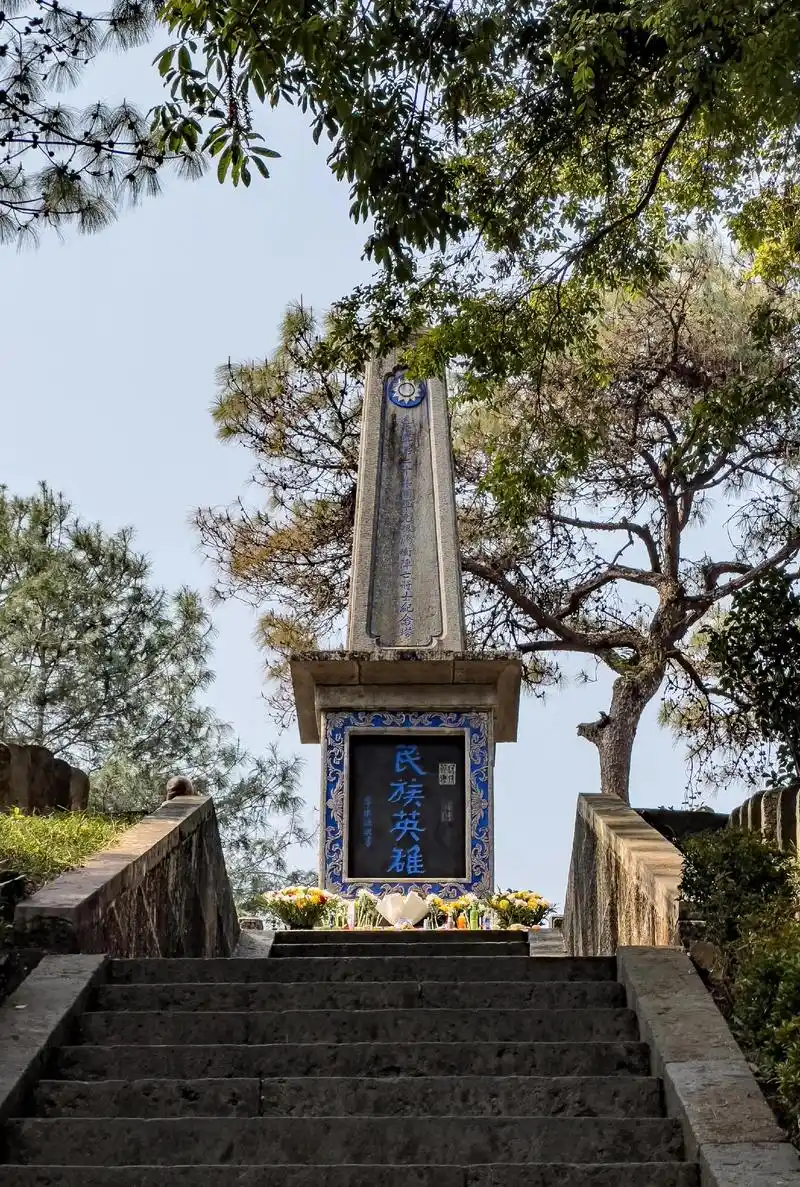 By 1942, Japan's seizure of Burma had severed China's last overland supply route, forcing General Joseph Stilwell's forces into a brutal retreat through the Hukawng Valley and Imphal. The 1944 counter-offensive that reopened the Burma Road and pushed into western Yunnan ranks among the war's most punishing campaigns, comparable in scale and sacrifice to the American push through Normandy's hedgerows or the Anzac advance at Gallipoli. When Tengchong finally fell after weeks of house-to-house combat, more than nine thousand Chinese soldiers lay dead on the battlefield. Within months, crews began laying out this cemetery, completing it in July 1945 just weeks before Japan's surrender, as a national act of remembrance.
The design draws directly on the axial, hillside-temple tradition exemplified by Sun Yat-sen's mausoleum in Nanjing, lifting visitors along a central processional way from the entrance plaza through the Zhonglie Shrine and on to the summit memorial tower. From that stone obelisk, rows of small earthen mounds radiate outward like the spokes of a wheel, each marking a name carved into the surrounding stone galleries. Flanking the Chinese graves stand smaller memorials to American fallen and a controversial Japanese tomb, a tripartite arrangement that consciously frames the conflict as both a Sino-Japanese war and a chapter of the larger Allied struggle.
Designated a national key cultural heritage site and a state-level AAAA scenic area, the cemetery now operates jointly with the adjacent Western Yunnan Anti-Japanese War Memorial Museum, where artifacts, period film, and recreated bunkers put the Burma campaign into wider Allied context. For overseas visitors used to the quiet lawns of Normandy or the bronze panels at Manila, the experience here is at once familiar and distinctly Chinese: the literary allusion in the name Guo Shang, drawn from the poet Qu Yuan's lament for his country's fallen, sets the entire site within a tradition of mourning that stretches back more than two millennia.
Entry is free but requires advance real-name reservation and the original of a passport or ID card. The grounds are open Tuesday through Sunday from 9 a.m. to 5 or 5:30 p.m. and closed on Mondays except during national holidays. Allow two to three hours: start in the museum to grasp the military narrative, then walk the central axis in silence. Phones should be set to silent, flash and tripods are prohibited, and visitors are asked to dress soberly; white chrysanthemums, available locally, are the customary offering at the graves.
Beyond the cemetery itself, the adjacent Dieshui River waterfall tumbles past the gate and offers a few minutes of scenic relief, while a short drive brings you to the cobbled lanes and library halls of Heshun Old Town, a half-day pairing that makes a comfortable day from either Tengchong city or the border crossings with Myanmar. Come at opening time or near dusk, when the mountain light softens and the rows of graves read more clearly as individual stories rather than statistics. Few sites in Asia bring home the human cost of the Second World War with such quiet, deliberate gravity.
By 1942, Japan's seizure of Burma had severed China's last overland supply route, forcing General Joseph Stilwell's forces into a brutal retreat through the Hukawng Valley and Imphal. The 1944 counter-offensive that reopened the Burma Road and pushed into western Yunnan ranks among the war's most punishing campaigns, comparable in scale and sacrifice to the American push through Normandy's hedgerows or the Anzac advance at Gallipoli. When Tengchong finally fell after weeks of house-to-house combat, more than nine thousand Chinese soldiers lay dead on the battlefield. Within months, crews began laying out this cemetery, completing it in July 1945 just weeks before Japan's surrender, as a national act of remembrance.
The design draws directly on the axial, hillside-temple tradition exemplified by Sun Yat-sen's mausoleum in Nanjing, lifting visitors along a central processional way from the entrance plaza through the Zhonglie Shrine and on to the summit memorial tower. From that stone obelisk, rows of small earthen mounds radiate outward like the spokes of a wheel, each marking a name carved into the surrounding stone galleries. Flanking the Chinese graves stand smaller memorials to American fallen and a controversial Japanese tomb, a tripartite arrangement that consciously frames the conflict as both a Sino-Japanese war and a chapter of the larger Allied struggle.
Designated a national key cultural heritage site and a state-level AAAA scenic area, the cemetery now operates jointly with the adjacent Western Yunnan Anti-Japanese War Memorial Museum, where artifacts, period film, and recreated bunkers put the Burma campaign into wider Allied context. For overseas visitors used to the quiet lawns of Normandy or the bronze panels at Manila, the experience here is at once familiar and distinctly Chinese: the literary allusion in the name Guo Shang, drawn from the poet Qu Yuan's lament for his country's fallen, sets the entire site within a tradition of mourning that stretches back more than two millennia.
Entry is free but requires advance real-name reservation and the original of a passport or ID card. The grounds are open Tuesday through Sunday from 9 a.m. to 5 or 5:30 p.m. and closed on Mondays except during national holidays. Allow two to three hours: start in the museum to grasp the military narrative, then walk the central axis in silence. Phones should be set to silent, flash and tripods are prohibited, and visitors are asked to dress soberly; white chrysanthemums, available locally, are the customary offering at the graves.
Beyond the cemetery itself, the adjacent Dieshui River waterfall tumbles past the gate and offers a few minutes of scenic relief, while a short drive brings you to the cobbled lanes and library halls of Heshun Old Town, a half-day pairing that makes a comfortable day from either Tengchong city or the border crossings with Myanmar. Come at opening time or near dusk, when the mountain light softens and the rows of graves read more clearly as individual stories rather than statistics. Few sites in Asia bring home the human cost of the Second World War with such quiet, deliberate gravity.