Tengchong Confucian Temple
⭐ 4.20
Wenmiao Street, Tengyue Town, Tengchong City, Baoshan City, Yunnan Province, China
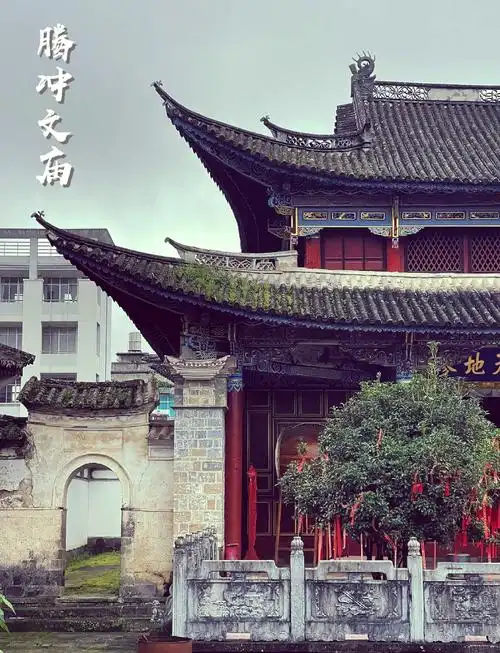 Built during the Ming Dynasty's Chenghua reign in 1480—just as the Medici were patronizing Renaissance Florence—this temple marks the southernmost frontier of Confucian civilization. Like Oxford's medieval colleges that anchored learning in remote English towns, the academy represents how Chinese imperial scholarship was deliberately transplanted to border regions. The complex survived the devastating 1944 Battle of Tengchong, when Chinese forces expelled Japanese occupiers and reduced much of the ancient town to ruins. A Qing-era "Zhonghe Weiyu" plaque from the reign of Emperor Xuantong (the last emperor) remains preserved inside, offering tangible evidence of late-imperial scholarly life.
The architectural layout follows strict Confucian principles of central symmetry, extending 260 meters along a north-south axis—roughly equivalent to two football fields. Visitors pass through the screen wall, Lingxing Gate, semicircular pond, Gate of Great Achievement, and culminate at the Hall of Great Achievement (Dacheng Dian). The panchi pond uses distinctive black volcanic stone from Tengchong's famous geological activity, while the main hall employs a rare double-eave hip-and-gable roof without dougong bracket sets—a regional variation unique to Yunnan, contrasting with the elaborate bracketwork seen in Beijing's Forbidden City.
Culturally, the temple functions as a living monument where ancient rites continue unbroken. Each September 28th, the traditional date of Confucius's birth, solemn ceremonies draw scholars and students for offerings and recitations of the Analects. Regular coming-of-age rituals for children and teenagers—comparable in gravity to Western confirmations or bar mitzvahs—reinforce classical values. Ancient cypress and ginkgo trees, planted in symbolic Confucian arrangements, create an atmosphere echoing the sacred groves of Greek academies or the contemplative courtyards of medieval European monasteries.
Admission is free year-round, though indoor halls typically open only 8:30-17:30. Visitors should bring passports, expect cashless payment via QR codes, and carry water as no commercial amenities exist on-site. Modest dress and quiet behavior are appreciated. While the temple is not a developed A-rated tourist attraction, its authenticity compensates for rustic facilities—expect worn stone paths and simple wooden halls rather than polished museum displays.
Plan 1 to 1.5 hours for a contemplative walk along the central axis, with early mornings offering the best light and cooler temperatures before midday heat. The temple sits adjacent to a restored Ming-Qing old street lined with traditional shops, and pairs naturally with the Western Yunnan Anti-Japanese War Memorial—a sobering complement that explains how this peaceful shrine survived its wartime ordeal. Just fifteen minutes by car lies the celebrated Heshun ancient town, whose cobbled lanes and overseas Chinese libraries make an ideal half-day cultural itinerary combining Confucian heritage, wartime memory, and frontier trade history.
Built during the Ming Dynasty's Chenghua reign in 1480—just as the Medici were patronizing Renaissance Florence—this temple marks the southernmost frontier of Confucian civilization. Like Oxford's medieval colleges that anchored learning in remote English towns, the academy represents how Chinese imperial scholarship was deliberately transplanted to border regions. The complex survived the devastating 1944 Battle of Tengchong, when Chinese forces expelled Japanese occupiers and reduced much of the ancient town to ruins. A Qing-era "Zhonghe Weiyu" plaque from the reign of Emperor Xuantong (the last emperor) remains preserved inside, offering tangible evidence of late-imperial scholarly life.
The architectural layout follows strict Confucian principles of central symmetry, extending 260 meters along a north-south axis—roughly equivalent to two football fields. Visitors pass through the screen wall, Lingxing Gate, semicircular pond, Gate of Great Achievement, and culminate at the Hall of Great Achievement (Dacheng Dian). The panchi pond uses distinctive black volcanic stone from Tengchong's famous geological activity, while the main hall employs a rare double-eave hip-and-gable roof without dougong bracket sets—a regional variation unique to Yunnan, contrasting with the elaborate bracketwork seen in Beijing's Forbidden City.
Culturally, the temple functions as a living monument where ancient rites continue unbroken. Each September 28th, the traditional date of Confucius's birth, solemn ceremonies draw scholars and students for offerings and recitations of the Analects. Regular coming-of-age rituals for children and teenagers—comparable in gravity to Western confirmations or bar mitzvahs—reinforce classical values. Ancient cypress and ginkgo trees, planted in symbolic Confucian arrangements, create an atmosphere echoing the sacred groves of Greek academies or the contemplative courtyards of medieval European monasteries.
Admission is free year-round, though indoor halls typically open only 8:30-17:30. Visitors should bring passports, expect cashless payment via QR codes, and carry water as no commercial amenities exist on-site. Modest dress and quiet behavior are appreciated. While the temple is not a developed A-rated tourist attraction, its authenticity compensates for rustic facilities—expect worn stone paths and simple wooden halls rather than polished museum displays.
Plan 1 to 1.5 hours for a contemplative walk along the central axis, with early mornings offering the best light and cooler temperatures before midday heat. The temple sits adjacent to a restored Ming-Qing old street lined with traditional shops, and pairs naturally with the Western Yunnan Anti-Japanese War Memorial—a sobering complement that explains how this peaceful shrine survived its wartime ordeal. Just fifteen minutes by car lies the celebrated Heshun ancient town, whose cobbled lanes and overseas Chinese libraries make an ideal half-day cultural itinerary combining Confucian heritage, wartime memory, and frontier trade history.