Heshun Ancient Town
⭐ 4.50
Baoshan City, Yunnan Province, China
 Founded during the Ming dynasty some six centuries ago, Heshun grew prosperous as a key stop on the Southern Silk Road linking Yunnan to Burma and beyond. From the 17th century onward, local men ventured south to seek fortunes in Mandalay and Rangoon, returning home to build mansions, fund schools, and endow libraries—a pattern not unlike the merchant dynasties of Renaissance Florence or the Hanseatic trading cities of northern Europe. This diaspora wealth and exposure to colonial-era Southeast Asia gave Heshun its distinctive cosmopolitan flavor, setting it apart from every other ancient town in Yunnan.
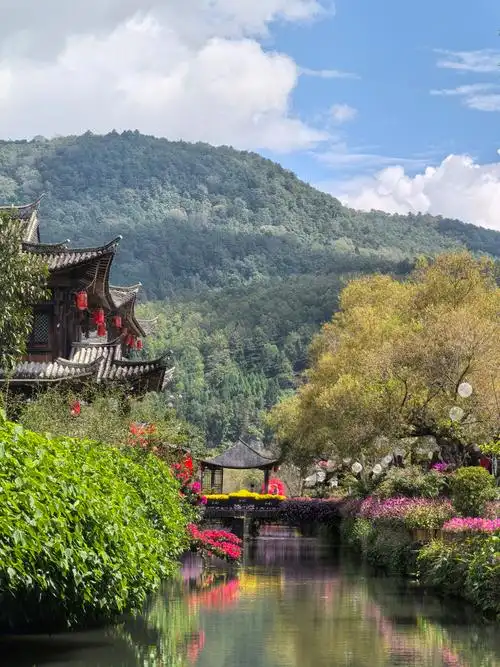
The town's architecture draws primarily from the Huizhou style of Anhui province—the same tradition that produced the whitewashed villages of Huangshan—with hallmark whitewashed walls, dark tiled roofs, and gracefully upturned eaves. Local builders softened these northern influences with Yunnan's own timber-frame traditions and tropical adaptations, creating an ensemble of more than a hundred heritage homes strung along a meandering stream. The result charms visitors much like a smaller, hillier version of Tuscany's hill towns or the painted villages of the Cinque Terre.
Wanlouzi, the former residence of a wealthy overseas Chinese family, is the town's architectural showpiece—a striking fusion of East and West. Its front courtyard follows classical Chinese symmetry, while the rear wing borrows European arcaded galleries and Romanesque arches, complete with imported Southeast Asian floral tiles and an original Western fireplace. Standing in its weathered rooms, visitors sense the same cross-cultural curiosity that shaped 18th-century Marseille's port houses or the merchant villas of Dutch Batavia.
The Heshun Library, opened in 1924 and funded entirely by overseas Chinese donations, holds more than 70,000 volumes and is routinely cited as China's finest rural library. Its stately Sino-Western façade evokes a smaller cousin of Shanghai's historic libraries, while inside, teak reading rooms and aging calligraphy scrolls create an atmosphere reminiscent of Oxford's Bodleian or the old reading rooms of Trinity College, Dublin. Still free to villagers and visitors alike, it remains a living symbol of Heshun's enduring belief that farming and learning go hand in hand.
Beyond the architecture, the natural setting steals the show. Wild Duck Lake, fringed with reeds and lotus, draws migratory waterfowl year-round, while the twin-arched Double Rainbow Bridge spans the gentle stream that loops around the village. In the soft light of early morning or dusk, whitewashed walls glow golden against surrounding rice paddies—a scene that has inspired Chinese painters for centuries and rivals the pastoral compositions of the English Lake District or the painted landscapes of Barbizon.
Plan at least one full day, ideally two, to absorb Heshun's quiet rhythm. The entrance ticket covers all major sites, which connect easily on foot along cobbled lanes. Numerous guesthouses operate out of restored ancestral homes, offering atmospheric, affordable stays; book ahead during peak seasons. Spring (March–May) and autumn (September–November) bring the most comfortable weather and loveliest colors—lotus blossoms in summer, golden rice in fall. Mornings and late afternoons are best for photography and for escaping both the midday heat and the daytime tour-bus crowds.
Founded during the Ming dynasty some six centuries ago, Heshun grew prosperous as a key stop on the Southern Silk Road linking Yunnan to Burma and beyond. From the 17th century onward, local men ventured south to seek fortunes in Mandalay and Rangoon, returning home to build mansions, fund schools, and endow libraries—a pattern not unlike the merchant dynasties of Renaissance Florence or the Hanseatic trading cities of northern Europe. This diaspora wealth and exposure to colonial-era Southeast Asia gave Heshun its distinctive cosmopolitan flavor, setting it apart from every other ancient town in Yunnan.
The town's architecture draws primarily from the Huizhou style of Anhui province—the same tradition that produced the whitewashed villages of Huangshan—with hallmark whitewashed walls, dark tiled roofs, and gracefully upturned eaves. Local builders softened these northern influences with Yunnan's own timber-frame traditions and tropical adaptations, creating an ensemble of more than a hundred heritage homes strung along a meandering stream. The result charms visitors much like a smaller, hillier version of Tuscany's hill towns or the painted villages of the Cinque Terre.
Wanlouzi, the former residence of a wealthy overseas Chinese family, is the town's architectural showpiece—a striking fusion of East and West. Its front courtyard follows classical Chinese symmetry, while the rear wing borrows European arcaded galleries and Romanesque arches, complete with imported Southeast Asian floral tiles and an original Western fireplace. Standing in its weathered rooms, visitors sense the same cross-cultural curiosity that shaped 18th-century Marseille's port houses or the merchant villas of Dutch Batavia.
The Heshun Library, opened in 1924 and funded entirely by overseas Chinese donations, holds more than 70,000 volumes and is routinely cited as China's finest rural library. Its stately Sino-Western façade evokes a smaller cousin of Shanghai's historic libraries, while inside, teak reading rooms and aging calligraphy scrolls create an atmosphere reminiscent of Oxford's Bodleian or the old reading rooms of Trinity College, Dublin. Still free to villagers and visitors alike, it remains a living symbol of Heshun's enduring belief that farming and learning go hand in hand.
Beyond the architecture, the natural setting steals the show. Wild Duck Lake, fringed with reeds and lotus, draws migratory waterfowl year-round, while the twin-arched Double Rainbow Bridge spans the gentle stream that loops around the village. In the soft light of early morning or dusk, whitewashed walls glow golden against surrounding rice paddies—a scene that has inspired Chinese painters for centuries and rivals the pastoral compositions of the English Lake District or the painted landscapes of Barbizon.
Plan at least one full day, ideally two, to absorb Heshun's quiet rhythm. The entrance ticket covers all major sites, which connect easily on foot along cobbled lanes. Numerous guesthouses operate out of restored ancestral homes, offering atmospheric, affordable stays; book ahead during peak seasons. Spring (March–May) and autumn (September–November) bring the most comfortable weather and loveliest colors—lotus blossoms in summer, golden rice in fall. Mornings and late afternoons are best for photography and for escaping both the midday heat and the daytime tour-bus crowds.