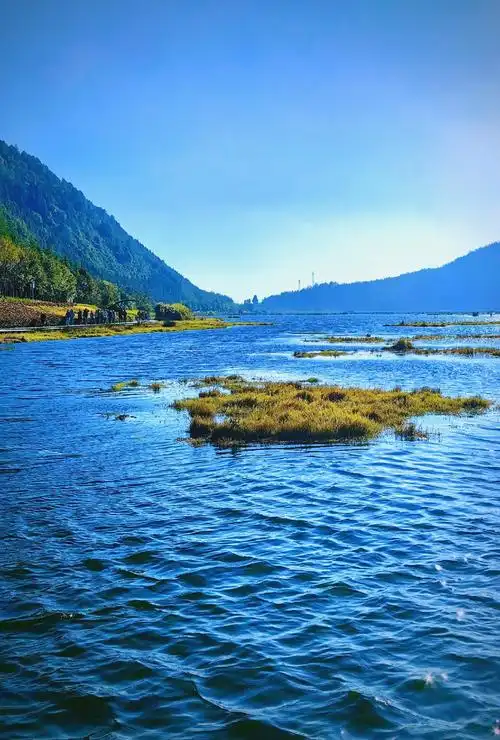
Beihai Wetland owes its very existence to volcanic cataclysm millions of years ago, when molten lava blocked an ancient river valley and pooled into a highland lake—a genesis reminiscent of Europe's volcanic lakes such as Italy's Lake Bolsena or Austria's Lake Ossiach. What makes Beihai extraordinary is not the lake itself but the two-meter-thick mat of interwoven roots that floats freely upon it, gradually built over millennia by generations of aquatic plants. The result is a living ecosystem unlike anything in Europe, though Western travelers may find echoes in Ireland's ancient peat bogs or France's bird-rich Camargue—an equally otherworldly terrain of tangled vegetation and shallow waters.
The park's signature experience is stepping onto the floating grass mat itself, an exhilarating sensation comparable to walking on a giant natural trampoline. Visitors can try traditional grass-raft boat rides, hop onto small platforms for grass-stepping and fish-stomping activities unique to this corner of Yunnan, or sample locally grilled freshwater fish. Local families have practiced this fishing style for generations, casting nets from the buoyant raft in ways that echo the reed-boat traditions of Peru's Lake Titicaca or the coracle fishing of southwest Wales—a reminder of how communities worldwide have learned to live upon water.
Ecologically, Beihai punches well above its weight. The shallow waters shelter endangered Baer's pochard, one of the world's rarest diving ducks, alongside purple herons, kingfishers, and the elusive water-shield vegetable prized in Chinese cuisine. In April and May, native irises paint the meadow edges in violet ribbons, attracting photographers who compare the spectacle to the spring tulip displays of Holland's Keukenhof Gardens. The wetland also sits within a region of deep historical resonance—Tengchong lies along the ancient Southern Silk Road and was a strategic battleground during World War II's Burma Campaign, lending the surrounding landscape a quiet gravitas beyond its natural beauty.
For a more contemplative encounter, kayaks glide silently through narrow channels where water plants tower two meters high, forming green tunnels that muffle the outside world—an atmosphere reminiscent of the cypress swamps of Louisiana or the back-channels of Slovenia's intermittent Lake Cerknica. The park's several-kilometer wooden boardwalk skirts the wetland edge, passing viewing platforms designed for birdwatching and photography. Most visitors complete the trail in one to two hours, with benches placed at scenic overlooks. The combination of boardwalk and boat allows travelers to experience Beihai from multiple vantage points, each revealing different facets of this intricate ecosystem.
Beihai is best reached from Tengchong city, about an hour's drive away, and combines naturally with visits to the town's famous hot springs, dormant volcanoes, and the moving memorial to the fallen of the 1944 Battle of Tengchong. The optimal visiting window runs from April through October, with mornings between 8:30 and 10:00 offering the softest light and fewest crowds—a tip seasoned travelers will recognize from visits to Venice's lagoon or the marshlands of England's Norfolk coast. Entry fees are modest by international standards, and on-site restaurants serve local mushroom dishes and highland trout. Bring binoculars, sun protection, and comfortable walking shoes.
Unlike China's more famous destinations—the misty karst peaks of Guilin, the dramatic gorges of Zhangjiajie—Beihai offers intimacy rather than grandeur. There are no towering vistas here, only the subtle wonder of walking on water, paddling through living green corridors, and sharing dawn with rare birds. For travelers seeking to step beyond the well-trodden tourist trail and discover a landscape that feels genuinely undiscovered, Beihai Wetland delivers an experience as quietly profound as any in Asia.