Zhaoqing Museum
⭐ 4.00
No. 1, Wenming Road, Huanggang Subdistrict, Duanzhou District, Zhaoqing, Guangdong, China
 Zhaoqing has long served as a gateway between central dynasties and the southern frontier, earning the poetic title "The First Prefecture South of the Nanling Mountains." The museum's permanent galleries unfold chronologically from prehistoric settlement through to the Republican era, threading together figures of global historical resonance: the Chan Buddhist master Huineng, who shaped East Asian spiritual life much like Thomas Merton would later shape Western monasticism; the upright Northern Song magistrate Bao Zheng, often likened to a Confucian Robin Hood; the Jesuit missionary Matteo Ricci, who passed through Zhaoqing in 1583 before introducing Christianity to Beijing; and General Ye Ting, a founder of the People's Liberation Army. Together they illuminate Zhaoqing's role as a hinge between empire, faith, and revolution.
The museum holds roughly 12,000 artefacts, including more than 200 classified as nationally significant. The signature piece, the "Nine Dragons Playing with Treasures Inkstone," required three years to carve in high relief, with nine dragons encircling the Eight Immortals' attributes, a masterpiece of Duan inkstone craftsmanship. Earlier treasures such as an Eastern Jin ceramic paddy-field model and a celadon lion-shaped water dropper offer rare glimpses of everyday agrarian and artisanal life in ancient Guangdong, comparable in historical value to the Romano-British farm implements preserved in sites along Hadrian's Wall.
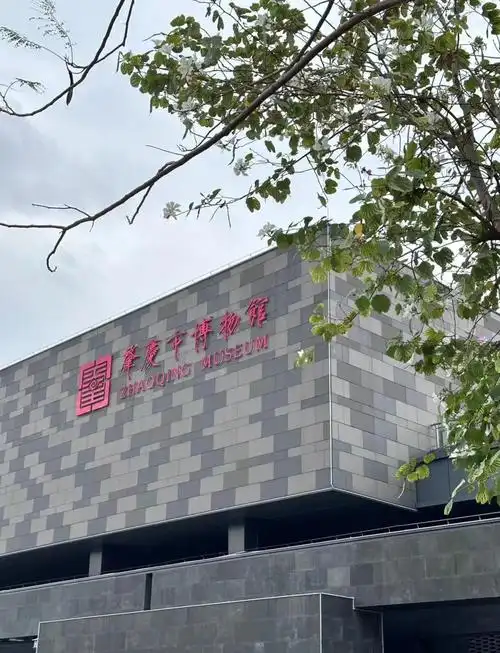
Opened in 2021, the new museum building covers approximately 11,550 square metres with over 4,000 square metres of exhibition space. Its clean, minimalist façade deliberately converses with the adjacent Song-dynasty brick wall and Chaotian Gate, a juxtaposition reminiscent of how the Louvre's glass pyramid meets its medieval palace. The site transforms the museum itself into a piece of urban theatre, where contemporary architecture frames one of southern China's best-preserved ancient city walls.
Beyond history, the museum safeguards Duan inkstone heritage, one of China's "Four Famous Inkstones" and a nationally protected intangible cultural tradition. Dedicated galleries explain the geology of the quarry sites, the carving techniques passed through generations, and the scholar's desk culture that elevated inkstones to artistic objects, a tradition roughly contemporaneous with the flourishing of Italian Renaissance writing desks. Regular workshops and study programmes allow visitors to watch master carvers at work, bridging museum display with living craft.
Admission is free but requires advance booking through the official WeChat account, with passport verification for foreign visitors. Opening hours are Tuesday to Sunday, 9:00 to 17:30 (last entry 17:00); the museum is closed on Mondays. Forty QR-code audio guide stations provide Chinese and English narration, and 1.5 to 2.5 hours are recommended. Flash photography is prohibited and the air conditioning runs cool, so a light jacket is advisable. Afterwards, walk the ancient city wall to Piyun Tower, then sample local specialties such as zongzi-style "裹蒸" rice parcels along the Song-era arcade streets at dusk.
Zhaoqing has long served as a gateway between central dynasties and the southern frontier, earning the poetic title "The First Prefecture South of the Nanling Mountains." The museum's permanent galleries unfold chronologically from prehistoric settlement through to the Republican era, threading together figures of global historical resonance: the Chan Buddhist master Huineng, who shaped East Asian spiritual life much like Thomas Merton would later shape Western monasticism; the upright Northern Song magistrate Bao Zheng, often likened to a Confucian Robin Hood; the Jesuit missionary Matteo Ricci, who passed through Zhaoqing in 1583 before introducing Christianity to Beijing; and General Ye Ting, a founder of the People's Liberation Army. Together they illuminate Zhaoqing's role as a hinge between empire, faith, and revolution.
The museum holds roughly 12,000 artefacts, including more than 200 classified as nationally significant. The signature piece, the "Nine Dragons Playing with Treasures Inkstone," required three years to carve in high relief, with nine dragons encircling the Eight Immortals' attributes, a masterpiece of Duan inkstone craftsmanship. Earlier treasures such as an Eastern Jin ceramic paddy-field model and a celadon lion-shaped water dropper offer rare glimpses of everyday agrarian and artisanal life in ancient Guangdong, comparable in historical value to the Romano-British farm implements preserved in sites along Hadrian's Wall.
Opened in 2021, the new museum building covers approximately 11,550 square metres with over 4,000 square metres of exhibition space. Its clean, minimalist façade deliberately converses with the adjacent Song-dynasty brick wall and Chaotian Gate, a juxtaposition reminiscent of how the Louvre's glass pyramid meets its medieval palace. The site transforms the museum itself into a piece of urban theatre, where contemporary architecture frames one of southern China's best-preserved ancient city walls.
Beyond history, the museum safeguards Duan inkstone heritage, one of China's "Four Famous Inkstones" and a nationally protected intangible cultural tradition. Dedicated galleries explain the geology of the quarry sites, the carving techniques passed through generations, and the scholar's desk culture that elevated inkstones to artistic objects, a tradition roughly contemporaneous with the flourishing of Italian Renaissance writing desks. Regular workshops and study programmes allow visitors to watch master carvers at work, bridging museum display with living craft.
Admission is free but requires advance booking through the official WeChat account, with passport verification for foreign visitors. Opening hours are Tuesday to Sunday, 9:00 to 17:30 (last entry 17:00); the museum is closed on Mondays. Forty QR-code audio guide stations provide Chinese and English narration, and 1.5 to 2.5 hours are recommended. Flash photography is prohibited and the air conditioning runs cool, so a light jacket is advisable. Afterwards, walk the ancient city wall to Piyun Tower, then sample local specialties such as zongzi-style "裹蒸" rice parcels along the Song-era arcade streets at dusk.