Xijiang Ancient Boat Tour
⭐ 4.50
Xijiang Ancient Boat Tour, Duanzhou District, Zhaoqing City, Guangdong Province, China
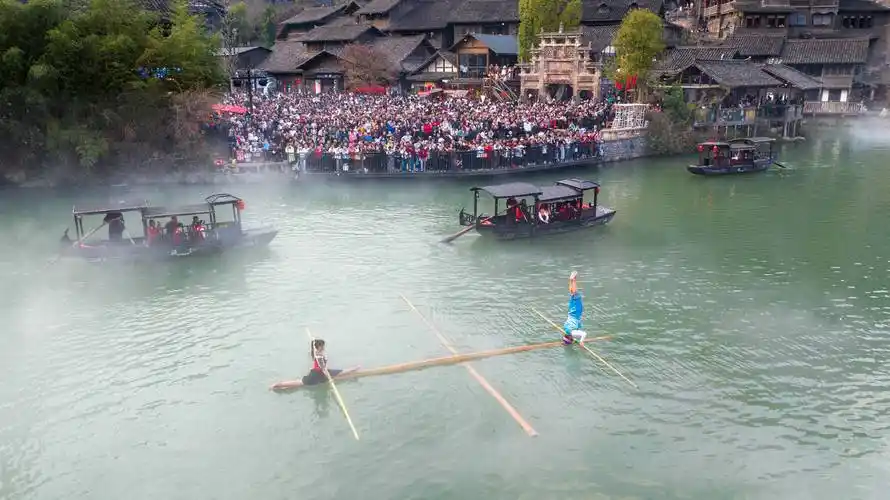 Lingyang Gorge has been a vital artery of southern China for over a millennium, connecting the Guangdong and Guangxi regions by water long before railroads cut through the interior. Often compared to a smaller, lusher version of the Yangtze's Three Gorges, its steep, jungle-clad walls once sheltered merchant junks carrying silk, tea, and porcelain toward the Pearl River Delta. Today, the same dramatic landscape draws travelers who want a gentler glimpse of southern China's water highways without the crowds of the more famous Yangtze route.
The Ziyun Valley wharf sets the tone before you even board. Its upturned eaves, vermilion lanterns, and weathered timber pavilion evoke the riverside inns of Ming and Qing-era travel paintings. Boarding the vessel feels like stepping into a Chinese watercolor: the engine pushes silently against the emerald current, and the city's noise dissolves into birdsong, breeze, and the soft slap of waves along the hull. Keep an eye out for river gulls skimming the surface—they often trail boats in playful, dipping arcs.
Midway through the journey, the flat, inkstone-shaped Yanzhou Island rises in the middle of the river—the only inhabited river island in the entire Xijiang basin. It's named after the legendary Duan inkstones, four of which once ranked among China's "Four Treasures of the Scholar's Studio." On the island, ruins of the Yanzhou Academy and a temple dedicated to Judge Bao Zheng recall the Northern Song dynasty magistrate (999–1062) whose reputation for incorruptible justice became so legendary that it later inspired Judge Dee, the fictional detective beloved by European readers from the 1940s onward.
One of the cruise's greatest charms is how it appeals to every generation. Children can lean over the rails to count kingfishers, track the V-shaped wakes of fish, or shout at the river gulls; adults can simply let the slow-moving scenery do the work, watching the green peaks scroll past like a slow-motion film. The combination of gentle motion, cool river air, and shade from the gorge makes it an unusually comfortable outing even in the humid Guangdong summer—often 4–5°C cooler than the city.
Practical planning is straightforward but worth noting. Boats typically run from morning until the last departure at around 18:00, with staggered routes to either Ziyun Valley or Yanzhou Island—these are separate lines, so confirm your boarding and alighting points before purchasing tickets. The wharf is roughly 40 minutes' drive from downtown Zhaoqing, and combining the cruise with a visit to the nearby Seven Star Crags (七星岩) makes a rewarding full-day itinerary. For the best photos and the smoothest water, choose a clear, sunny morning; the diffused light just after rain is equally magical for those chasing more atmospheric shots.
History buffs will appreciate that Zhaoqing itself carries international weight: it was the first mainland home of the Jesuit missionary Matteo Ricci in the 1580s, making this stretch of river part of the early story of China's encounter with Europe. Sailing the same waters Bao Zheng once patrolled, with the same limestone peaks that enchanted Renaissance travelers, gives the cruise a quiet depth that purely scenic boat rides rarely achieve.
Lingyang Gorge has been a vital artery of southern China for over a millennium, connecting the Guangdong and Guangxi regions by water long before railroads cut through the interior. Often compared to a smaller, lusher version of the Yangtze's Three Gorges, its steep, jungle-clad walls once sheltered merchant junks carrying silk, tea, and porcelain toward the Pearl River Delta. Today, the same dramatic landscape draws travelers who want a gentler glimpse of southern China's water highways without the crowds of the more famous Yangtze route.
The Ziyun Valley wharf sets the tone before you even board. Its upturned eaves, vermilion lanterns, and weathered timber pavilion evoke the riverside inns of Ming and Qing-era travel paintings. Boarding the vessel feels like stepping into a Chinese watercolor: the engine pushes silently against the emerald current, and the city's noise dissolves into birdsong, breeze, and the soft slap of waves along the hull. Keep an eye out for river gulls skimming the surface—they often trail boats in playful, dipping arcs.
Midway through the journey, the flat, inkstone-shaped Yanzhou Island rises in the middle of the river—the only inhabited river island in the entire Xijiang basin. It's named after the legendary Duan inkstones, four of which once ranked among China's "Four Treasures of the Scholar's Studio." On the island, ruins of the Yanzhou Academy and a temple dedicated to Judge Bao Zheng recall the Northern Song dynasty magistrate (999–1062) whose reputation for incorruptible justice became so legendary that it later inspired Judge Dee, the fictional detective beloved by European readers from the 1940s onward.
One of the cruise's greatest charms is how it appeals to every generation. Children can lean over the rails to count kingfishers, track the V-shaped wakes of fish, or shout at the river gulls; adults can simply let the slow-moving scenery do the work, watching the green peaks scroll past like a slow-motion film. The combination of gentle motion, cool river air, and shade from the gorge makes it an unusually comfortable outing even in the humid Guangdong summer—often 4–5°C cooler than the city.
Practical planning is straightforward but worth noting. Boats typically run from morning until the last departure at around 18:00, with staggered routes to either Ziyun Valley or Yanzhou Island—these are separate lines, so confirm your boarding and alighting points before purchasing tickets. The wharf is roughly 40 minutes' drive from downtown Zhaoqing, and combining the cruise with a visit to the nearby Seven Star Crags (七星岩) makes a rewarding full-day itinerary. For the best photos and the smoothest water, choose a clear, sunny morning; the diffused light just after rain is equally magical for those chasing more atmospheric shots.
History buffs will appreciate that Zhaoqing itself carries international weight: it was the first mainland home of the Jesuit missionary Matteo Ricci in the 1580s, making this stretch of river part of the early story of China's encounter with Europe. Sailing the same waters Bao Zheng once patrolled, with the same limestone peaks that enchanted Renaissance travelers, gives the cruise a quiet depth that purely scenic boat rides rarely achieve.