Deqing Confucian Temple
⭐ 4.50
Deqing Confucian Temple, Deqing County, Zhaoqing City, Guangdong Province, China
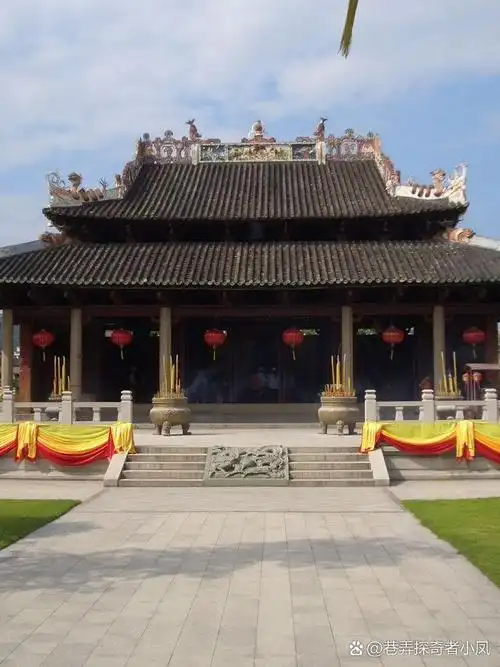 Founded in the eleventh year of Emperor Zhenzong's reign (1011 AD), Deqing Confucian Temple predates the Norman completion of England's Canterbury Cathedral by just decades, yet belongs to an entirely different civilisational lineage—one devoted not to divine kings but to the philosopher-teacher Confucius, whose moral philosophy shaped East Asia much as Aristotle shaped the Mediterranean world. Located in what was once a remote southern frontier, the temple's establishment in 1011 marked a deliberate imperial gesture: bringing Confucian learning to the Lingnan region, hundreds of miles south of the traditional Chinese heartland. After reconstruction in 1297, during the Mongol-led Yuan Dynasty—a period contemporary with Italy's late medieval communes—the temple evolved into the cultural anchor of the region, a role it still fulfils today.
The undisputed architectural marvel is the Dacheng Hall, the only complete Yuan-era wooden great hall surviving in southern China and a rarity even in the north. Its signature "Four Pillars Not Topping" (四柱不顶) technique is a masterclass in structural ingenuity: four golden columns deliberately stop short of the roof, transferring the entire load onto a forest of interlocking wooden brackets known as dougong (斗拱). To picture it, imagine the flying buttresses of Notre-Dame translated into pure timber, with bracket arms extending a record 122 fen-degrees—the deepest such projection among all Song and Yuan structures in China. This daring economy of supports, paired with the "reduced-column" (减柱造) method that opens vast interior space without obstructive pillars, has kept the hall standing through earthquakes, typhoons, and seven centuries of monsoon weather.
Beyond architecture, the temple remains a living classroom of Confucian heritage. Every autumn, on Confucius's birthday, monks of a different sort—scholars, officials, and students—gather for solemn ceremonies of remembrance, echoing rituals performed for nearly a millennium. Younger visitors delight in the "Kai Bi Li" (开笔礼), a coming-of-age ritual celebrating a child's first brushstroke, while the 160-metre-long porcelain relief corridor traces Confucius's life in what is claimed to be China's longest narrative artwork of its kind. Nearby, the "Top Scholar Handprint Wall" immortalises graduates of the imperial examination system—an ancient civil service exam that, in its day, attracted scholars as fiercely as admission to Oxford or the Sorbonne.
Practical visiting details are refreshingly straightforward. The temple sits at 50-1 Chaoyang West Road, Decheng Town, Deqing County, and is open daily from 8:30 a.m. to 5:30 p.m., with last tickets sold at 5:00 p.m. Adult admission is a modest 30 RMB; minors, seniors over 60, teachers, and military personnel enter free with valid ID. Plan for 1 to 1.5 hours for a thorough visit. Photography is permitted inside the hall but flash is prohibited to protect the ancient woodwork. Note that on-site dining options are minimal, so bring water and wear comfortable walking shoes—the cobbled courtyards reward unhurried exploration.
For a fuller experience, pair the temple with the nearby Sanyuan Pagoda, a short walk away, and the legendary Yuecheng Dragon Mother Ancestral Temple, just twenty minutes by car. Together, these three sites form a half-day "Ancient Deqing Heritage Trail" that contrasts Confucian scholarship, Buddhist-inspired pagoda architecture, and folk religion in a single compact loop—an itinerary that condenses two millennia of southern Chinese spiritual life into one unforgettable afternoon.
Founded in the eleventh year of Emperor Zhenzong's reign (1011 AD), Deqing Confucian Temple predates the Norman completion of England's Canterbury Cathedral by just decades, yet belongs to an entirely different civilisational lineage—one devoted not to divine kings but to the philosopher-teacher Confucius, whose moral philosophy shaped East Asia much as Aristotle shaped the Mediterranean world. Located in what was once a remote southern frontier, the temple's establishment in 1011 marked a deliberate imperial gesture: bringing Confucian learning to the Lingnan region, hundreds of miles south of the traditional Chinese heartland. After reconstruction in 1297, during the Mongol-led Yuan Dynasty—a period contemporary with Italy's late medieval communes—the temple evolved into the cultural anchor of the region, a role it still fulfils today.
The undisputed architectural marvel is the Dacheng Hall, the only complete Yuan-era wooden great hall surviving in southern China and a rarity even in the north. Its signature "Four Pillars Not Topping" (四柱不顶) technique is a masterclass in structural ingenuity: four golden columns deliberately stop short of the roof, transferring the entire load onto a forest of interlocking wooden brackets known as dougong (斗拱). To picture it, imagine the flying buttresses of Notre-Dame translated into pure timber, with bracket arms extending a record 122 fen-degrees—the deepest such projection among all Song and Yuan structures in China. This daring economy of supports, paired with the "reduced-column" (减柱造) method that opens vast interior space without obstructive pillars, has kept the hall standing through earthquakes, typhoons, and seven centuries of monsoon weather.
Beyond architecture, the temple remains a living classroom of Confucian heritage. Every autumn, on Confucius's birthday, monks of a different sort—scholars, officials, and students—gather for solemn ceremonies of remembrance, echoing rituals performed for nearly a millennium. Younger visitors delight in the "Kai Bi Li" (开笔礼), a coming-of-age ritual celebrating a child's first brushstroke, while the 160-metre-long porcelain relief corridor traces Confucius's life in what is claimed to be China's longest narrative artwork of its kind. Nearby, the "Top Scholar Handprint Wall" immortalises graduates of the imperial examination system—an ancient civil service exam that, in its day, attracted scholars as fiercely as admission to Oxford or the Sorbonne.
Practical visiting details are refreshingly straightforward. The temple sits at 50-1 Chaoyang West Road, Decheng Town, Deqing County, and is open daily from 8:30 a.m. to 5:30 p.m., with last tickets sold at 5:00 p.m. Adult admission is a modest 30 RMB; minors, seniors over 60, teachers, and military personnel enter free with valid ID. Plan for 1 to 1.5 hours for a thorough visit. Photography is permitted inside the hall but flash is prohibited to protect the ancient woodwork. Note that on-site dining options are minimal, so bring water and wear comfortable walking shoes—the cobbled courtyards reward unhurried exploration.
For a fuller experience, pair the temple with the nearby Sanyuan Pagoda, a short walk away, and the legendary Yuecheng Dragon Mother Ancestral Temple, just twenty minutes by car. Together, these three sites form a half-day "Ancient Deqing Heritage Trail" that contrasts Confucian scholarship, Buddhist-inspired pagoda architecture, and folk religion in a single compact loop—an itinerary that condenses two millennia of southern Chinese spiritual life into one unforgettable afternoon.