Five-Color Sea
⭐ 3.50
Sanchong Work Area, Daocheng County, Garzê Tibetan Autonomous Prefecture, Sichuan Province, China
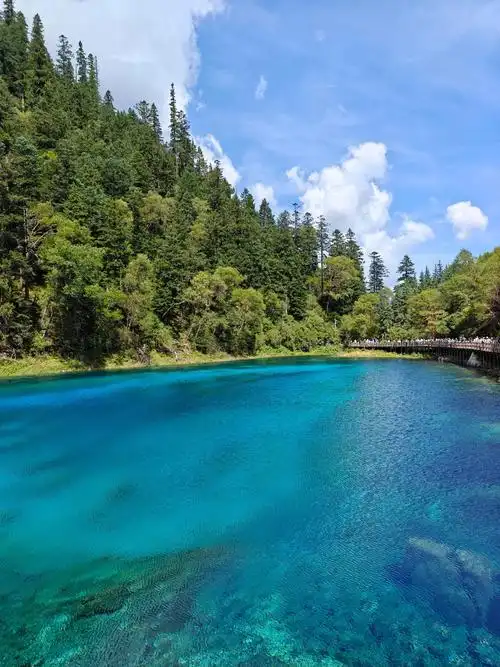 Tucked into the remote Kham Tibetan region of Sichuan, the Five-Color Lake lies within Yading—a wilderness reserve that conservationists call "the last pure land on the water-blue planet." For centuries, this corner of the eastern Tibetan Plateau has been a spiritual frontier, where Buddhist monks and nomadic herders trekked across passes above 4,000 meters—comparable in elevation to Europe's highest Alpine cols. The reserve's three holy peaks represent the three protective bodhisattvas of Vajrayana Buddhism, and pilgrims still complete ritual kora circuits around their flanks, much like Christian pilgrims circling Santiago de Compostela.
The lake itself rests in a glacial cirque—a bowl-shaped hollow carved during the Ice Age when massive glaciers ground through the Hengduan Mountains. Shaped almost perfectly round and roughly 150 meters across, it is the highest of Yading's three sacred lakes, loftier than any tarn in the Dolomites or around Mont Blanc. Its mineral-rich bed scatters sunlight into shifting bands of cobalt, jade, and violet. On still mornings, the surface mirrors the 5,958-meter peak of Jambeyang with such precision that visitors feel suspended between earth and sky.
Known in Tibetan as "Tenzin Tso"—the "Lake of Empowerment"—the waters are believed to confer spiritual merit and good fortune. During summer festivals, pilgrims traverse the kora path and tie prayer flags at the shoreline, a tradition predating the Tibetan Empire of the 7th century. Visitors must refrain from touching the water, littering, or building cairns; the lake's sanctity is protected by both religious custom and park regulation, much as sacred wells at Lourdes or springs at Delphi are guarded today.
Reaching the lake demands real effort. From Luorong Pasture (4,150 m), the trail climbs a punishing 1.5 km through alpine meadow and a steep final slope unsuitable for horses. The round-trip covers 10–12 km and requires 6–8 hours at altitude. The park opens 7:00–16:40 in August, with entry barred after 14:30. For 2026 (August 1–October 31), entrance is free; shuttle and electric-cart fees apply. Spend 1–2 nights in Shangri-La Town (2,900 m) to acclimatize, and carry portable oxygen, layered clothing, and trekking poles.
Photographers prize the upper viewing platform where Milk Lake and Five-Color Lake share one frame—a composition rivaling Switzerland's Oeschinensee for alpine drama. Calm winds and clear skies are essential. The ideal window runs 9:00 a.m. to noon, before afternoon clouds build. Sunrise brings the most vivid color play; late morning delivers the sharpest reflections of Jambeyang's summit. In one frame, snow peaks, glacial water, and shifting light create an image worthy of any National Geographic archive.
Visiting Five-Color Lake is less a sightseeing trip than a modern pilgrimage—one that asks breath, patience, and respect. Few places on Earth reward effort so vividly: an alpine jewel guarded by two snow gods, painted by shifting light, and sanctified by twenty centuries of devotion. For travelers who have trekked Patagonia's Torres del Paine or crossed the Haute Route in the Alps, this is Asia's next great horizon—a sanctuary of stone, water, and silence.
Tucked into the remote Kham Tibetan region of Sichuan, the Five-Color Lake lies within Yading—a wilderness reserve that conservationists call "the last pure land on the water-blue planet." For centuries, this corner of the eastern Tibetan Plateau has been a spiritual frontier, where Buddhist monks and nomadic herders trekked across passes above 4,000 meters—comparable in elevation to Europe's highest Alpine cols. The reserve's three holy peaks represent the three protective bodhisattvas of Vajrayana Buddhism, and pilgrims still complete ritual kora circuits around their flanks, much like Christian pilgrims circling Santiago de Compostela.
The lake itself rests in a glacial cirque—a bowl-shaped hollow carved during the Ice Age when massive glaciers ground through the Hengduan Mountains. Shaped almost perfectly round and roughly 150 meters across, it is the highest of Yading's three sacred lakes, loftier than any tarn in the Dolomites or around Mont Blanc. Its mineral-rich bed scatters sunlight into shifting bands of cobalt, jade, and violet. On still mornings, the surface mirrors the 5,958-meter peak of Jambeyang with such precision that visitors feel suspended between earth and sky.
Known in Tibetan as "Tenzin Tso"—the "Lake of Empowerment"—the waters are believed to confer spiritual merit and good fortune. During summer festivals, pilgrims traverse the kora path and tie prayer flags at the shoreline, a tradition predating the Tibetan Empire of the 7th century. Visitors must refrain from touching the water, littering, or building cairns; the lake's sanctity is protected by both religious custom and park regulation, much as sacred wells at Lourdes or springs at Delphi are guarded today.
Reaching the lake demands real effort. From Luorong Pasture (4,150 m), the trail climbs a punishing 1.5 km through alpine meadow and a steep final slope unsuitable for horses. The round-trip covers 10–12 km and requires 6–8 hours at altitude. The park opens 7:00–16:40 in August, with entry barred after 14:30. For 2026 (August 1–October 31), entrance is free; shuttle and electric-cart fees apply. Spend 1–2 nights in Shangri-La Town (2,900 m) to acclimatize, and carry portable oxygen, layered clothing, and trekking poles.
Photographers prize the upper viewing platform where Milk Lake and Five-Color Lake share one frame—a composition rivaling Switzerland's Oeschinensee for alpine drama. Calm winds and clear skies are essential. The ideal window runs 9:00 a.m. to noon, before afternoon clouds build. Sunrise brings the most vivid color play; late morning delivers the sharpest reflections of Jambeyang's summit. In one frame, snow peaks, glacial water, and shifting light create an image worthy of any National Geographic archive.
Visiting Five-Color Lake is less a sightseeing trip than a modern pilgrimage—one that asks breath, patience, and respect. Few places on Earth reward effort so vividly: an alpine jewel guarded by two snow gods, painted by shifting light, and sanctified by twenty centuries of devotion. For travelers who have trekked Patagonia's Torres del Paine or crossed the Haute Route in the Alps, this is Asia's next great horizon—a sanctuary of stone, water, and silence.