Luorong Pasture
⭐ 4.60
Luorong Pasture, Daocheng County, Ganzi Tibetan Autonomous Prefecture, Sichuan Province, China
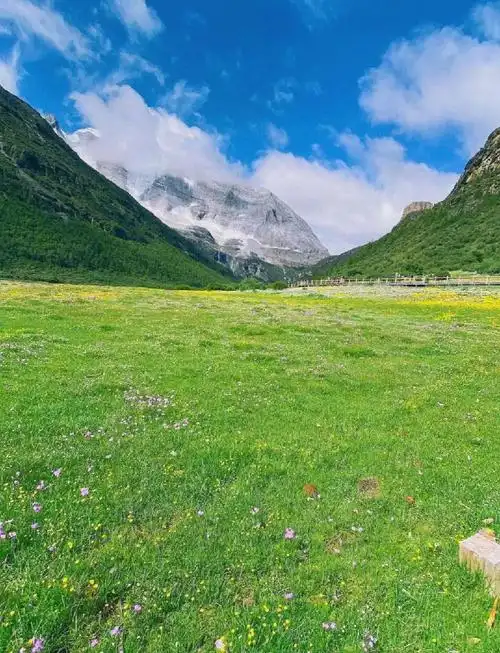 The Yading peaks have drawn Tibetan Buddhist pilgrims for over a millennium, each summit embodying a bodhisattva: Chenresig (Avalokiteshvara, the bodhisattva of compassion), Jambeyang (Manjushri, of wisdom), and Chana Dorje (Vajrapani, of power). The meadow itself is sanctified by legends of Padmasambhava, the eighth-century tantric master who brought Vajrayana Buddhism to Tibet and is said to have meditated here. Western travelers may recognize this landscape through James Hilton's 1933 novel "Lost Horizon," which birthed the modern myth of Shangri-La—a hidden Himalayan paradise of peace and spiritual perfection that travelers have chased ever since.
At 4,150 meters—roughly the elevation of the upper trails in the Mont Blanc massif—Luorong's broad, undulating meadows feel startlingly Alpine in their lushness, yet distinctly Tibetan in their wildness. Crystal-clear snowmelt streams carve through the turf, feeding wetlands where yaks graze beside weathered wooden herders' shelters. The view is dominated by Jambeyang's pyramid-shaped summit, often likened to a Tibetan crystal stupa piercing the sky. In summer, wildflowers paint the slopes; by October, the entire valley blazes gold. Photographers consider this the single most rewarding panorama in all of Yading.
For local Tibetan herders, the pasture remains a working landscape where yaks still roam beneath sacred peaks. Scattered across the meadow are mani stone piles—mounds of carved prayer stones that visitors must walk around clockwise, following the ancient kora ritual. Some areas are explicitly off-limits to photography out of respect. The harmony between daily pastoral life and profound spirituality gives Luorong the quality of a "living temple," where one encounters the same mountain reverence that shaped Tibetan culture since the era of the Yarlung dynasty in the seventh through ninth centuries CE.
Reaching Luorong requires patience: visitors first take a shuttle bus from the Yading gate to Zhagongpeng, then transfer to an electric cart (around 70–80 RMB round-trip) for the final leg to the pasture. Altitude is a serious concern—4,150 meters is roughly 1,000 meters higher than Chamonix—so spend at least two nights acclimatizing in the lower town of Shangri-La Town at 2,900 meters before ascending. Carry oxygen canisters, glucose tablets, and a three-in-one shell jacket; nights even in August can drop sharply. Camping is no longer permitted in the park, and dining options are sparse and pricey, so bring high-energy snacks.
From Luorong, the trail to Milk Lake (4,500 meters) and Five-Color Lake (4,600 meters) climbs 300 meters over 4.5 kilometers each way—comparable in difficulty to the ascent to Annapurna Base Camp, though shorter. The final two kilometers involve steep, loose scree that punishes the lungs. Most trekkers need three to four hours up and two hours down, so set out by eight in the morning and avoid starting the climb after 2:30 p.m., when sudden storms and high winds sweep in. Pack layers, water, and snacks; the reward is two astonishing glacial lakes of impossible turquoise blue.
May and June bring spectacular rhododendron blooms that rival Scotland's Highland heather; July through August delivers the greenest meadows and fullest streams, though afternoon thunderstorms are common. October offers the most cinematic gold-and-rust palette but with sub-freezing nights. Crowds peak during China's National Day holiday from October 1 through 7, when the pasture can feel less like Shangri-La and more like a music festival. Aim for shoulder periods—late September or mid-October weekdays, or early June—for the best balance of weather, color, and solitude.
The Yading peaks have drawn Tibetan Buddhist pilgrims for over a millennium, each summit embodying a bodhisattva: Chenresig (Avalokiteshvara, the bodhisattva of compassion), Jambeyang (Manjushri, of wisdom), and Chana Dorje (Vajrapani, of power). The meadow itself is sanctified by legends of Padmasambhava, the eighth-century tantric master who brought Vajrayana Buddhism to Tibet and is said to have meditated here. Western travelers may recognize this landscape through James Hilton's 1933 novel "Lost Horizon," which birthed the modern myth of Shangri-La—a hidden Himalayan paradise of peace and spiritual perfection that travelers have chased ever since.
At 4,150 meters—roughly the elevation of the upper trails in the Mont Blanc massif—Luorong's broad, undulating meadows feel startlingly Alpine in their lushness, yet distinctly Tibetan in their wildness. Crystal-clear snowmelt streams carve through the turf, feeding wetlands where yaks graze beside weathered wooden herders' shelters. The view is dominated by Jambeyang's pyramid-shaped summit, often likened to a Tibetan crystal stupa piercing the sky. In summer, wildflowers paint the slopes; by October, the entire valley blazes gold. Photographers consider this the single most rewarding panorama in all of Yading.
For local Tibetan herders, the pasture remains a working landscape where yaks still roam beneath sacred peaks. Scattered across the meadow are mani stone piles—mounds of carved prayer stones that visitors must walk around clockwise, following the ancient kora ritual. Some areas are explicitly off-limits to photography out of respect. The harmony between daily pastoral life and profound spirituality gives Luorong the quality of a "living temple," where one encounters the same mountain reverence that shaped Tibetan culture since the era of the Yarlung dynasty in the seventh through ninth centuries CE.
Reaching Luorong requires patience: visitors first take a shuttle bus from the Yading gate to Zhagongpeng, then transfer to an electric cart (around 70–80 RMB round-trip) for the final leg to the pasture. Altitude is a serious concern—4,150 meters is roughly 1,000 meters higher than Chamonix—so spend at least two nights acclimatizing in the lower town of Shangri-La Town at 2,900 meters before ascending. Carry oxygen canisters, glucose tablets, and a three-in-one shell jacket; nights even in August can drop sharply. Camping is no longer permitted in the park, and dining options are sparse and pricey, so bring high-energy snacks.
From Luorong, the trail to Milk Lake (4,500 meters) and Five-Color Lake (4,600 meters) climbs 300 meters over 4.5 kilometers each way—comparable in difficulty to the ascent to Annapurna Base Camp, though shorter. The final two kilometers involve steep, loose scree that punishes the lungs. Most trekkers need three to four hours up and two hours down, so set out by eight in the morning and avoid starting the climb after 2:30 p.m., when sudden storms and high winds sweep in. Pack layers, water, and snacks; the reward is two astonishing glacial lakes of impossible turquoise blue.
May and June bring spectacular rhododendron blooms that rival Scotland's Highland heather; July through August delivers the greenest meadows and fullest streams, though afternoon thunderstorms are common. October offers the most cinematic gold-and-rust palette but with sub-freezing nights. Crowds peak during China's National Day holiday from October 1 through 7, when the pasture can feel less like Shangri-La and more like a music festival. Aim for shoulder periods—late September or mid-October weekdays, or early June—for the best balance of weather, color, and solitude.