Milk Lake
⭐ 4.50
Daocheng County, Garzê Tibetan Autonomous Prefecture, Sichuan Province, China
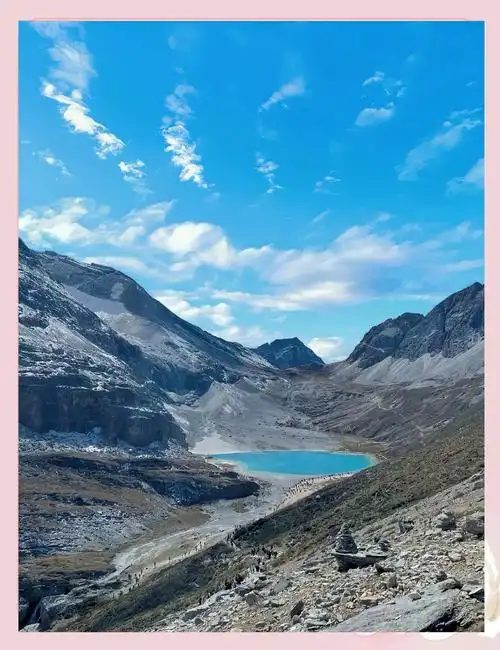 Milk Sea was carved during the Pleistocene glaciations, sharing its origins with the great alpine lakes of Switzerland and Italy's Dolomites. Like Lake Geneva or Lake Como, its basin was gouged by a retreating ice sheet, leaving behind a deep bowl that later filled with snowmelt. At 4,600 meters—loftier than all but a handful of summits in the European Alps—the lake sits above the permanent tree line and well beyond the timberline of every peak in the Himalayas outside the 8,000-meter giants. Its waters are mineral-rich, and a slow process of calcium carbonate precipitation has built the distinctive pale shoreline shelf that gives the lake its English name.
Few alpine lakes match Milk Sea's chromatic range. In shifting light, the water moves from pale jade to saturated Tiffany blue—a hue more familiar from Caribbean shallows than from the so-called roof of the world. Surrounded by the snow-clad guardian peaks Chenresig, Jambeyang, and Chanadorje—Yading's sacred trinity—the lake functions as a natural mirror doubling the mountains. Compare its clarity to Iceland's geothermal basins or to Lake Louise in Banff, but remember that here the air contains barely half the oxygen of sea level, and ultraviolet radiation is intense even in cloud.
For Tibetan Buddhists, Yading is a Three Holy Mountains sanctuary, analogous in reverence to Mount Kailash or, in the Christian West, the pilgrimage abbey of Mont Saint-Michel. The lake is believed to embody the nectar of Avalokiteshvara's compassion, and walking the shoreline clockwise—a kora—is thought to bring purification and merit. Prayer flags and stone cairns line the paths, and local Tibetans regard the catchment as inviolable. Western visitors should approach it less as a photo stop than as a living sanctuary, much as pilgrims approach Lake Titicaca or the grotto at Lourdes.
The journey begins at the Yading Scenic Area entrance, where a mandatory shuttle bus ferries travelers to Zhagunpeng. From there an optional electric cart, or a short hike, reaches Luorong Meadow, the launchpad for the final 3–4 kilometer ascent. Expect a 400–500 meter elevation gain in thin air and budget four to six hours round-trip. Tickets cost 146 yuan in peak season (April 15 to November 19), with the shuttle adding 120 yuan. An electric cart upgrade runs 80 yuan; horses can be hired for around 300 yuan one-way.
Far fewer international visitors reach Milk Sea than Everest Base Camp, but those who do describe a moment of planetary stillness worthy of either pilgrimage. Spend one or two nights in Shangri-La Town at 2,900 meters before ascending, and pack a windproof shell, trekking poles, portable oxygen, sunscreen, and calorie-dense snacks. After 14:30 the park enforces exit-only at the lake; afternoon winds regularly reach Beaufort Force seven or eight, and a narrow cliff traverse becomes treacherous when wet. Children, the elderly, and those with cardiac or respiratory conditions should stop at Luorong Meadow, which alone delivers ninety percent of the view.
Milk Sea was carved during the Pleistocene glaciations, sharing its origins with the great alpine lakes of Switzerland and Italy's Dolomites. Like Lake Geneva or Lake Como, its basin was gouged by a retreating ice sheet, leaving behind a deep bowl that later filled with snowmelt. At 4,600 meters—loftier than all but a handful of summits in the European Alps—the lake sits above the permanent tree line and well beyond the timberline of every peak in the Himalayas outside the 8,000-meter giants. Its waters are mineral-rich, and a slow process of calcium carbonate precipitation has built the distinctive pale shoreline shelf that gives the lake its English name.
Few alpine lakes match Milk Sea's chromatic range. In shifting light, the water moves from pale jade to saturated Tiffany blue—a hue more familiar from Caribbean shallows than from the so-called roof of the world. Surrounded by the snow-clad guardian peaks Chenresig, Jambeyang, and Chanadorje—Yading's sacred trinity—the lake functions as a natural mirror doubling the mountains. Compare its clarity to Iceland's geothermal basins or to Lake Louise in Banff, but remember that here the air contains barely half the oxygen of sea level, and ultraviolet radiation is intense even in cloud.
For Tibetan Buddhists, Yading is a Three Holy Mountains sanctuary, analogous in reverence to Mount Kailash or, in the Christian West, the pilgrimage abbey of Mont Saint-Michel. The lake is believed to embody the nectar of Avalokiteshvara's compassion, and walking the shoreline clockwise—a kora—is thought to bring purification and merit. Prayer flags and stone cairns line the paths, and local Tibetans regard the catchment as inviolable. Western visitors should approach it less as a photo stop than as a living sanctuary, much as pilgrims approach Lake Titicaca or the grotto at Lourdes.
The journey begins at the Yading Scenic Area entrance, where a mandatory shuttle bus ferries travelers to Zhagunpeng. From there an optional electric cart, or a short hike, reaches Luorong Meadow, the launchpad for the final 3–4 kilometer ascent. Expect a 400–500 meter elevation gain in thin air and budget four to six hours round-trip. Tickets cost 146 yuan in peak season (April 15 to November 19), with the shuttle adding 120 yuan. An electric cart upgrade runs 80 yuan; horses can be hired for around 300 yuan one-way.
Far fewer international visitors reach Milk Sea than Everest Base Camp, but those who do describe a moment of planetary stillness worthy of either pilgrimage. Spend one or two nights in Shangri-La Town at 2,900 meters before ascending, and pack a windproof shell, trekking poles, portable oxygen, sunscreen, and calorie-dense snacks. After 14:30 the park enforces exit-only at the lake; afternoon winds regularly reach Beaufort Force seven or eight, and a narrow cliff traverse becomes treacherous when wet. Children, the elderly, and those with cardiac or respiratory conditions should stop at Luorong Meadow, which alone delivers ninety percent of the view.