Sangdui Temple
⭐ 3.20
Sangdui Temple, Daocheng County, Garzê Tibetan Autonomous Prefecture, Sichuan Province, China
 Founded in 1178 during China's Southern Song dynasty—the same era as Saladin's rise and the consecration of Chartres Cathedral's choir—the temple predates both the Franciscan order and the Mongol conquests that would soon reshape Tibet. Its founder, the 1st Karmapa Düsum Khyenpa, established one of Tibetan Buddhism's most influential lineages, the Karma Kagyu school, often compared in its meditative rigor to the Cistercian reform movement in medieval Europe. As the ancestral seat of Kagyu practice in southern Kham, the monastery has witnessed nearly nine centuries of unbroken religious transmission.
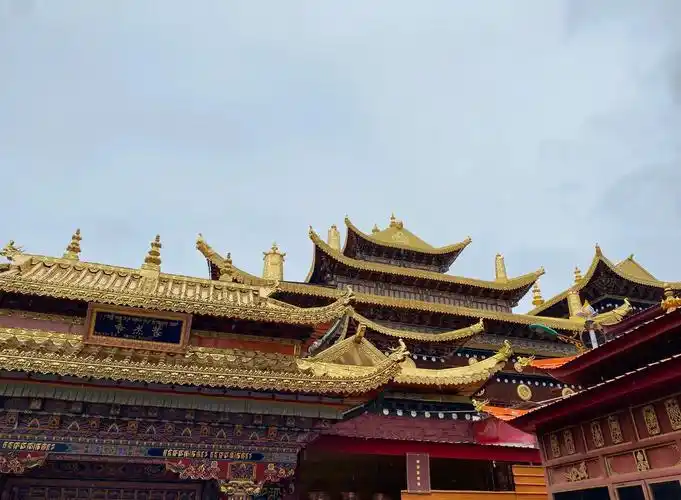
Though modest in scale, the temple preserves a classic Tibetan Buddhist layout that visitors will recognize from older Lhasa monasteries, though considerably more intimate. The bold color palette—deep crimson walls contrasted with golden-yellow roof trim—is set off magnificently against the crystalline high-altitude sky, producing a visual punch reminiscent of Italian hillside towns where terracotta meets azure. The main hall houses statues of successive Karmapas and various Buddhist figures, while the cliff behind the temple conceals meditation caves and ancient rock paintings left by generations of hermit practitioners.
The monastery's most celebrated tradition is its daily fish-feeding ceremony. Monks toss tsampa—roasted barley flour—into the Sangdui River, and over centuries this ritual has conditioned wild fish to gather in dense, swirling schools. Visitors can wade into the shallows and touch the fish directly, an experience that transforms an abstract Buddhist principle of compassion for all sentient beings into something tangibly felt. This living practice, sustained for hundreds of years, embodies the Tibetan worldview of harmony between humans, animals, and landscape.
The temple sits about 30 kilometers from Daocheng town, conveniently close to Daocheng-Yading Airport, at an altitude of roughly 3,940 meters—comparable to the elevation of the Jungfraujoch in Switzerland. Admission is free, and the grounds are open daily from 7:00 AM to 6:00 PM. Most travelers spend two to three hours here, often combining the visit with the nearby Sangdui village and the Rubuchaka hot springs. The best season runs from August through early October, when morning light is soft and monks are most active.
Altitude sickness is a real consideration at nearly 4,000 meters, so visitors should acclimatize gradually, stay hydrated, and consider anti-altitude medication before arrival. Modest dress is expected, and travelers should refrain from photographing monks during rituals or touching statues and scriptures; always walk clockwise around prayer wheels and stupas. The temple pairs naturally with a trip to Yading Nature Reserve and works beautifully as a quieter, contemplative counterpoint to that park's more strenuous trekking circuits.
Founded in 1178 during China's Southern Song dynasty—the same era as Saladin's rise and the consecration of Chartres Cathedral's choir—the temple predates both the Franciscan order and the Mongol conquests that would soon reshape Tibet. Its founder, the 1st Karmapa Düsum Khyenpa, established one of Tibetan Buddhism's most influential lineages, the Karma Kagyu school, often compared in its meditative rigor to the Cistercian reform movement in medieval Europe. As the ancestral seat of Kagyu practice in southern Kham, the monastery has witnessed nearly nine centuries of unbroken religious transmission.
Though modest in scale, the temple preserves a classic Tibetan Buddhist layout that visitors will recognize from older Lhasa monasteries, though considerably more intimate. The bold color palette—deep crimson walls contrasted with golden-yellow roof trim—is set off magnificently against the crystalline high-altitude sky, producing a visual punch reminiscent of Italian hillside towns where terracotta meets azure. The main hall houses statues of successive Karmapas and various Buddhist figures, while the cliff behind the temple conceals meditation caves and ancient rock paintings left by generations of hermit practitioners.
The monastery's most celebrated tradition is its daily fish-feeding ceremony. Monks toss tsampa—roasted barley flour—into the Sangdui River, and over centuries this ritual has conditioned wild fish to gather in dense, swirling schools. Visitors can wade into the shallows and touch the fish directly, an experience that transforms an abstract Buddhist principle of compassion for all sentient beings into something tangibly felt. This living practice, sustained for hundreds of years, embodies the Tibetan worldview of harmony between humans, animals, and landscape.
The temple sits about 30 kilometers from Daocheng town, conveniently close to Daocheng-Yading Airport, at an altitude of roughly 3,940 meters—comparable to the elevation of the Jungfraujoch in Switzerland. Admission is free, and the grounds are open daily from 7:00 AM to 6:00 PM. Most travelers spend two to three hours here, often combining the visit with the nearby Sangdui village and the Rubuchaka hot springs. The best season runs from August through early October, when morning light is soft and monks are most active.
Altitude sickness is a real consideration at nearly 4,000 meters, so visitors should acclimatize gradually, stay hydrated, and consider anti-altitude medication before arrival. Modest dress is expected, and travelers should refrain from photographing monks during rituals or touching statues and scriptures; always walk clockwise around prayer wheels and stupas. The temple pairs naturally with a trip to Yading Nature Reserve and works beautifully as a quieter, contemplative counterpoint to that park's more strenuous trekking circuits.