Zhaguanbeng
⭐ 4.20
Zhaguanbeng Scenic Area, Daocheng County, Garzê Tibetan Autonomous Prefecture, Sichuan Province, China
 PARAGRAPH 1:
Zhaguanbeng lies within Yading, known in Tibetan as "the place closest to the sun and moon," a name that echoes the spiritual ambition of such Himalayan pilgrimage sites as Muktinath in Nepal or Mount Kailash. Nestled on the eastern fringe of the Tibetan Plateau in Sichuan's Garzi Prefecture, the area has long been venerated by Tibetan Buddhists as the earthly abode of three protective deities—Chenresig (the Bodhisattva of Compassion), Jambeyang (Manjushri), and Chanadorje (Vajrapani)—whose snow-capped summits pierce the sky above this alpine meadow. The site's three-peak configuration has drawn comparisons to Switzerland's Bernese Oberland or the Dolomites, though the Tibetan cultural overlay makes it wholly unique.
PARAGRAPH 2:
At 3,850 meters, Zhaguanbeng functions as the nerve center of the Yading reserve. Visitors arriving from the Daocheng-Yading Visitor Center transfer to the official shuttle bus for a one-hour journey into the valley, ending at this broad grassy clearing crisscrossed by wooden boardwalks. The platform itself is deliberately understated—simple rest areas, ecological restrooms, and prayer-fluttered viewing points—designed to keep the focus on the natural grandeur rather than on built structures. In this respect, it recalls the minimalist approach of Alpine refuges in the Mont Blanc massif.
PARAGRAPH 3:
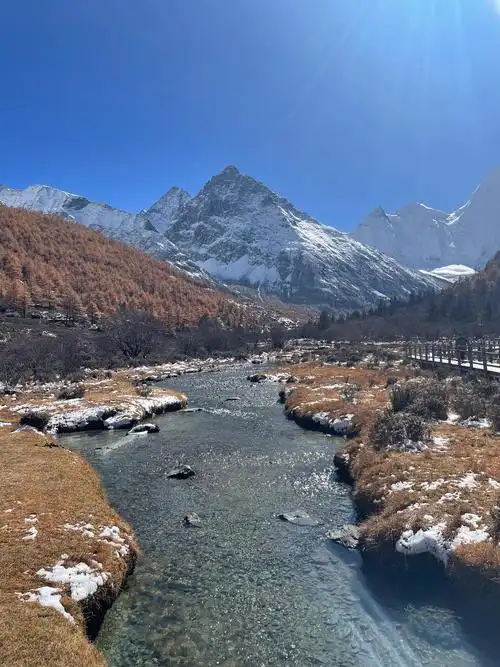
The location is the reserve's premier photographic vantage point. On clear mornings and afternoons, the three holy mountains stand in razor-sharp relief against a cobalt sky, their silhouettes shifting as light plays across glaciers and cirques. Meandering streams cut through emerald turf while prayer flags snap in the wind, creating scenes that rival the dramatic panoramas of the Matterhorn viewed from the Gornergrat. Photographers should arrive between 7 and 9 a.m., particularly during the August monsoon, when the still air yields the sharpest reflections and golden light on snow.
PARAGRAPH 4]
Culturally, Zhaguanbeng is inseparable from the nearby Chonggu Temple, a Tibetan Buddhist sanctuary first established in the 18th century and rebuilt in the 1980s. Though visitors often pause only briefly, the meadow itself is animated by the same devotional energy that animates Bhutanese or Ladakhi mountain sites. Strict etiquette applies: never step on prayer flags or mani stones, walk clockwise around shrines, refrain from photography inside any sacred structure, and respect all marked ecological boundaries.
PARAGRAPH 5:
Practically speaking, Zhaguanbeng requires no separate ticket; admission is bundled with the Yading entrance fee (approximately 146 yuan in peak season) plus the shuttle bus fare (around 120 yuan). Electric shuttle service to Luorong Pasture costs extra. Facilities are deliberately modest—visitors should bring their own high-energy snacks, bottled water, and portable oxygen, as on-site food is limited and expensive. Most travelers spend only one to two hours here unless continuing on foot.
PARAGRAPH 6:
The best visiting window runs from May to October, though even summer nights can drop near freezing. Altitude sickness is a real concern at nearly 4,000 meters, so pacing oneself, hydrating, and avoiding alcohol are essential. Those who treat Zhaguanbeng merely as a quick photo stop will miss the point; it is best appreciated as a threshold—either the dramatic prologue before a short walk to Pearl Lake or the launchpad for the longer, more strenuous trek to Luorong Pasture and the Milk Lake. Allow a full day in the reserve to do it justice.
PARAGRAPH 1:
Zhaguanbeng lies within Yading, known in Tibetan as "the place closest to the sun and moon," a name that echoes the spiritual ambition of such Himalayan pilgrimage sites as Muktinath in Nepal or Mount Kailash. Nestled on the eastern fringe of the Tibetan Plateau in Sichuan's Garzi Prefecture, the area has long been venerated by Tibetan Buddhists as the earthly abode of three protective deities—Chenresig (the Bodhisattva of Compassion), Jambeyang (Manjushri), and Chanadorje (Vajrapani)—whose snow-capped summits pierce the sky above this alpine meadow. The site's three-peak configuration has drawn comparisons to Switzerland's Bernese Oberland or the Dolomites, though the Tibetan cultural overlay makes it wholly unique.
PARAGRAPH 2:
At 3,850 meters, Zhaguanbeng functions as the nerve center of the Yading reserve. Visitors arriving from the Daocheng-Yading Visitor Center transfer to the official shuttle bus for a one-hour journey into the valley, ending at this broad grassy clearing crisscrossed by wooden boardwalks. The platform itself is deliberately understated—simple rest areas, ecological restrooms, and prayer-fluttered viewing points—designed to keep the focus on the natural grandeur rather than on built structures. In this respect, it recalls the minimalist approach of Alpine refuges in the Mont Blanc massif.
PARAGRAPH 3:
The location is the reserve's premier photographic vantage point. On clear mornings and afternoons, the three holy mountains stand in razor-sharp relief against a cobalt sky, their silhouettes shifting as light plays across glaciers and cirques. Meandering streams cut through emerald turf while prayer flags snap in the wind, creating scenes that rival the dramatic panoramas of the Matterhorn viewed from the Gornergrat. Photographers should arrive between 7 and 9 a.m., particularly during the August monsoon, when the still air yields the sharpest reflections and golden light on snow.
PARAGRAPH 4]
Culturally, Zhaguanbeng is inseparable from the nearby Chonggu Temple, a Tibetan Buddhist sanctuary first established in the 18th century and rebuilt in the 1980s. Though visitors often pause only briefly, the meadow itself is animated by the same devotional energy that animates Bhutanese or Ladakhi mountain sites. Strict etiquette applies: never step on prayer flags or mani stones, walk clockwise around shrines, refrain from photography inside any sacred structure, and respect all marked ecological boundaries.
PARAGRAPH 5:
Practically speaking, Zhaguanbeng requires no separate ticket; admission is bundled with the Yading entrance fee (approximately 146 yuan in peak season) plus the shuttle bus fare (around 120 yuan). Electric shuttle service to Luorong Pasture costs extra. Facilities are deliberately modest—visitors should bring their own high-energy snacks, bottled water, and portable oxygen, as on-site food is limited and expensive. Most travelers spend only one to two hours here unless continuing on foot.
PARAGRAPH 6:
The best visiting window runs from May to October, though even summer nights can drop near freezing. Altitude sickness is a real concern at nearly 4,000 meters, so pacing oneself, hydrating, and avoiding alcohol are essential. Those who treat Zhaguanbeng merely as a quick photo stop will miss the point; it is best appreciated as a threshold—either the dramatic prologue before a short walk to Pearl Lake or the launchpad for the longer, more strenuous trek to Luorong Pasture and the Milk Lake. Allow a full day in the reserve to do it justice.