Temple of Meng Jiangnu
⭐ 4.00
Shanhaiguan District, Qinhuangdao City, Hebei Province, China
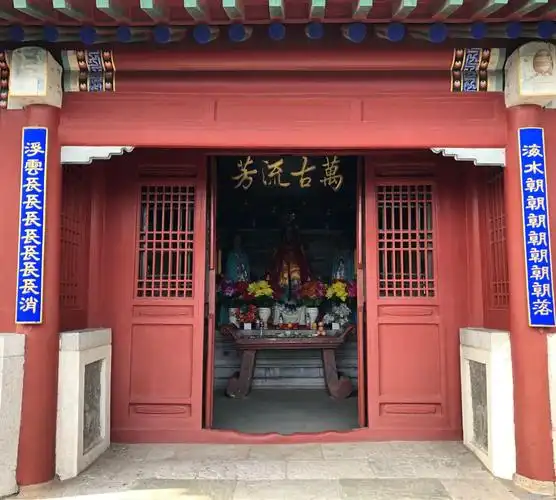 The temple commemorates Meng Jiangnu, a figure whose tragic tale echoes through Chinese folk literature much like European ballads of faithful wives such as Patient Griselda or the Greek myth of Hero and Leander. Tradition holds that her husband was entombed within the wall during its Qin-dynasty construction; her weeping caused a 100-li section to crumble, exposing his bones. The shrine predates the Song Dynasty, but the present brick-and-timber halls were reconstructed in 1594 during the Wanli reign of the Ming, and it was among Hebei Province's first protected cultural sites in 1956. Today it stands as one of China's most evocative monuments to folk faith.
Architecturally modest at just 1.6 mu (under 1,100 square meters), the complex climbs the hillside in classic Ming style. The front hall enshrines Meng Jiangnu herself, while the rear hall houses Guanyin, flanked by a bell tower and the Zhanyi Pavilion. Most striking is the approach: 108 steep stone steps symbolizing her thousand-mile journey in search of her husband. Behind the rear hall, the Weathering Stone and Sea Eye Well mark the supposed site where she flung herself into the sea. The whole ensemble feels intimate yet carefully orchestrated, more akin to a small pilgrimage chapel than a grand temple.
The temple's cultural fame rests largely on two attractions. The first is the so-called "First Strange Couplet Under Heaven," hung above the mountain gate. Its genius lies in the multiple pronunciations of "chao" and "zhang"—reading variously as "morning," "tide," "long," or "grow"—producing a single poetic line that simultaneously describes the eternal rhythm of sea tides and the impermanence of floating clouds. The second is the northern Meng Jiangnu Garden, where twenty diorama-style clay tableaux, executed in Jiangnan garden landscaping, illustrate the legend from beginning to end—a vivid visual primer on one of East Asia's oldest oral traditions.
Practical information: Admission runs a very modest ¥10–25, with seasonal opening hours that vary. Allow 1 to 1.5 hours for your visit. The steep, handrail-free stone steps demand sturdy non-slip footwear—take particular care with elderly companions or young children. Visitors should maintain a respectful atmosphere; avoid pointing at statues, keep voices low, and switch off camera flashes to protect the Ming-era woodwork and historic artifacts. Photographers will find the soft side-light between 9 and 11 AM most flattering, while also avoiding the midday glare.
The temple sits squarely within Shanhaiguan's core tourist zone, where "the head of the dragon meets the tail of the Great Wall." Visitors almost inevitably combine it with two neighboring landmarks: the First Pass Under Heaven (Diyiguan)—the dramatic Ming gate-tower complex that rivals any medieval European fortress—and Old Dragon Head (Laolongtou), where the wall plunges directly into the Bohai Sea. Together, the three sites form a single coherent cultural circuit linking imperial defense architecture with the human stories woven into the wall itself.
The temple commemorates Meng Jiangnu, a figure whose tragic tale echoes through Chinese folk literature much like European ballads of faithful wives such as Patient Griselda or the Greek myth of Hero and Leander. Tradition holds that her husband was entombed within the wall during its Qin-dynasty construction; her weeping caused a 100-li section to crumble, exposing his bones. The shrine predates the Song Dynasty, but the present brick-and-timber halls were reconstructed in 1594 during the Wanli reign of the Ming, and it was among Hebei Province's first protected cultural sites in 1956. Today it stands as one of China's most evocative monuments to folk faith.
Architecturally modest at just 1.6 mu (under 1,100 square meters), the complex climbs the hillside in classic Ming style. The front hall enshrines Meng Jiangnu herself, while the rear hall houses Guanyin, flanked by a bell tower and the Zhanyi Pavilion. Most striking is the approach: 108 steep stone steps symbolizing her thousand-mile journey in search of her husband. Behind the rear hall, the Weathering Stone and Sea Eye Well mark the supposed site where she flung herself into the sea. The whole ensemble feels intimate yet carefully orchestrated, more akin to a small pilgrimage chapel than a grand temple.
The temple's cultural fame rests largely on two attractions. The first is the so-called "First Strange Couplet Under Heaven," hung above the mountain gate. Its genius lies in the multiple pronunciations of "chao" and "zhang"—reading variously as "morning," "tide," "long," or "grow"—producing a single poetic line that simultaneously describes the eternal rhythm of sea tides and the impermanence of floating clouds. The second is the northern Meng Jiangnu Garden, where twenty diorama-style clay tableaux, executed in Jiangnan garden landscaping, illustrate the legend from beginning to end—a vivid visual primer on one of East Asia's oldest oral traditions.
Practical information: Admission runs a very modest ¥10–25, with seasonal opening hours that vary. Allow 1 to 1.5 hours for your visit. The steep, handrail-free stone steps demand sturdy non-slip footwear—take particular care with elderly companions or young children. Visitors should maintain a respectful atmosphere; avoid pointing at statues, keep voices low, and switch off camera flashes to protect the Ming-era woodwork and historic artifacts. Photographers will find the soft side-light between 9 and 11 AM most flattering, while also avoiding the midday glare.
The temple sits squarely within Shanhaiguan's core tourist zone, where "the head of the dragon meets the tail of the Great Wall." Visitors almost inevitably combine it with two neighboring landmarks: the First Pass Under Heaven (Diyiguan)—the dramatic Ming gate-tower complex that rivals any medieval European fortress—and Old Dragon Head (Laolongtou), where the wall plunges directly into the Bohai Sea. Together, the three sites form a single coherent cultural circuit linking imperial defense architecture with the human stories woven into the wall itself.