Laolongtou (Old Dragon Head)
⭐ 4.70
Shanhaiguan District, Qinhuangdao City, Hebei Province, China
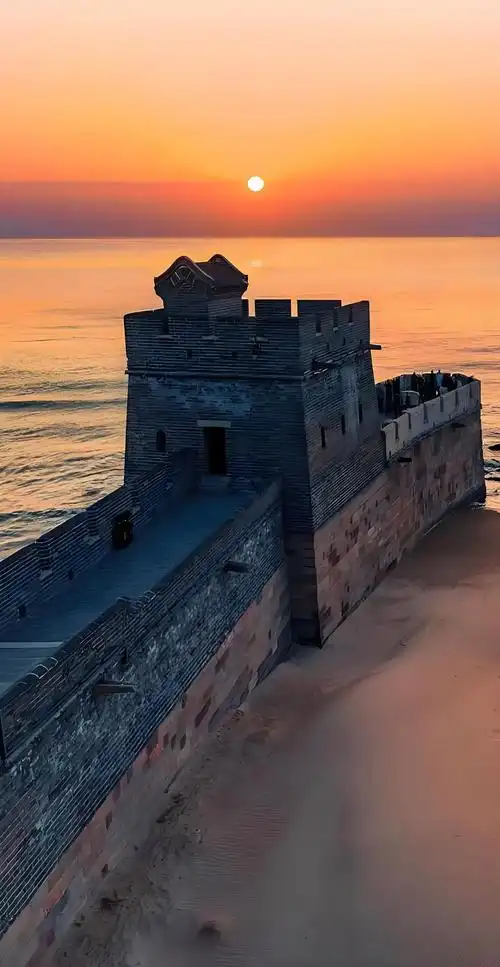 Constructed in 1381 during the reign of the founding Ming emperor Zhu Yuanzhang, Old Dragon Head served as the seaward anchor of the Shanhaiguan defense line, a position roughly contemporary with the Hundred Years' War in France. While European castles were evolving toward gunpowder-resistant bastions, China was perfecting its own answer to seaborne assault: a continuous granite wall that ends not in a tower but in the sea itself. General Qi Jiguang, whose military reforms prefigured those of Vauban by two centuries, reinforced the seawall in the 1560s to repel Japanese pirates and northern raiders. The site thus stands as the Ming answer to coastal forts like Henry VIII's Device Forts along England's south coast.
The sea-entering stone city is the engineering showpiece. Massive granite blocks, some weighing several tons, are stacked in tight courses and locked together with mortar of glutinous rice paste and iron dowels, a bonding technique reminiscent of Roman concrete but adapted to resist salt-water corrosion. The wall extends roughly 100 meters into the Bohai, its silhouette evoking a dragon dipping its head to drink—hence the poetic name "Old Dragon Head." After more than six centuries of typhoon-driven surf and grinding winter ice, the structure remains virtually intact, a testament to Ming military engineering on par with the durability of the Tower of London's outer curtain walls.
The clifftop Chenghai Tower, or "Sea-Gazing Tower," is the soul of the complex. Climbing its tiered balconies—each level symbolizing ten thousand li of empire—visitors reach the celebrated vista of the Great Wall meeting the boundless sea. Inside, an imperial calligraphy collection features plaques such as "Xiongjin Wanli" ("Mighty Embrace of Ten Thousand Li"), bestowed by Qing emperors who summered here. Surrounding the tower, the restored Ninghai Garrison, life-size bronze statues of Ming sentries, and a small Sea God Temple recreate the rhythms of frontier life. Multilingual audio guides in Chinese, English, Russian, Korean, and Japanese bring the layered history to international visitors.
The scenic area lies about 15 km east of Qinhuangdao and roughly 300 km east of Beijing, easily reached by high-speed rail to Shanhaiguan Station followed by a short taxi or local bus. On-site amenities include a Great Wall Museum, a craft village selling Ming-inspired souvenirs, and several restaurants specializing in fresh Bohai seafood such as mantis shrimp, steamed clams, and locally caught yellow croaker. Plan for 2-3 hours on site, though enthusiasts can easily spend half a day. Spring (April-May) and autumn (September-October) bring the most comfortable weather, while winter offers its own stark drama with snow-dusted battlements rising above frozen surf.
Old Dragon Head offers something no other section of the Great Wall can: an unbroken sightline from inland battlements to open ocean, capturing the full ambition of Ming frontier defense in a single frame. For Western travelers who have already ticked off the polished Badaling stretch or the wild Jiankou ridges, Laolongtou delivers the wall's most poetic image—its head finally dipping, after 8,800 kilometers of mountain and desert, into the Bohai Sea. Arrive at sunrise for the legendary "Dragon Bathing in the Sun" moment, when the seawall glows copper-gold and the tour buses have not yet arrived; you will have one of China's most photographed vistas almost to yourself.
Constructed in 1381 during the reign of the founding Ming emperor Zhu Yuanzhang, Old Dragon Head served as the seaward anchor of the Shanhaiguan defense line, a position roughly contemporary with the Hundred Years' War in France. While European castles were evolving toward gunpowder-resistant bastions, China was perfecting its own answer to seaborne assault: a continuous granite wall that ends not in a tower but in the sea itself. General Qi Jiguang, whose military reforms prefigured those of Vauban by two centuries, reinforced the seawall in the 1560s to repel Japanese pirates and northern raiders. The site thus stands as the Ming answer to coastal forts like Henry VIII's Device Forts along England's south coast.
The sea-entering stone city is the engineering showpiece. Massive granite blocks, some weighing several tons, are stacked in tight courses and locked together with mortar of glutinous rice paste and iron dowels, a bonding technique reminiscent of Roman concrete but adapted to resist salt-water corrosion. The wall extends roughly 100 meters into the Bohai, its silhouette evoking a dragon dipping its head to drink—hence the poetic name "Old Dragon Head." After more than six centuries of typhoon-driven surf and grinding winter ice, the structure remains virtually intact, a testament to Ming military engineering on par with the durability of the Tower of London's outer curtain walls.
The clifftop Chenghai Tower, or "Sea-Gazing Tower," is the soul of the complex. Climbing its tiered balconies—each level symbolizing ten thousand li of empire—visitors reach the celebrated vista of the Great Wall meeting the boundless sea. Inside, an imperial calligraphy collection features plaques such as "Xiongjin Wanli" ("Mighty Embrace of Ten Thousand Li"), bestowed by Qing emperors who summered here. Surrounding the tower, the restored Ninghai Garrison, life-size bronze statues of Ming sentries, and a small Sea God Temple recreate the rhythms of frontier life. Multilingual audio guides in Chinese, English, Russian, Korean, and Japanese bring the layered history to international visitors.
The scenic area lies about 15 km east of Qinhuangdao and roughly 300 km east of Beijing, easily reached by high-speed rail to Shanhaiguan Station followed by a short taxi or local bus. On-site amenities include a Great Wall Museum, a craft village selling Ming-inspired souvenirs, and several restaurants specializing in fresh Bohai seafood such as mantis shrimp, steamed clams, and locally caught yellow croaker. Plan for 2-3 hours on site, though enthusiasts can easily spend half a day. Spring (April-May) and autumn (September-October) bring the most comfortable weather, while winter offers its own stark drama with snow-dusted battlements rising above frozen surf.
Old Dragon Head offers something no other section of the Great Wall can: an unbroken sightline from inland battlements to open ocean, capturing the full ambition of Ming frontier defense in a single frame. For Western travelers who have already ticked off the polished Badaling stretch or the wild Jiankou ridges, Laolongtou delivers the wall's most poetic image—its head finally dipping, after 8,800 kilometers of mountain and desert, into the Bohai Sea. Arrive at sunrise for the legendary "Dragon Bathing in the Sun" moment, when the seawall glows copper-gold and the tour buses have not yet arrived; you will have one of China's most photographed vistas almost to yourself.