Shennong Altar
⭐ 3.50
Shennongtan Scenic Area, Shennongjia Forestry District, Hubei Province, China
 **Echoes of a Mythic Founder**
Shennong, the Yan Emperor, ranks among the most revered primordial ancestors in Chinese tradition, credited with teaching humanity agriculture, identifying medicinal herbs, and establishing early markets. Much like Demeter in Greek myth who gifted grain to mortals, Shennong is celebrated as a divine benefactor who lifted civilization from foraging to farming. This altar complex, built into the forested slopes near Muyu Town, transforms abstract mythology into tangible pilgrimage experience, inviting visitors to walk where legendary emperors once communed with heaven and earth.
**The Colossus of Emperor Yan**
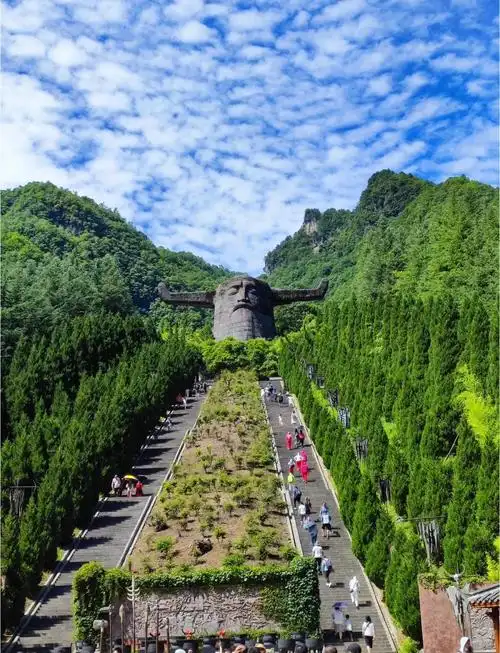
The site's centerpiece is a monumental bust of Shennong rising 21 meters high and stretching 35 meters across its pedestal, with a total vertical reach of 56 meters—one meter for each of China's recognized ethnic groups. The serene, closed-eyed visage gazes over the mountains with the gravitas of a figure half Christ the Redeemer, half ancient oracle. Stone terraces climb toward the statue, mirroring the processional ascent of Greek amphitheaters or Roman triumphal approaches, transforming a simple visit into a ceremonial journey of reverence.
**The Thousand-Year King Fir**
Within the grounds stands a magnificent iron-bark Chinese fir estimated at over 1,200 years old, its massive trunk requiring several adults to encircle. Comparable in stature to the ancient Major Oak of Sherwood Forest or the revered olive trees of Gethsemane, this living patriarch is venerated as a sacred tree where pilgrims circle clockwise offering prayers. The surrounding primeval fir forest, rich with negative ions and birdsong, offers an immersive encounter with Shennongjia's celebrated biodiversity, often called the "lungs of central China."
**The Bagua Square and Cosmic Geometry**
At the altar's ceremonial heart lies the Earth Platform, a circular plaza inlaid with the Bagua (Eight Trigrams) pattern, embodying the ancient Chinese cosmological concept of "round heaven, square earth." The five-colored pavement corresponds to the Five Elements of wood, fire, earth, metal, and water. Like Stonehenge or the zodiac alignments of pre-Columbian temples, this sacred geometry reflects humanity's universal desire to map the cosmos onto the land. The square forms the lower forecourt, with the colossal statue crowning the upper terrace in classical "front altar, rear image" ritual layout.
**Practical Information for Visitors**
The altar lies in Muyu Town within the Shennongjia Forestry District, roughly 3.5 hours by car from Yichang city center—comparable to traveling from London to the Scottish Highlands. Allow two to three hours for the visit, ideally following the natural progression from the Bagua Square up through the ancient trees to the towering statue. Comfortable walking shoes are essential due to numerous steps. Misty or rainy weather, common in these mountains, dramatically shrouds the statue in swirling clouds, creating unforgettable photographic conditions and lending the entire site an ethereal, otherworldly atmosphere that has drawn pilgrims for millennia.
**Echoes of a Mythic Founder**
Shennong, the Yan Emperor, ranks among the most revered primordial ancestors in Chinese tradition, credited with teaching humanity agriculture, identifying medicinal herbs, and establishing early markets. Much like Demeter in Greek myth who gifted grain to mortals, Shennong is celebrated as a divine benefactor who lifted civilization from foraging to farming. This altar complex, built into the forested slopes near Muyu Town, transforms abstract mythology into tangible pilgrimage experience, inviting visitors to walk where legendary emperors once communed with heaven and earth.
**The Colossus of Emperor Yan**
The site's centerpiece is a monumental bust of Shennong rising 21 meters high and stretching 35 meters across its pedestal, with a total vertical reach of 56 meters—one meter for each of China's recognized ethnic groups. The serene, closed-eyed visage gazes over the mountains with the gravitas of a figure half Christ the Redeemer, half ancient oracle. Stone terraces climb toward the statue, mirroring the processional ascent of Greek amphitheaters or Roman triumphal approaches, transforming a simple visit into a ceremonial journey of reverence.
**The Thousand-Year King Fir**
Within the grounds stands a magnificent iron-bark Chinese fir estimated at over 1,200 years old, its massive trunk requiring several adults to encircle. Comparable in stature to the ancient Major Oak of Sherwood Forest or the revered olive trees of Gethsemane, this living patriarch is venerated as a sacred tree where pilgrims circle clockwise offering prayers. The surrounding primeval fir forest, rich with negative ions and birdsong, offers an immersive encounter with Shennongjia's celebrated biodiversity, often called the "lungs of central China."
**The Bagua Square and Cosmic Geometry**
At the altar's ceremonial heart lies the Earth Platform, a circular plaza inlaid with the Bagua (Eight Trigrams) pattern, embodying the ancient Chinese cosmological concept of "round heaven, square earth." The five-colored pavement corresponds to the Five Elements of wood, fire, earth, metal, and water. Like Stonehenge or the zodiac alignments of pre-Columbian temples, this sacred geometry reflects humanity's universal desire to map the cosmos onto the land. The square forms the lower forecourt, with the colossal statue crowning the upper terrace in classical "front altar, rear image" ritual layout.
**Practical Information for Visitors**
The altar lies in Muyu Town within the Shennongjia Forestry District, roughly 3.5 hours by car from Yichang city center—comparable to traveling from London to the Scottish Highlands. Allow two to three hours for the visit, ideally following the natural progression from the Bagua Square up through the ancient trees to the towering statue. Comfortable walking shoes are essential due to numerous steps. Misty or rainy weather, common in these mountains, dramatically shrouds the statue in swirling clouds, creating unforgettable photographic conditions and lending the entire site an ethereal, otherworldly atmosphere that has drawn pilgrims for millennia.