Shennong Altar
⭐ 3.80
Shennong Altar, Shennongjia Forestry District, Hubei Province, China
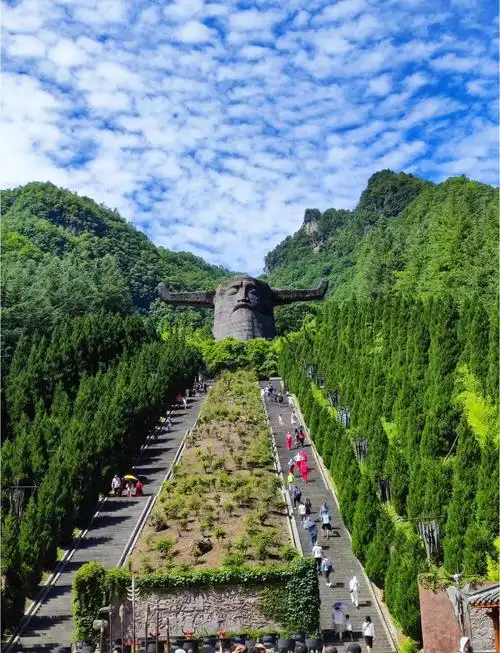 The Shennong Altar honors Yan Emperor Shennong, a culture hero revered across East Asia as the father of agriculture, herbal medicine, and settled civilization—comparable in stature to figures like Prometheus in Greek myth or Saturn in Roman tradition, credited with teaching the fundamentals of human survival. Long before written history, communities across the Yellow River basin celebrated him as the divine originator of farming techniques and the organizer of seasonal markets. Today, his legacy is ritually honored here each year on the 26th day of the fourth lunar month, when grand public ceremonies draw diaspora Chinese from around the world in a poignant act of cultural remembrance.
The architectural centerpiece is a 21-meter-tall granite statue depicting Shennong in his iconic ox-headed, human-bodied form, eyes gently closed in meditative grace. The monument rises from a square terrace paved with five-colored stones representing the classical elements, embodying the ancient "round heaven, square earth" cosmology—a design philosophy echoed in sacred spaces from Rome's Pantheon to the geometric altars of classical antiquity. Visitors climb 243 steps up to a circular upper platform, the number evoking imperial hierarchies familiar to students of European court ritual.
Beyond its sculptural grandeur, the altar functions as an open-air museum of cultural memory. Bas-relief carvings flanking the stairway vividly portray Shennong tasting a hundred herbs, teaching the sowing of five grains, and bringing civilization to early peoples—narratives that predate the Homeric epics yet share the same timeless reverence for humanity's earliest benefactors. The layout reflects a deeply rooted philosophy of harmony between heaven, earth, and humankind, transforming a simple mountain clearing into a contemplative stage for ancestral devotion.
Equally compelling is the surrounding natural heritage. A revered "Thousand-Year Fir King," over 1,200 years old, stands as a living fossil beside the path, while a small botanical garden preserves rare relict species that survived the last Ice Age. Together they create an atmosphere reminiscent of Europe's ancient sacred groves, where sacred monuments coexist with primordial woodland.
Practical details make visiting straightforward. The site lies about six kilometers from Muyu Town, a 2.5 to 3-hour drive from Yichang through scenic mountain roads. Tickets typically range from 30 to 60 yuan, and the attraction reopened in early 2025 after thoughtful renovations. Allow roughly an hour for the full circuit, which moves briskly from the lower plaza's carved nine tripods up the steps and onward to the ancient trees. Comfortable walking shoes are essential. Early morning or late afternoon offers softer light, fewer crowds, and the best photography conditions for capturing the statue's full majesty against the forested peaks.
The Shennong Altar honors Yan Emperor Shennong, a culture hero revered across East Asia as the father of agriculture, herbal medicine, and settled civilization—comparable in stature to figures like Prometheus in Greek myth or Saturn in Roman tradition, credited with teaching the fundamentals of human survival. Long before written history, communities across the Yellow River basin celebrated him as the divine originator of farming techniques and the organizer of seasonal markets. Today, his legacy is ritually honored here each year on the 26th day of the fourth lunar month, when grand public ceremonies draw diaspora Chinese from around the world in a poignant act of cultural remembrance.
The architectural centerpiece is a 21-meter-tall granite statue depicting Shennong in his iconic ox-headed, human-bodied form, eyes gently closed in meditative grace. The monument rises from a square terrace paved with five-colored stones representing the classical elements, embodying the ancient "round heaven, square earth" cosmology—a design philosophy echoed in sacred spaces from Rome's Pantheon to the geometric altars of classical antiquity. Visitors climb 243 steps up to a circular upper platform, the number evoking imperial hierarchies familiar to students of European court ritual.
Beyond its sculptural grandeur, the altar functions as an open-air museum of cultural memory. Bas-relief carvings flanking the stairway vividly portray Shennong tasting a hundred herbs, teaching the sowing of five grains, and bringing civilization to early peoples—narratives that predate the Homeric epics yet share the same timeless reverence for humanity's earliest benefactors. The layout reflects a deeply rooted philosophy of harmony between heaven, earth, and humankind, transforming a simple mountain clearing into a contemplative stage for ancestral devotion.
Equally compelling is the surrounding natural heritage. A revered "Thousand-Year Fir King," over 1,200 years old, stands as a living fossil beside the path, while a small botanical garden preserves rare relict species that survived the last Ice Age. Together they create an atmosphere reminiscent of Europe's ancient sacred groves, where sacred monuments coexist with primordial woodland.
Practical details make visiting straightforward. The site lies about six kilometers from Muyu Town, a 2.5 to 3-hour drive from Yichang through scenic mountain roads. Tickets typically range from 30 to 60 yuan, and the attraction reopened in early 2025 after thoughtful renovations. Allow roughly an hour for the full circuit, which moves briskly from the lower plaza's carved nine tripods up the steps and onward to the ancient trees. Comfortable walking shoes are essential. Early morning or late afternoon offers softer light, fewer crowds, and the best photography conditions for capturing the statue's full majesty against the forested peaks.