Tiaozini Wetland Park
⭐ 4.60
Tiaozini Wetland Park, Yandu District, Yancheng City, Jiangsu Province, China
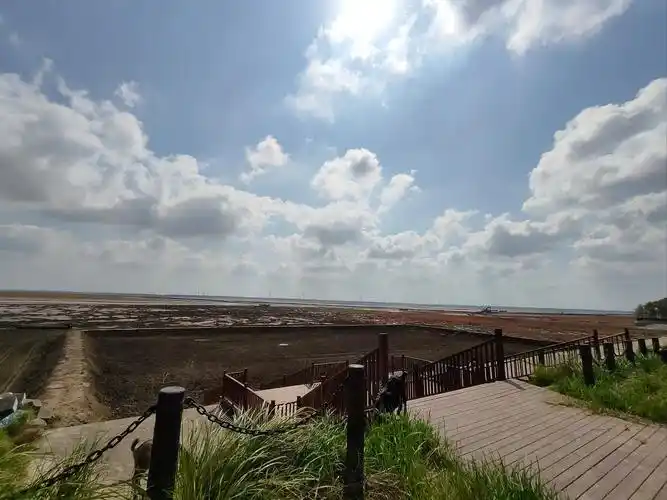 Stretching across the Jiangsu coastline, Tiaozini's remarkable fan-shaped radial sand ridges were sculpted over millennia by silt deposition from the old Yellow River and Yangtze. This geological fingerprint makes the site a natural counterpart to the Wadden Sea's tidal flats—a UNESCO treasure itself—and unlike most Chinese wetlands, it remains almost entirely undeveloped. In 2019, it became part of the "Migratory Bird Habitats along the Coast of Yellow Sea-Bohai Gulf of China," filling a long-standing gap in World Heritage listings for coastal ecosystems and earning praise from BirdLife International as the flyway's most critical staging post.
The park's signature attraction is the "720" high-tide bird sanctuary, an engineered refuge where rising tides concentrate foraging flocks onto a narrow strip of mudflat. Come spring or autumn migration, hundreds of thousands of shorebirds, waterfowl, and herons erupt into swirling clouds at the slightest disturbance—a phenomenon locals call "bird waves," rivaling the mass movements at Scotland's Forth estuary or Israel's Hula Valley. Keen eyes may spot the critically endangered spoon-billed sandpiper, fewer than 800 of which remain on Earth.
Beyond birdwatching, visitors can join fishermen for traditional mudflat foraging, wading through soft silt at low tide to collect mudskippers, crabs, and sea snails. This hands-on experience echoes centuries-old coastal livelihoods across East Asia and offers an immersive lesson in tidal ecology that delights families and curious travelers alike. The on-site Wetland Science Museum reinforces the lesson with specimens and multimedia exhibits.
Practical comforts include a 2-kilometer observation boardwalk extending into the mudflats, a tidal-viewing platform, and several glassed bird blinds fitted with high-powered telescopes. Best viewing seasons run April through June and September through November, with golden-hour light at dawn and dusk producing the most photogenic flocks. Local restaurants specialize in Yancheng seafood and lighter Huaiyang cuisine.
Consult tide tables in advance to align mudflat foraging with birdwatching, and pack tall rubber boots, sun protection, and binoculars. Reaching the park takes roughly one hour by car from Yancheng High-Speed Rail Station, making it an ideal three-day eco-escape from Shanghai, Nanjing, or Hangzhou for anyone seeking a quieter, wilder side of China's booming eastern seaboard.
Stretching across the Jiangsu coastline, Tiaozini's remarkable fan-shaped radial sand ridges were sculpted over millennia by silt deposition from the old Yellow River and Yangtze. This geological fingerprint makes the site a natural counterpart to the Wadden Sea's tidal flats—a UNESCO treasure itself—and unlike most Chinese wetlands, it remains almost entirely undeveloped. In 2019, it became part of the "Migratory Bird Habitats along the Coast of Yellow Sea-Bohai Gulf of China," filling a long-standing gap in World Heritage listings for coastal ecosystems and earning praise from BirdLife International as the flyway's most critical staging post.
The park's signature attraction is the "720" high-tide bird sanctuary, an engineered refuge where rising tides concentrate foraging flocks onto a narrow strip of mudflat. Come spring or autumn migration, hundreds of thousands of shorebirds, waterfowl, and herons erupt into swirling clouds at the slightest disturbance—a phenomenon locals call "bird waves," rivaling the mass movements at Scotland's Forth estuary or Israel's Hula Valley. Keen eyes may spot the critically endangered spoon-billed sandpiper, fewer than 800 of which remain on Earth.
Beyond birdwatching, visitors can join fishermen for traditional mudflat foraging, wading through soft silt at low tide to collect mudskippers, crabs, and sea snails. This hands-on experience echoes centuries-old coastal livelihoods across East Asia and offers an immersive lesson in tidal ecology that delights families and curious travelers alike. The on-site Wetland Science Museum reinforces the lesson with specimens and multimedia exhibits.
Practical comforts include a 2-kilometer observation boardwalk extending into the mudflats, a tidal-viewing platform, and several glassed bird blinds fitted with high-powered telescopes. Best viewing seasons run April through June and September through November, with golden-hour light at dawn and dusk producing the most photogenic flocks. Local restaurants specialize in Yancheng seafood and lighter Huaiyang cuisine.
Consult tide tables in advance to align mudflat foraging with birdwatching, and pack tall rubber boots, sun protection, and binoculars. Reaching the park takes roughly one hour by car from Yancheng High-Speed Rail Station, making it an ideal three-day eco-escape from Shanghai, Nanjing, or Hangzhou for anyone seeking a quieter, wilder side of China's booming eastern seaboard.