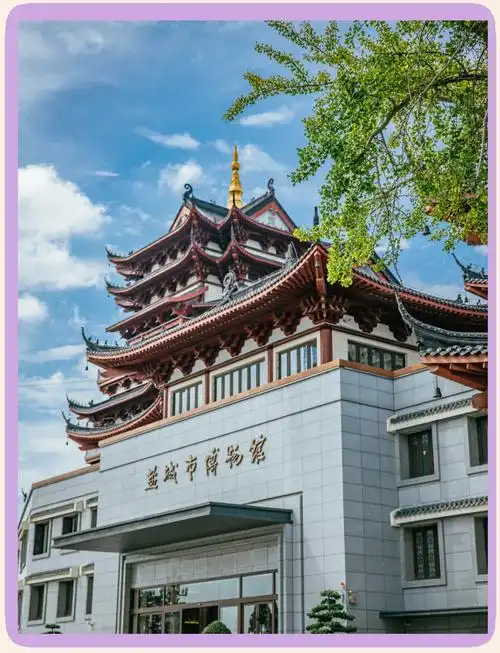
Yancheng Museum sits at the cultural heart of one of China's oldest maritime-influenced cities, where the practice of boiling seawater for salt dates back millennia—much like the salt-producing traditions of Mediterranean coastlines from Sicily to Sardinia. Founded in 1961 and relocated to its present home on Xianfeng Island in 2021, the institution safeguards more than 20,000 artifacts spanning Neolithic painted pottery through the revolutionary legacy of the New Fourth Army. The collection places regional Chinese history in dialogue with broader East Asian developments, from Han dynasty salt-boilers to contemporary wetland conservation efforts.
The architecture itself rewards attention. Designers fused traditional temple-roof silhouettes with curtain-wall transparency, achieving what locals describe as "majestic yet supple"—comparable in ambition to Sir Norman Foster's contemporary Asian civic projects. Facilities include a lecture hall, design shop, and café, making extended visits comfortable. Notably, Yancheng Museum is the city's first to remain open until 9 p.m., and after dusk its illuminated façade becomes a riverside beacon rivaling the evening appeal of waterfront museums in Hamburg or Bilbao.
Culturally, the four permanent halls—"Yancheng of the World," "Rhythm of the Sea," "Elegance of Water," and "Wings of Salt"—weave together intangible heritage such as Huai opera masks with ecological storytelling about the Yellow Sea–Bohai Gulf migratory bird corridor, a UNESCO World Heritage Site. The dramatic centerpiece is a fully articulated sperm whale skeleton, displayed alongside red-crowned crane and Père David's deer taxidermy in a space that evokes London's Natural History Museum's grand biology halls.
Until October 2026, the temporary Ancient Egyptian Civilization exhibition brings 171 genuine artifacts from Italy's Museo Egizio in Turin—one of the world's premier Egyptological collections, founded in 1824. Visitors can examine mummification implements, amulets, and statuary in a thoughtful cross-civilization dialogue with Yancheng's own ancient salt-making relics, offering rare context for travelers accustomed to seeing such objects only in Cairo, London, or Paris.
Practical details: The museum lies at 126 Jianjun West Road in Tinghu District, open daily 9 a.m. to 9 p.m. (last entry 8:30 p.m.), closed Mondays—comparable to Western museum schedules. Permanent galleries are free with advance booking via ID; the Egyptian exhibition requires a separate ticket, and English-speaking guided tours can be arranged by calling 0515-88550080. Allow two and a half to three hours, following the recommended route from permanent halls on the second floor to the special exhibition space. Bring a light jacket—the air-conditioning runs brisk—and plan an evening stroll through the lantern-lit Yanzhen Water Street next door, which echoes Venice's smaller canal quarters for an atmospheric conclusion to the day.