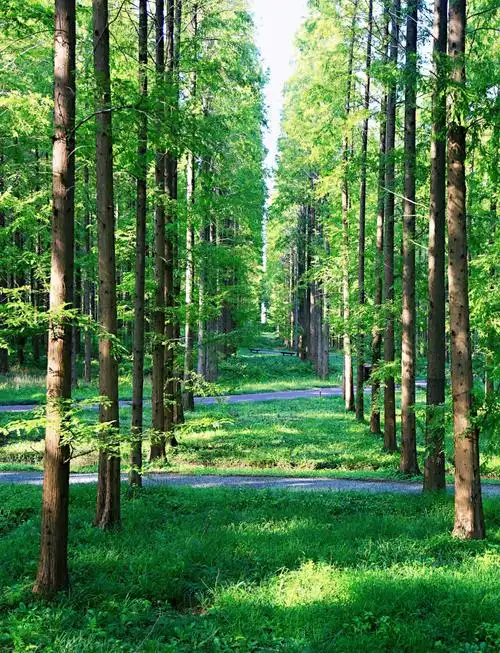
The dawn redwoods of Huanghai Forest Park are part of one of botany's greatest comeback stories. Metasequoia glyptostroboides was known only from 50-million-year-old fossils and presumed extinct until a living stand was discovered in Hubei Province in 1944. Seeds sent to botanic gardens around the world helped save the species, and today these "living fossils" form a planted forest here on the former salt flats of the Yellow Sea coast. While it lacks the wild antiquity of Europe's Białowieża Forest, the park offers a comparable sense of immersion into towering conifers—deliberately engineered as a coastal windbreak beginning in the 1960s.
What makes this forest unusual is its flatness—a true "plains forest" stretching to the horizon rather than climbing hillsides as in Germany or Switzerland. The neatly planted columns of dawn redwood, swamp cypress, and pond cypress create cathedral-like aisles that shift dramatically with the seasons: tender spring green, dense summer shade, fiery autumn russets, and the misty grey-green tones of winter. More than 100 bird species inhabit the canopy, and the air carries ion concentrations several times higher than in nearby cities, earning the park its "natural oxygen bar" nickname and making it a popular retreat for stressed urbanites from Shanghai, Nanjing, and Hangzhou.
The Mist Forest Boardwalk is the park's most photographed feature. Around 11 a.m. each morning, staff activate an artificial fog system that sends a soft, cool mist drifting through the lower trunks of the redwoods. Visitors compare the effect to scenes from a Studio Ghibli film or the misty woodlands of British fairy tales. The flat wooden walkway winds for several kilometres through the trees and links multiple viewing platforms, with gentle gradients suitable for strollers, wheelchairs, and grandparents. Photographers should arrive early to beat the crowds; anyone with a smartphone will leave with dreamy, frame-worthy shots.
The park's narrow-gauge forest train is a delight for both children and nostalgic adults. Modeled on the kind of forestry railways once common across European countryside in places like the Harz Mountains or the Black Forest, the small diesel cars weave for roughly 30 minutes through the densest stands of trees. Locals strongly recommend sitting in the third carriage, where the front window offers an unobstructed view of the oncoming green corridor—ideal for photos. The gentle rocking and the rustle of redwood needles make this an unexpectedly meditative ride.
Beyond recreation, the forest serves a serious ecological purpose as part of China's coastal shelterbelt program—a 20th-century effort that recalls America's Civilian Conservation Corps tree-planting campaigns of the 1930s or France's Landes forest restoration. Today the park also functions as a wellness destination, with cycling paths, tent camping areas, and parent-child activity zones scattered between the stands. It is a place where Shanghai schoolchildren learn about wetland ecosystems and where city families come to barbecue, cycle, and breathe deeply. For Western travelers used to manicured French or German forests, this managed landscape offers a fascinating glimpse of how a modern nation can rebuild an entire ecosystem from former salt marsh.
The park is open year-round, though late April through early October offers the most comfortable weather and richest foliage. Allow four to six hours to enjoy both the boardwalk and the train ride. Enter through the East Gate or South Gate, plan to reach the Mist Forest by mid-morning, and save the train for the early afternoon when sunlight slants through the canopy. On-site restaurants serve simple Jiangsu-style noodles and rice dishes, and bicycles are available for rent. Wear comfortable walking shoes, bring sunscreen and insect repellent, and pack a light jacket—coastal breezes can be cooler than inland Jiangsu.