Princess Wencheng Temple
⭐ 3.00
Princess Wencheng Temple, Yushu City, Yushu Tibetan Autonomous Prefecture, Qinghai Province, China
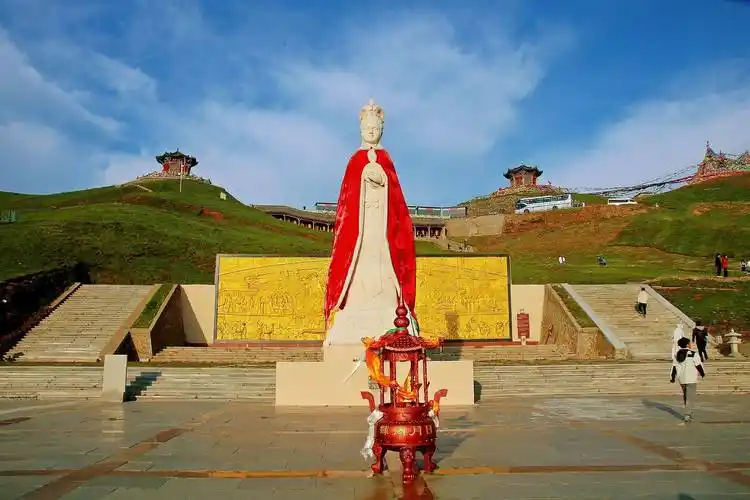 Carved into a cliff above a mountain stream, the Princess Wencheng Temple dates to the Zhenguan era (627–649 AD) of Emperor Taizong's reign—a period when Byzantium was still recovering from the Iconoclast Controversy and Islam was barely a century old. According to local tradition, Princess Wencheng, the imperial bride sent to wed Songtsen Gampo of Tibet, lingered here for months during her epic journey from Chang'an, teaching local herdsmen farming and weaving. The grateful Tibetans repaid her by hewing statues directly into the living rock. Comparable in spirit to Spain's cave-shrines of Covarrubias or the rock-cut churches of Cappadocia, this site predates the more famous Potala Palace in Lhasa by several decades.
The architectural ensemble is remarkable for its restraint and intimate scale. A three-tiered Tibetan-style flat-roof structure with a deep crimson-and-gold fining presses tightly against the cliff, sheltering an inner chamber where nine sculpted Buddhas and dense walls of ancient Tibetan and Chinese sutras are etched directly into the stone. The central figure—a 7.3-meter "Vaidurya" (Beryl) Tathagata Buddha—flanked by eight bodhisattvas, shows the muscular, earthbound drapery of Tang Central Plains workmanship softened by the more stylized iconography of early Tibetan craftsmanship. Unlike the gilded grandeur of Lhasa's monasteries, this feels like stepping into a prayer carved into the mountain itself.
Designated a Major National Cultural Heritage Site, the temple embodies a singular moment when two great civilizations met not through warfare but through marriage, language, and faith. The Tang-Tibet Ancient Road that Princess Wencheng traveled was the medieval equivalent of the Silk Road, carrying not only silk but also Buddhist sutras, irrigation techniques, and papermaking westward. The temple's bilingual inscriptions—some of the earliest known Tibetan script carvings—represent a precious artifact of linguistic history as much as of devotion.
Practical access is straightforward: the temple lies about 25 kilometers from Jiegu, the capital of Yushu, along a fully paved road, and admission is free. The most comfortable visiting season runs June through September, when the surrounding Leba Valley forests and the riverside "Water Mani" stones are at their most photogenic. Plan two to three hours including the nearby Wencheng Memorial Hall and the gentle Leba Valley walking trails. Mornings offer the purest light for photographing the white stupas and prayer flags fluttering against the cliff.
At an elevation where the air thins and the sky feels close enough to touch, the Princess Wencheng Temple offers something increasingly rare in modern tourism: a site of profound historical weight that remains unspoiled by commercialization. For travelers drawn to deep cultural encounters rather than checklist attractions, this small but irreplaceable sanctuary rewards those willing to make the journey into Qinghai's high plateau. Travelers should respect local customs—circumambulate clockwise, dress in long sleeves and trousers, never step on mani stones, and refrain from photography inside the main hall. Prepare for altitude with rest, oxygen, and layered windproof clothing.
Carved into a cliff above a mountain stream, the Princess Wencheng Temple dates to the Zhenguan era (627–649 AD) of Emperor Taizong's reign—a period when Byzantium was still recovering from the Iconoclast Controversy and Islam was barely a century old. According to local tradition, Princess Wencheng, the imperial bride sent to wed Songtsen Gampo of Tibet, lingered here for months during her epic journey from Chang'an, teaching local herdsmen farming and weaving. The grateful Tibetans repaid her by hewing statues directly into the living rock. Comparable in spirit to Spain's cave-shrines of Covarrubias or the rock-cut churches of Cappadocia, this site predates the more famous Potala Palace in Lhasa by several decades.
The architectural ensemble is remarkable for its restraint and intimate scale. A three-tiered Tibetan-style flat-roof structure with a deep crimson-and-gold fining presses tightly against the cliff, sheltering an inner chamber where nine sculpted Buddhas and dense walls of ancient Tibetan and Chinese sutras are etched directly into the stone. The central figure—a 7.3-meter "Vaidurya" (Beryl) Tathagata Buddha—flanked by eight bodhisattvas, shows the muscular, earthbound drapery of Tang Central Plains workmanship softened by the more stylized iconography of early Tibetan craftsmanship. Unlike the gilded grandeur of Lhasa's monasteries, this feels like stepping into a prayer carved into the mountain itself.
Designated a Major National Cultural Heritage Site, the temple embodies a singular moment when two great civilizations met not through warfare but through marriage, language, and faith. The Tang-Tibet Ancient Road that Princess Wencheng traveled was the medieval equivalent of the Silk Road, carrying not only silk but also Buddhist sutras, irrigation techniques, and papermaking westward. The temple's bilingual inscriptions—some of the earliest known Tibetan script carvings—represent a precious artifact of linguistic history as much as of devotion.
Practical access is straightforward: the temple lies about 25 kilometers from Jiegu, the capital of Yushu, along a fully paved road, and admission is free. The most comfortable visiting season runs June through September, when the surrounding Leba Valley forests and the riverside "Water Mani" stones are at their most photogenic. Plan two to three hours including the nearby Wencheng Memorial Hall and the gentle Leba Valley walking trails. Mornings offer the purest light for photographing the white stupas and prayer flags fluttering against the cliff.
At an elevation where the air thins and the sky feels close enough to touch, the Princess Wencheng Temple offers something increasingly rare in modern tourism: a site of profound historical weight that remains unspoiled by commercialization. For travelers drawn to deep cultural encounters rather than checklist attractions, this small but irreplaceable sanctuary rewards those willing to make the journey into Qinghai's high plateau. Travelers should respect local customs—circumambulate clockwise, dress in long sleeves and trousers, never step on mani stones, and refrain from photography inside the main hall. Prepare for altitude with rest, oxygen, and layered windproof clothing.