Volcanic Crater Geological Park
⭐ 3.50
Jiangshan Peninsula, Fangcheng District, Fangchenggang City, Guangxi Zhuang Autonomous Region, China
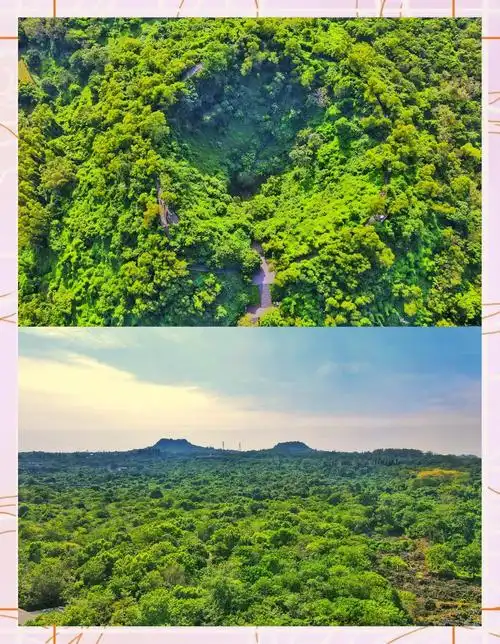 Far less famous than Italy's Stromboli or the dramatic volcanic peaks of Lanzarote, this small island holds a quieter kind of geological drama. Its bedrock was laid down roughly 500,000 years ago during the Tertiary Period, when ancient eruptions blanketed what is now the Beibu Gulf in basalt and tuff. Centuries of tectonic uplift, monsoon-driven waves, and salt weathering have since exposed those subterranean layers, turning them into the colorful, sculpted coastline you see today—a living textbook of Cenozoic volcanism that draws comparisons to Northern Ireland's Giant's Causeway or Iceland's black-sand shores, but on a far more intimate scale.
The island's defining feature is its "weathered-volcanic" aesthetic. Scattered across the shore lie countless rounded "volcanic eggs"—spheroidal basalt nodules polished by millennia of wave action—as well as pebble beaches streaked in iron-red, ochre, amber, and bluish-green hues, the colors tracing back to differing mineral compositions in the original lava flows. Sea stacks and reef outcrops rise along the coast like natural sculpture, creating scenes reminiscent of the Faraglioni rocks off Capri, though colored by an entirely different geological palette.
Local imagination has christened several of the more striking formations after the Olympic rings and the Chinese zodiac, dubbing them the "Olympic Wonder Rocks." These naturally carved shapes have become a favorite subject for landscape photographers, who flock here at sunrise and sunset when the multicolored stones seem to glow. For visitors, the rocks also serve as an open-air geology lesson, illustrating how erosion, mineralogy, and time combine to shape coastlines in ways no human architect could replicate.
Access is straightforward but requires some planning. The island lies about a forty-minute drive from Fangchenggang city, after which visitors board small boats from either Hongsha Village Wharf or Qinzhou Port Wharf. The site is open year-round from 08:00 to 17:30; tickets can be purchased on-site or through official channels. Once on the island, a circular walking trail threads past the main rock formations and viewpoints, while at low tide shallow reefs and tiny satellite islets become walkable, perfect for families and gentle exploration.
Because the island remains a relatively undeveloped destination, visitors should treat it as an adventure rather than a resort. Bring plenty of drinking water, snacks, sunscreen, and mosquito repellent, and wear sturdy non-slip hiking shoes—reef sections can be treacherous when wet. Public transport is limited, so renting a car with driver or arranging private transfers to the pier is strongly recommended; tide tables and boat schedules should be checked in advance. Those who make the effort will be rewarded with one of southern China's most photogenic and least crowded coastal landscapes.
Far less famous than Italy's Stromboli or the dramatic volcanic peaks of Lanzarote, this small island holds a quieter kind of geological drama. Its bedrock was laid down roughly 500,000 years ago during the Tertiary Period, when ancient eruptions blanketed what is now the Beibu Gulf in basalt and tuff. Centuries of tectonic uplift, monsoon-driven waves, and salt weathering have since exposed those subterranean layers, turning them into the colorful, sculpted coastline you see today—a living textbook of Cenozoic volcanism that draws comparisons to Northern Ireland's Giant's Causeway or Iceland's black-sand shores, but on a far more intimate scale.
The island's defining feature is its "weathered-volcanic" aesthetic. Scattered across the shore lie countless rounded "volcanic eggs"—spheroidal basalt nodules polished by millennia of wave action—as well as pebble beaches streaked in iron-red, ochre, amber, and bluish-green hues, the colors tracing back to differing mineral compositions in the original lava flows. Sea stacks and reef outcrops rise along the coast like natural sculpture, creating scenes reminiscent of the Faraglioni rocks off Capri, though colored by an entirely different geological palette.
Local imagination has christened several of the more striking formations after the Olympic rings and the Chinese zodiac, dubbing them the "Olympic Wonder Rocks." These naturally carved shapes have become a favorite subject for landscape photographers, who flock here at sunrise and sunset when the multicolored stones seem to glow. For visitors, the rocks also serve as an open-air geology lesson, illustrating how erosion, mineralogy, and time combine to shape coastlines in ways no human architect could replicate.
Access is straightforward but requires some planning. The island lies about a forty-minute drive from Fangchenggang city, after which visitors board small boats from either Hongsha Village Wharf or Qinzhou Port Wharf. The site is open year-round from 08:00 to 17:30; tickets can be purchased on-site or through official channels. Once on the island, a circular walking trail threads past the main rock formations and viewpoints, while at low tide shallow reefs and tiny satellite islets become walkable, perfect for families and gentle exploration.
Because the island remains a relatively undeveloped destination, visitors should treat it as an adventure rather than a resort. Bring plenty of drinking water, snacks, sunscreen, and mosquito repellent, and wear sturdy non-slip hiking shoes—reef sections can be treacherous when wet. Public transport is limited, so renting a car with driver or arranging private transfers to the pier is strongly recommended; tide tables and boat schedules should be checked in advance. Those who make the effort will be rewarded with one of southern China's most photogenic and least crowded coastal landscapes.