Peach Blossom Land Scenic Area
⭐ 3.20
Changshan County, Quzhou City, Zhejiang Province, China
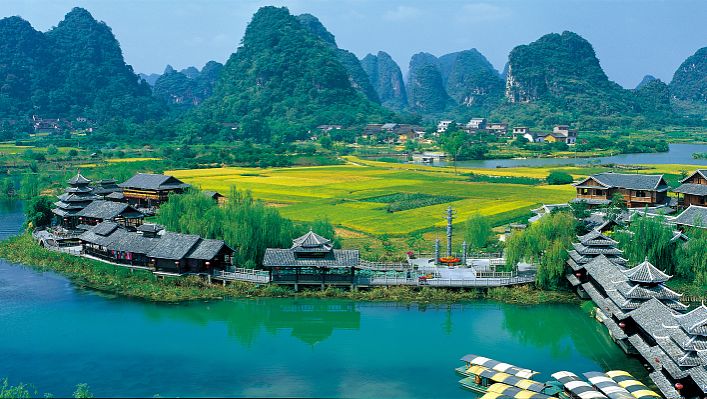 Despite its evocative name, Taohuayuan has no direct connection to the legendary utopia described by Tao Yuanming in his 421 CE essay "The Peach Blossom Spring," one of Chinese literature's most celebrated parables of escape from worldly turmoil, widely taught across East Asia and familiar to many readers through translations by Arthur Waley. The valley actually takes its identity from a single line of calligraphy on the Lefeng Bridge: "Jing si taoyuan," meaning "A Scene Like the Peach Garden." Built during the Qing dynasty (1644–1911), roughly contemporaneous with the reign of the Sun King in France and the rebuilding of Versailles, this modest single-arch stone span is the cultural heart of the site. Local tradition holds that a passing scholar, charmed by the encircling peaks and twin streams, paused here to inscribe the verse that would name the valley forever.
The natural setting is the real showstopper. The mountains rise around the valley in a distinctive gourd or calabash shape, an arrangement reminiscent of glacial cirques found in the Tyrolean Alps, while the confluence of Taohua Stream and Baiyun Stream creates a postcard-perfect water-meets-cliff composition. A wooden plank path winds along the canyon walls, passing the charmingly named Blue Magpie Bridge and leading into Furong Gorge, the principal hiking zone where layered ridgelines fade into misty blue distance. With near-total forest cover, the air carries that clean, pine-and-humus scent familiar to hikers in the Black Forest or Scandinavian woodlands, and summer temperatures hover around a comfortable 22°C, roughly ten degrees cooler than nearby lowlands.
A less expected dimension awaits on the valley's upper trails: traces of the Red Army route associated with Fang Zhimin, the Communist commander martyred in 1935 whose final writings, including the famous "Plea for Lovely China," remain required reading in Chinese schools. Small sections of original marching path survive, and the site now hosts school groups for patriotic education sessions. Visitors can walk a half-hour stretch of the historic trail alongside the nature hike, lending the outing a sense of historical weight that elevates it beyond pure scenic strolling. Several local farmstays, notably Taoyuan Shanzhuang, lean into this heritage with rustic menus featuring red rice and pumpkin soup, evoking the austere field rations of the 1930s revolution.
Practically speaking, this is an easy, unhurried destination rather than a blockbuster sight. Entry is free or nominal, with no mandatory shuttles, and the full walking loop from the entrance archway via Lefeng Bridge, the canyon plank road, Furong Gorge viewpoint, and Red Army trail section takes two to three hours at a relaxed pace. Late March through mid-April brings the celebrated peach blossoms, when the valley briefly justifies its poetic name in full color; August visitors should expect lush green monochrome rather than floral spectacle. Reaching the site requires a self-drive or chartered car on winding mountain roads, public buses being infrequent, and the final lanes include steep grades that demand caution from inexperienced drivers.
Accommodation and amenities remain resolutely rustic. Mountain homestays and farmstays cluster near the entrance, offering clean but simple rooms with mountain views at budget-friendly rates, and most include meals. There are no convenience stores, vending machines, or developed tourist facilities, so visitors should stock water and snacks, download offline maps, and keep a translation app handy as English signage is sparse. Mobile signal can drop out in the deeper gorge. Those who arrive with modest expectations, comfortable hiking shoes, and a willingness to slow down will find exactly what the Qing scholar saw four centuries ago: a quiet pocket of China where the rush of the modern world has not quite arrived.
Despite its evocative name, Taohuayuan has no direct connection to the legendary utopia described by Tao Yuanming in his 421 CE essay "The Peach Blossom Spring," one of Chinese literature's most celebrated parables of escape from worldly turmoil, widely taught across East Asia and familiar to many readers through translations by Arthur Waley. The valley actually takes its identity from a single line of calligraphy on the Lefeng Bridge: "Jing si taoyuan," meaning "A Scene Like the Peach Garden." Built during the Qing dynasty (1644–1911), roughly contemporaneous with the reign of the Sun King in France and the rebuilding of Versailles, this modest single-arch stone span is the cultural heart of the site. Local tradition holds that a passing scholar, charmed by the encircling peaks and twin streams, paused here to inscribe the verse that would name the valley forever.
The natural setting is the real showstopper. The mountains rise around the valley in a distinctive gourd or calabash shape, an arrangement reminiscent of glacial cirques found in the Tyrolean Alps, while the confluence of Taohua Stream and Baiyun Stream creates a postcard-perfect water-meets-cliff composition. A wooden plank path winds along the canyon walls, passing the charmingly named Blue Magpie Bridge and leading into Furong Gorge, the principal hiking zone where layered ridgelines fade into misty blue distance. With near-total forest cover, the air carries that clean, pine-and-humus scent familiar to hikers in the Black Forest or Scandinavian woodlands, and summer temperatures hover around a comfortable 22°C, roughly ten degrees cooler than nearby lowlands.
A less expected dimension awaits on the valley's upper trails: traces of the Red Army route associated with Fang Zhimin, the Communist commander martyred in 1935 whose final writings, including the famous "Plea for Lovely China," remain required reading in Chinese schools. Small sections of original marching path survive, and the site now hosts school groups for patriotic education sessions. Visitors can walk a half-hour stretch of the historic trail alongside the nature hike, lending the outing a sense of historical weight that elevates it beyond pure scenic strolling. Several local farmstays, notably Taoyuan Shanzhuang, lean into this heritage with rustic menus featuring red rice and pumpkin soup, evoking the austere field rations of the 1930s revolution.
Practically speaking, this is an easy, unhurried destination rather than a blockbuster sight. Entry is free or nominal, with no mandatory shuttles, and the full walking loop from the entrance archway via Lefeng Bridge, the canyon plank road, Furong Gorge viewpoint, and Red Army trail section takes two to three hours at a relaxed pace. Late March through mid-April brings the celebrated peach blossoms, when the valley briefly justifies its poetic name in full color; August visitors should expect lush green monochrome rather than floral spectacle. Reaching the site requires a self-drive or chartered car on winding mountain roads, public buses being infrequent, and the final lanes include steep grades that demand caution from inexperienced drivers.
Accommodation and amenities remain resolutely rustic. Mountain homestays and farmstays cluster near the entrance, offering clean but simple rooms with mountain views at budget-friendly rates, and most include meals. There are no convenience stores, vending machines, or developed tourist facilities, so visitors should stock water and snacks, download offline maps, and keep a translation app handy as English signage is sparse. Mobile signal can drop out in the deeper gorge. Those who arrive with modest expectations, comfortable hiking shoes, and a willingness to slow down will find exactly what the Qing scholar saw four centuries ago: a quiet pocket of China where the rush of the modern world has not quite arrived.