Taishan Cableway
⭐ 4.20
Taishan Cableway, Taishan District, Tai'an City, Shandong Province, China
 Mount Tai anchors the eastern extremity of China's Five Sacred Mountains, a chain that stretches across the cultural heartland much as the pilgrimage routes of Santiago de Compostela anchor spiritual Europe. Emperors of the Han, Tang, and Qing dynasties all climbed here to perform the feng and shan sacrifices, leaving behind more than 1,800 surviving inscriptions and stone tablets carved directly into the cliffs. Designated a UNESCO World Heritage Site in 1987 for both its natural and cultural value, the mountain occupies a place in the Chinese imagination comparable to Olympus in Greece or Croagh Patrick in Ireland—a summit where heaven and earth are said to meet. The cableways do not diminish this legacy; they simply deliver modern pilgrims to where ancient ones walked.
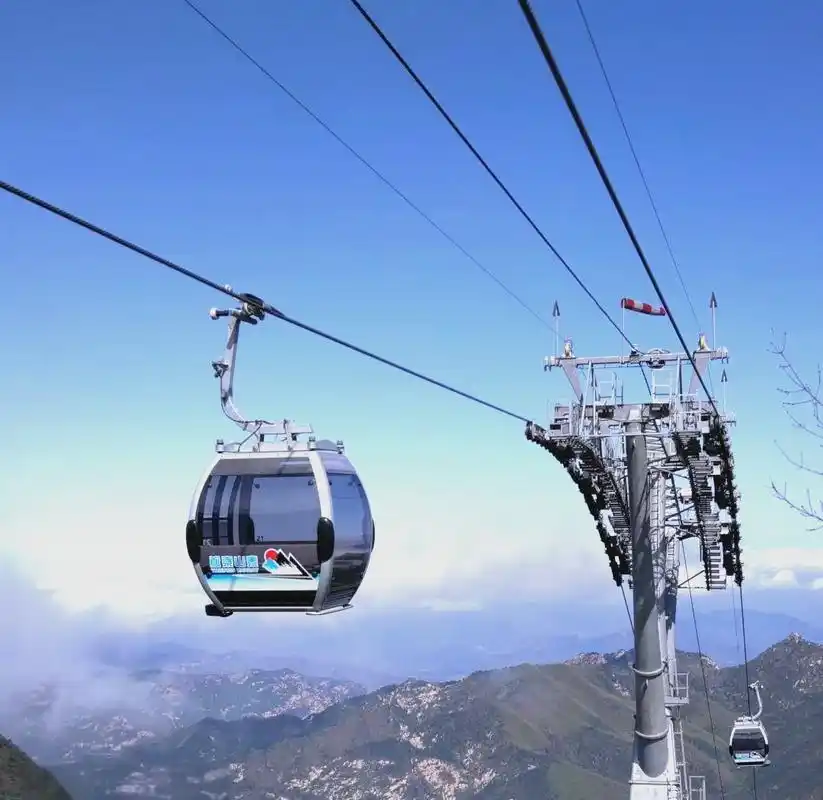
The system comprises three separate lines, each engineered for a different approach. The Zhongtianmen Cableway is the workhorse: it spans the gap between Zhongtianmen Gate and Nantianmen, completing the journey in roughly six minutes. The Taohuayuan Cableway, on the western flank, runs for about fifteen minutes through the gorge of the Colored Stone Stream, where mineral-stained boulders create a palette that shifts with the seasons. The Houshiwu Cableway is the budget option at just 20 yuan, serving the quieter back-mountain trails. All equipment was overhauled in 2024, and the cabins glide smoothly even when carrying full loads of sightseers.
Culturally, the Zhongtianmen line delivers the headline spectacle: from the cabin window you stare straight down the Eighteen Turns, the near-vertical stone stairway known as the "Heavenly Gate Cloud Ladder." Seen from the air, the relentless switchbacks feel like a scar cut into the living rock, a visual punch similar to glimpsing the switchbacks of the Stelvio Pass from a cable car in the Italian Alps. Ming and Qing dynasty inscriptions crowd the cliff walls beside this route, so the few minutes spent aloft carry more than scenery—they pass three centuries of carved poetry. The Taohuayuan line offers a softer counterpoint, threading through forested valleys where the only sound is the creek below.
Tickets cost 100 yuan one-way on the Zhongtimen and Taohuayuan lines, 20 yuan on Houshiwu, with half-price concessions for visitors over 60. Operating hours generally run from 6:00 a.m. to 6:30 p.m. in peak season, though they shorten in winter—always confirm the last descent, because a missed cableway means hiking down in the dark on treacherous stone steps. Book through the official "Mount Tai Scenic Area" WeChat mini-program; the on-site windows offer no discounts and accept only mobile payment. Children, elderly travelers, and anyone with knee issues will find the cableway almost essential, since the lower sections of the mountain involve thousands of uneven steps.
The chief complaint is queuing. During summer and national holidays, the Zhongtianmen line's descent can stretch past two hours at peak, so early morning ascents or a switch to the Taohuayuan line for the way down are smart strategies. Weather is the other variable: high winds, lightning, or icy conditions can suspend operations with little warning, so check the official notice board the morning of your visit. Despite the price and the crowds, the calculation is simple—against a four-hour grind of stone steps in summer heat, a six-minute glide past the Eighteen Turns is not a luxury but a reasonable trade.
What separates the Mount Tai cableways from their European counterparts is the cargo they carry. You are not simply transported to a viewpoint; you are lifted toward a summit that has defined Chinese civilization for millennia, where the sunrise has been celebrated in verse since the Bronze Age. Stand on the upper platform as the cabin doors open and the South Gate to Heaven appears ahead, and the brevity of the ride becomes irrelevant. The mountain does the rest.
Mount Tai anchors the eastern extremity of China's Five Sacred Mountains, a chain that stretches across the cultural heartland much as the pilgrimage routes of Santiago de Compostela anchor spiritual Europe. Emperors of the Han, Tang, and Qing dynasties all climbed here to perform the feng and shan sacrifices, leaving behind more than 1,800 surviving inscriptions and stone tablets carved directly into the cliffs. Designated a UNESCO World Heritage Site in 1987 for both its natural and cultural value, the mountain occupies a place in the Chinese imagination comparable to Olympus in Greece or Croagh Patrick in Ireland—a summit where heaven and earth are said to meet. The cableways do not diminish this legacy; they simply deliver modern pilgrims to where ancient ones walked.
The system comprises three separate lines, each engineered for a different approach. The Zhongtianmen Cableway is the workhorse: it spans the gap between Zhongtianmen Gate and Nantianmen, completing the journey in roughly six minutes. The Taohuayuan Cableway, on the western flank, runs for about fifteen minutes through the gorge of the Colored Stone Stream, where mineral-stained boulders create a palette that shifts with the seasons. The Houshiwu Cableway is the budget option at just 20 yuan, serving the quieter back-mountain trails. All equipment was overhauled in 2024, and the cabins glide smoothly even when carrying full loads of sightseers.
Culturally, the Zhongtianmen line delivers the headline spectacle: from the cabin window you stare straight down the Eighteen Turns, the near-vertical stone stairway known as the "Heavenly Gate Cloud Ladder." Seen from the air, the relentless switchbacks feel like a scar cut into the living rock, a visual punch similar to glimpsing the switchbacks of the Stelvio Pass from a cable car in the Italian Alps. Ming and Qing dynasty inscriptions crowd the cliff walls beside this route, so the few minutes spent aloft carry more than scenery—they pass three centuries of carved poetry. The Taohuayuan line offers a softer counterpoint, threading through forested valleys where the only sound is the creek below.
Tickets cost 100 yuan one-way on the Zhongtimen and Taohuayuan lines, 20 yuan on Houshiwu, with half-price concessions for visitors over 60. Operating hours generally run from 6:00 a.m. to 6:30 p.m. in peak season, though they shorten in winter—always confirm the last descent, because a missed cableway means hiking down in the dark on treacherous stone steps. Book through the official "Mount Tai Scenic Area" WeChat mini-program; the on-site windows offer no discounts and accept only mobile payment. Children, elderly travelers, and anyone with knee issues will find the cableway almost essential, since the lower sections of the mountain involve thousands of uneven steps.
The chief complaint is queuing. During summer and national holidays, the Zhongtianmen line's descent can stretch past two hours at peak, so early morning ascents or a switch to the Taohuayuan line for the way down are smart strategies. Weather is the other variable: high winds, lightning, or icy conditions can suspend operations with little warning, so check the official notice board the morning of your visit. Despite the price and the crowds, the calculation is simple—against a four-hour grind of stone steps in summer heat, a six-minute glide past the Eighteen Turns is not a luxury but a reasonable trade.
What separates the Mount Tai cableways from their European counterparts is the cargo they carry. You are not simply transported to a viewpoint; you are lifted toward a summit that has defined Chinese civilization for millennia, where the sunrise has been celebrated in verse since the Bronze Age. Stand on the upper platform as the cabin doors open and the South Gate to Heaven appears ahead, and the brevity of the ride becomes irrelevant. The mountain does the rest.