Hongmen Palace
⭐ 3.80
Hongmen Palace, Taishan District, Tai'an City, Shandong Province, China
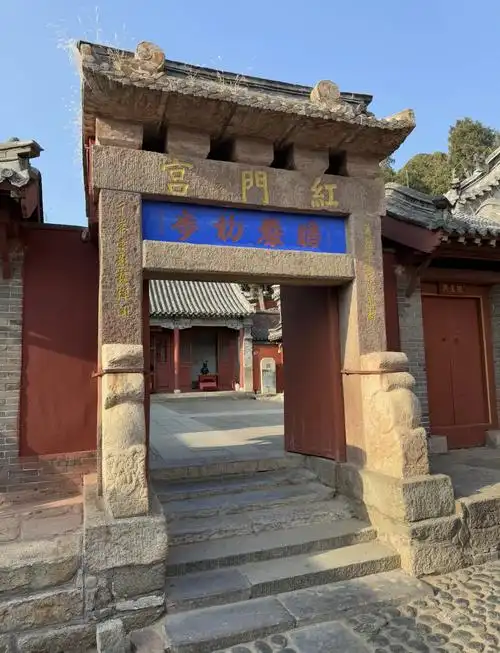 Red Gate Palace stands at the threshold of Mount Tai's sacred central ascent, a counterpart in spiritual weight to the pilgrim paths leading to sites like Santiago de Compostela or Greece's Mount Parnassus. For more than two thousand years, emperors journeyed here to perform the fengshan rituals, Heaven-and-Earth ceremonies meant to legitimize their rule—practices that parallel the ancient Roman tradition of augury on sacred peaks. The complex you see today was largely reshaped during a 1626 Ming restoration, but the site itself has served as a ceremonial threshold for centuries, watched over by generations of scholars, monks, and common pilgrims.
Architecturally, the palace is a model of Ming-era ingenuity. The complex straddles the mountain path in symmetrical twin courtyards: an eastern hall dedicated to Maitreya Buddha and a western shrine honoring Bixia Yuanjun, the Taoist goddess who presides over Mount Tai. Between them, the elegant Feiyun Pavilion bridges the trail, drawing the eye upward. Four stone memorial archways line the approach in sequence, including the celebrated "Confucius's Ascent" gateway, creating a processional corridor that heightens anticipation much as the nave of a Gothic cathedral channels worshippers toward the altar.
Beyond its architecture, Red Gate Palace preserves a vivid slice of syncretic Chinese religious culture. In the western courtyard, a remarkable "Mini-Tai" installation of carved boulders mimics the summit, allowing elderly or infirm devotees to symbolically complete the pilgrimage on their behalf—an imaginative solution echoing the votive offerings found in medieval European churches. The dense cluster of stelae and inscriptions further enriches the site, and in 2013 the palace was designated a nationally protected cultural treasure.
Practical access is straightforward: the courtyard itself is free to enter, but visitors must purchase a Mount Tai entry ticket (115 RMB for adults) at the lower gatehouse before reaching this zone. Opening hours generally run 7:00 a.m. to 5:00 p.m., though extended evening access is common around the fifteenth day of the third lunar month. Allow twenty to forty minutes for the core area, though most travelers weave it naturally into a broader ascent that also includes the nearby Guandi Temple, Doumu Palace, and the famous Jingshiyu stone-carved valley.
Arrive in the early morning or just after rainfall, when mist clings to the pines and the four archways seem to dissolve into the mountain air—a moment of hushed grandeur that recalls the opening cantos of Dante's Divine Comedy. Modest dress and quiet behavior are appreciated, as the site remains an active place of worship. Red Gate Palace is small in scale but profound in atmosphere, an essential first chapter for anyone seeking to understand why Mount Tai has drawn worshippers, poets, and emperors for three thousand years.
Red Gate Palace stands at the threshold of Mount Tai's sacred central ascent, a counterpart in spiritual weight to the pilgrim paths leading to sites like Santiago de Compostela or Greece's Mount Parnassus. For more than two thousand years, emperors journeyed here to perform the fengshan rituals, Heaven-and-Earth ceremonies meant to legitimize their rule—practices that parallel the ancient Roman tradition of augury on sacred peaks. The complex you see today was largely reshaped during a 1626 Ming restoration, but the site itself has served as a ceremonial threshold for centuries, watched over by generations of scholars, monks, and common pilgrims.
Architecturally, the palace is a model of Ming-era ingenuity. The complex straddles the mountain path in symmetrical twin courtyards: an eastern hall dedicated to Maitreya Buddha and a western shrine honoring Bixia Yuanjun, the Taoist goddess who presides over Mount Tai. Between them, the elegant Feiyun Pavilion bridges the trail, drawing the eye upward. Four stone memorial archways line the approach in sequence, including the celebrated "Confucius's Ascent" gateway, creating a processional corridor that heightens anticipation much as the nave of a Gothic cathedral channels worshippers toward the altar.
Beyond its architecture, Red Gate Palace preserves a vivid slice of syncretic Chinese religious culture. In the western courtyard, a remarkable "Mini-Tai" installation of carved boulders mimics the summit, allowing elderly or infirm devotees to symbolically complete the pilgrimage on their behalf—an imaginative solution echoing the votive offerings found in medieval European churches. The dense cluster of stelae and inscriptions further enriches the site, and in 2013 the palace was designated a nationally protected cultural treasure.
Practical access is straightforward: the courtyard itself is free to enter, but visitors must purchase a Mount Tai entry ticket (115 RMB for adults) at the lower gatehouse before reaching this zone. Opening hours generally run 7:00 a.m. to 5:00 p.m., though extended evening access is common around the fifteenth day of the third lunar month. Allow twenty to forty minutes for the core area, though most travelers weave it naturally into a broader ascent that also includes the nearby Guandi Temple, Doumu Palace, and the famous Jingshiyu stone-carved valley.
Arrive in the early morning or just after rainfall, when mist clings to the pines and the four archways seem to dissolve into the mountain air—a moment of hushed grandeur that recalls the opening cantos of Dante's Divine Comedy. Modest dress and quiet behavior are appreciated, as the site remains an active place of worship. Red Gate Palace is small in scale but profound in atmosphere, an essential first chapter for anyone seeking to understand why Mount Tai has drawn worshippers, poets, and emperors for three thousand years.