Tengwang Pavilion Scenic Area
⭐ 4.50
Tengwang Pavilion Scenic Area, Nanchang, Jiangxi, China
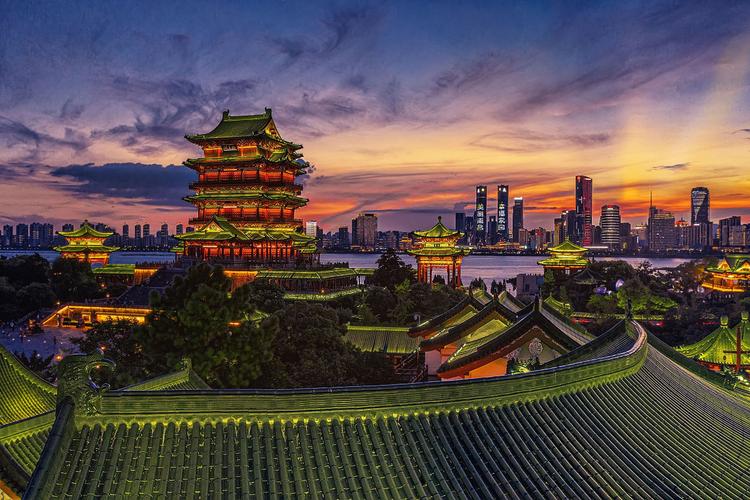 Built in 653 AD during the early Tang Dynasty—an era that produced some of humanity's greatest artistic achievements, from the soaring cathedrals of early medieval Europe to the golden mosaics of Constantinople—the Tengwang Pavilion was commissioned by Prince Li Yuanying, the younger brother of Emperor Tang Taizong. Over its 1,370-year history, this royal riverside retreat has been destroyed and rebuilt twenty-nine times, a remarkable cycle of devastation and renewal that parallels the fate of monuments like London's Old St. Paul's or Berlin's Reichstag. The present structure, completed in 1989, faithfully follows architectural plans left by Liang Sicheng, China's pioneering preservationist, restoring the pavilion's Tang-Song dynasty grandeur and cementing its place as Nanchang's most powerful historical symbol.
Rising 57.5 meters, the main pavilion employs an ingenious "apparent three, hidden seven" design—appearing as a modest three-story structure from outside while concealing seven interior levels within. Inside, visitors discover grand murals such as "Portrait of Talents" and "Map of Sacred Land," alongside scale models charting the pavilion's evolution through the centuries. The surrounding grounds feature Tang-style auxiliary buildings including the Ganfeng Hall and Ancient Music Workshop, whose tiered roofs and sweeping eaves evoke a classical Chinese painting brought to life. For Western travelers, the silhouette recalls the layered majesty of a Romanesque cathedral façade or the soaring tiers of an Ottoman palace, yet rendered entirely in native timber and tile.
The pavilion's true immortality lies in literature: in 675 AD, the young poet Wang Bo—then only twenty-five—penned his "Preface to the Pavilion of Prince Teng" during a banquet held here. This single composition, ranking among the finest works of classical Chinese prose, transformed the building from a royal retreat into a cultural touchstone revered across East Asia. Its most celebrated lines—"the setting sun and the solitary wild duck fly together; the autumn water merges with the boundless sky"—have been memorized by generations of Chinese students. The pavilion thus occupies a place in Chinese imagination comparable to Shakespeare's enduring connection with Stratford-upon-Avon or Petrarch's legacy over Avignon.
Admission to the main pavilion costs 50 yuan for adults, while the surrounding northern and southern gardens remain free to all visitors. The venue offers a remarkable literary incentive: reciting the "Preface to the Pavilion of Prince Teng" from memory earns a same-day complimentary ticket. A special 2026 summer promotion challenges guests to recite three classical texts for lifetime free entry, limited to 1,350 participants. The pavilion sits at 58 Fanggu Street in Donghu District, directly accessible via Exit 2 of Tengwang Pavilion Station on Metro Line 1. No advance reservation is required, though weekends draw heavier crowds.
For the richest experience, plan your visit between 4:00 PM and 10:00 PM, when sunset paints the Gan River in amber before the pavilion's floodlights ignite a shimmering dialogue with the water below. From the top observation deck, the panoramic view encompasses the winding river, the Bayi Bridge, and Nanchang's modern skyline—a scene nearly identical to the one Wang Bo immortalized thirteen centuries ago. Photographers will find the riverside angles especially rewarding after dark. Note that summer heat, narrow staircases, and dense crowds make the climb challenging for elderly visitors and small children; consider lighter clothing, as the interior lacks air conditioning.
After exploring the pavilion, walk to the nearby Wanshou Palace Historic Cultural District to sample authentic Jiangxi flavors such as Nanchang mixed rice noodles and clay-pot soup. Travelers with additional time can pair this visit with the August 1st Uprising Memorial Hall, commemorating the 1927 communist insurrection that shaped modern Chinese history. Together, these sites form a compact half-day itinerary weaving Tang-era literary romance with twentieth-century revolutionary memory—an unusual pairing rarely found in a single Chinese city.
Built in 653 AD during the early Tang Dynasty—an era that produced some of humanity's greatest artistic achievements, from the soaring cathedrals of early medieval Europe to the golden mosaics of Constantinople—the Tengwang Pavilion was commissioned by Prince Li Yuanying, the younger brother of Emperor Tang Taizong. Over its 1,370-year history, this royal riverside retreat has been destroyed and rebuilt twenty-nine times, a remarkable cycle of devastation and renewal that parallels the fate of monuments like London's Old St. Paul's or Berlin's Reichstag. The present structure, completed in 1989, faithfully follows architectural plans left by Liang Sicheng, China's pioneering preservationist, restoring the pavilion's Tang-Song dynasty grandeur and cementing its place as Nanchang's most powerful historical symbol.
Rising 57.5 meters, the main pavilion employs an ingenious "apparent three, hidden seven" design—appearing as a modest three-story structure from outside while concealing seven interior levels within. Inside, visitors discover grand murals such as "Portrait of Talents" and "Map of Sacred Land," alongside scale models charting the pavilion's evolution through the centuries. The surrounding grounds feature Tang-style auxiliary buildings including the Ganfeng Hall and Ancient Music Workshop, whose tiered roofs and sweeping eaves evoke a classical Chinese painting brought to life. For Western travelers, the silhouette recalls the layered majesty of a Romanesque cathedral façade or the soaring tiers of an Ottoman palace, yet rendered entirely in native timber and tile.
The pavilion's true immortality lies in literature: in 675 AD, the young poet Wang Bo—then only twenty-five—penned his "Preface to the Pavilion of Prince Teng" during a banquet held here. This single composition, ranking among the finest works of classical Chinese prose, transformed the building from a royal retreat into a cultural touchstone revered across East Asia. Its most celebrated lines—"the setting sun and the solitary wild duck fly together; the autumn water merges with the boundless sky"—have been memorized by generations of Chinese students. The pavilion thus occupies a place in Chinese imagination comparable to Shakespeare's enduring connection with Stratford-upon-Avon or Petrarch's legacy over Avignon.
Admission to the main pavilion costs 50 yuan for adults, while the surrounding northern and southern gardens remain free to all visitors. The venue offers a remarkable literary incentive: reciting the "Preface to the Pavilion of Prince Teng" from memory earns a same-day complimentary ticket. A special 2026 summer promotion challenges guests to recite three classical texts for lifetime free entry, limited to 1,350 participants. The pavilion sits at 58 Fanggu Street in Donghu District, directly accessible via Exit 2 of Tengwang Pavilion Station on Metro Line 1. No advance reservation is required, though weekends draw heavier crowds.
For the richest experience, plan your visit between 4:00 PM and 10:00 PM, when sunset paints the Gan River in amber before the pavilion's floodlights ignite a shimmering dialogue with the water below. From the top observation deck, the panoramic view encompasses the winding river, the Bayi Bridge, and Nanchang's modern skyline—a scene nearly identical to the one Wang Bo immortalized thirteen centuries ago. Photographers will find the riverside angles especially rewarding after dark. Note that summer heat, narrow staircases, and dense crowds make the climb challenging for elderly visitors and small children; consider lighter clothing, as the interior lacks air conditioning.
After exploring the pavilion, walk to the nearby Wanshou Palace Historic Cultural District to sample authentic Jiangxi flavors such as Nanchang mixed rice noodles and clay-pot soup. Travelers with additional time can pair this visit with the August 1st Uprising Memorial Hall, commemorating the 1927 communist insurrection that shaped modern Chinese history. Together, these sites form a compact half-day itinerary weaving Tang-era literary romance with twentieth-century revolutionary memory—an unusual pairing rarely found in a single Chinese city.