Tianwaicun
⭐ 3.80
Tianwaicun, Taishan District, Tai'an City, Shandong Province, China
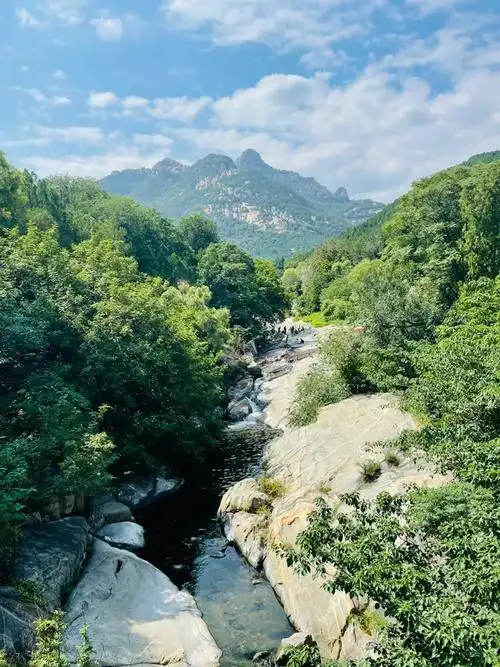 For more than two thousand years, Tianwai Village has marked the western approach to Mount Tai, China's most venerated peak and the supreme sanctuary among the Five Sacred Mountains. From the Qin Dynasty's first emperor through the Ming and Qing courts, over a hundred rulers ascended through this gateway to perform the fengshan sacrifice—an elaborate dual ritual offering tribute to heaven at the summit and to earth at the base, legitimizing imperial authority in a manner comparable to Roman triumphs or the coronation rites of ancient Near Eastern monarchs. The village's elevated stream-fed valley preserves this legacy along the western trail, where Taoist and Buddhist hermitages have gathered for centuries.
The architectural heart of Tianwai Village is Tiandi Square, an expansive ceremonial plaza anchored by a massive bronze relief embodying the ancient Chinese cosmological principle of "round heaven, square earth"—a worldview echoed in Renaissance representations of cosmic order from Dante to da Vinci. Twelve monolithic dragon pillars encircle the square, each carved with bas-relief scenes commemorating a different dynasty's imperial visit. At the plaza's terminus rises a monumental mural wall depicting the dramatic stairway ascent up Mount Tai, condensing the pilgrimage into a single sweeping visual narrative reminiscent of medieval cathedral tympana illustrating the path to salvation.
Beyond its function as a transport hub, Tianwai Village functions as a condensed museum of imperial mountain worship. The twelve dragon pillars systematically chronicle two thousand years of Chinese state ritual, providing visitors with an accessible introduction to why Mount Tai holds the title "Supreme Among the Five Sacred Mountains." The adjacent Puzhao Temple and Sanyang Taoist Monastery continue the spiritual tradition, allowing travelers to experience the syncretic fusion of Confucian, Buddhist, and Taoist thought that has shaped Chinese civilization—a coexistence comparable to how pilgrims at Mount Athos encounter Orthodox Christian monasticism in multiple forms. Nearby lies the tomb of Republican general Feng Yuxiang, a fascinating footnote of twentieth-century Chinese history.
Tianwai Square itself is free and open to the public at all hours, ideal for photography and brief exploration. Entry to the broader Mount Tai scenic area requires a main gate ticket, typically priced at 115 yuan during peak season (March through November) and 100 yuan in winter. A sightseeing bus connects Tianwai Village to Zhongtian Gate in roughly thirty minutes, with one-way fares around 30 to 40 yuan; from Zhongtian Gate, cable cars whisk visitors toward the summit. Bus operations generally run from 6:00 AM to 9:00 PM. Allow about thirty minutes for the square alone, or two to four hours if exploring the western creek line's Black Dragon Pool, White Dragon Pool, and Fanshi Cliff.
For most Western visitors, Tianwai Village offers the gentlest route to Mount Tai's summit at 1,545 meters, bypassing the grueling seven-thousand-step southern staircase that historically tested imperial stamina. The combination of bus and cable car suits families with children, elderly travelers, and those with limited time or mobility concerns. The western creek corridor is most spectacular after summer rainfall, when waterfalls surge dramatically along the trail. To avoid crowds at the bus queue, arrive before 7:00 AM or visit midweek. Visitors should stay on designated paths, refrain from carrying open flames, and prepare for substantial temperature swings between valley and summit—layered clothing is essential.
For more than two thousand years, Tianwai Village has marked the western approach to Mount Tai, China's most venerated peak and the supreme sanctuary among the Five Sacred Mountains. From the Qin Dynasty's first emperor through the Ming and Qing courts, over a hundred rulers ascended through this gateway to perform the fengshan sacrifice—an elaborate dual ritual offering tribute to heaven at the summit and to earth at the base, legitimizing imperial authority in a manner comparable to Roman triumphs or the coronation rites of ancient Near Eastern monarchs. The village's elevated stream-fed valley preserves this legacy along the western trail, where Taoist and Buddhist hermitages have gathered for centuries.
The architectural heart of Tianwai Village is Tiandi Square, an expansive ceremonial plaza anchored by a massive bronze relief embodying the ancient Chinese cosmological principle of "round heaven, square earth"—a worldview echoed in Renaissance representations of cosmic order from Dante to da Vinci. Twelve monolithic dragon pillars encircle the square, each carved with bas-relief scenes commemorating a different dynasty's imperial visit. At the plaza's terminus rises a monumental mural wall depicting the dramatic stairway ascent up Mount Tai, condensing the pilgrimage into a single sweeping visual narrative reminiscent of medieval cathedral tympana illustrating the path to salvation.
Beyond its function as a transport hub, Tianwai Village functions as a condensed museum of imperial mountain worship. The twelve dragon pillars systematically chronicle two thousand years of Chinese state ritual, providing visitors with an accessible introduction to why Mount Tai holds the title "Supreme Among the Five Sacred Mountains." The adjacent Puzhao Temple and Sanyang Taoist Monastery continue the spiritual tradition, allowing travelers to experience the syncretic fusion of Confucian, Buddhist, and Taoist thought that has shaped Chinese civilization—a coexistence comparable to how pilgrims at Mount Athos encounter Orthodox Christian monasticism in multiple forms. Nearby lies the tomb of Republican general Feng Yuxiang, a fascinating footnote of twentieth-century Chinese history.
Tianwai Square itself is free and open to the public at all hours, ideal for photography and brief exploration. Entry to the broader Mount Tai scenic area requires a main gate ticket, typically priced at 115 yuan during peak season (March through November) and 100 yuan in winter. A sightseeing bus connects Tianwai Village to Zhongtian Gate in roughly thirty minutes, with one-way fares around 30 to 40 yuan; from Zhongtian Gate, cable cars whisk visitors toward the summit. Bus operations generally run from 6:00 AM to 9:00 PM. Allow about thirty minutes for the square alone, or two to four hours if exploring the western creek line's Black Dragon Pool, White Dragon Pool, and Fanshi Cliff.
For most Western visitors, Tianwai Village offers the gentlest route to Mount Tai's summit at 1,545 meters, bypassing the grueling seven-thousand-step southern staircase that historically tested imperial stamina. The combination of bus and cable car suits families with children, elderly travelers, and those with limited time or mobility concerns. The western creek corridor is most spectacular after summer rainfall, when waterfalls surge dramatically along the trail. To avoid crowds at the bus queue, arrive before 7:00 AM or visit midweek. Visitors should stay on designated paths, refrain from carrying open flames, and prepare for substantial temperature swings between valley and summit—layered clothing is essential.