Confucius' Ascending Place
⭐ 2.50
Confucius Ascending Place, Taishan District, Tai'an City, Shandong Province, China
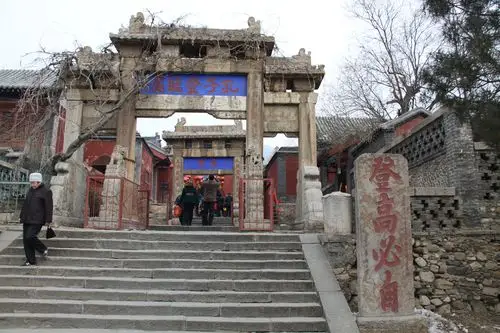 Standing in solemn grandeur, this four-pillar stone archway was commissioned during the reign of the Jiajing Emperor in 1560, roughly contemporaneous with Shakespeare's birth in Elizabethan England. The calligraphy crowning the gateway was penned by Luo Hongxian, the top-ranking scholar of his imperial examinations—an honor equivalent to a valedictorian of China's ancient civil service academy. The original couplet carved into its pillars has weathered away, but the chiseled grooves remain, offering a tactile connection to 16th-century literati craftsmanship and the deep Ming reverence for the Sage of Lu.
Architecturally, the monument embodies classical Chinese ceremonial design principles, with its three graduated gateways directing pilgrims northward along the sacred pathway. To the east, the "Climbing Begins with the First Step" tablet and to the west, the "First Mountain of the Realm" inscription frame the archway, echoing the Confucian maxim of "beginning low to reach high"—a philosophy that would have resonated with Renaissance humanists contemplating virtuous ascent. This composition, similar in spirit to the processional arches of ancient Rome, transforms mere passage into ritual progression.
The site's cultural weight derives from the famous passage in the Analects where Confucius declares that "the world seems small" from Mount Tai's summit. Modern visitors who embark from this archway follow the same path as emperors from the Tang and Song dynasties, transforming a physical climb into a philosophical pilgrimage. Standing here, one understands why UNESCO designated Mount Tai a World Heritage site in 1987—not merely for its geological majesty but as a cultural landscape where Confucian ideals, imperial ambition, and natural grandeur converge.
For practical planning, the archway is included in Mount Tai's main entrance ticket and open year-round, with no separate admission fee. Allow just 5 to 15 minutes for photographs and reading the inscriptions. Visit in late April or May to witness the wisteria in full bloom, when purple flower cascades transform the gray stone into a living tapestry—a scene that has inspired Chinese painters for centuries. The flat terrain makes it accessible to all visitors, requiring no special footwear or fitness preparation.
The optimal itinerary connects this site with the adjacent Dai Temple, Hongmen Gate, and Yitianmen archway before continuing toward Zhongtianmen and the South Gate to Heaven. Foreign visitors are strongly encouraged to hire a bilingual guide or download a translation app, as the philosophical allusions embedded in the inscriptions reveal layers of meaning that bring the entire journey to life. Plan a full day, approximately four to six hours for the complete ascent, and arrive in the morning to avoid afternoon crowds and enjoy cooler climbing temperatures.
Standing in solemn grandeur, this four-pillar stone archway was commissioned during the reign of the Jiajing Emperor in 1560, roughly contemporaneous with Shakespeare's birth in Elizabethan England. The calligraphy crowning the gateway was penned by Luo Hongxian, the top-ranking scholar of his imperial examinations—an honor equivalent to a valedictorian of China's ancient civil service academy. The original couplet carved into its pillars has weathered away, but the chiseled grooves remain, offering a tactile connection to 16th-century literati craftsmanship and the deep Ming reverence for the Sage of Lu.
Architecturally, the monument embodies classical Chinese ceremonial design principles, with its three graduated gateways directing pilgrims northward along the sacred pathway. To the east, the "Climbing Begins with the First Step" tablet and to the west, the "First Mountain of the Realm" inscription frame the archway, echoing the Confucian maxim of "beginning low to reach high"—a philosophy that would have resonated with Renaissance humanists contemplating virtuous ascent. This composition, similar in spirit to the processional arches of ancient Rome, transforms mere passage into ritual progression.
The site's cultural weight derives from the famous passage in the Analects where Confucius declares that "the world seems small" from Mount Tai's summit. Modern visitors who embark from this archway follow the same path as emperors from the Tang and Song dynasties, transforming a physical climb into a philosophical pilgrimage. Standing here, one understands why UNESCO designated Mount Tai a World Heritage site in 1987—not merely for its geological majesty but as a cultural landscape where Confucian ideals, imperial ambition, and natural grandeur converge.
For practical planning, the archway is included in Mount Tai's main entrance ticket and open year-round, with no separate admission fee. Allow just 5 to 15 minutes for photographs and reading the inscriptions. Visit in late April or May to witness the wisteria in full bloom, when purple flower cascades transform the gray stone into a living tapestry—a scene that has inspired Chinese painters for centuries. The flat terrain makes it accessible to all visitors, requiring no special footwear or fitness preparation.
The optimal itinerary connects this site with the adjacent Dai Temple, Hongmen Gate, and Yitianmen archway before continuing toward Zhongtianmen and the South Gate to Heaven. Foreign visitors are strongly encouraged to hire a bilingual guide or download a translation app, as the philosophical allusions embedded in the inscriptions reveal layers of meaning that bring the entire journey to life. Plan a full day, approximately four to six hours for the complete ascent, and arrive in the morning to avoid afternoon crowds and enjoy cooler climbing temperatures.